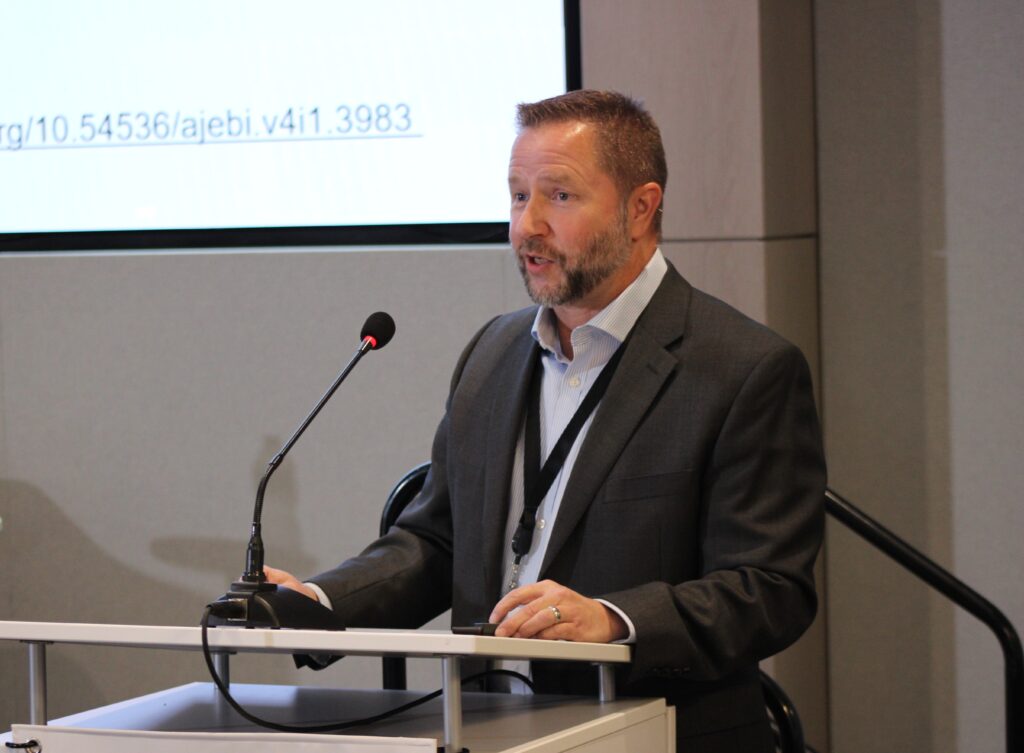
A life science hub in North Texas offers an inspiring model for how to build a robust community that thrives on healthcare and biotech innovation. In a presentation at INVEST Digital Health, Pegasus Park Executive Director David Snow, PhD, offered an overview of how the Pegasus Park campus has evolved, fueled by Lyda Hill’s vision and supported by an extensive network of collaboration partners across Dallas-Fort Worth.
“Lyda Hill is passionate about two things,” Snow said. “Growing life science companies and building a social impact hub that keeps talent, capital, and innovation here in North Texas.”
One reason innovation hubs are critical is that their intentional design encourages creativity, collaboration, and idea exchange among people working towards shared or similar goals. Their residents offer a wealth of talent with researchers, students, and mentors on demand. It can take years before life science startups are profitable, so shared lab space is essential for lower burn rates. The close proximity of these startups to each other, to collaboration partners, and to investors inevitably leads to partnerships and M&A deals as venture capitalists, angel investors, and seed funders are drawn to these hubs of talent and potential. The reputation of academic institutions, investors, and researchers involved in the life science startups add credibility to these hubs.
Location is critical to any innovation hub. Pegasus Park is strategically located in the heart of Dallas’ rapidly growing Innovation District, adjacent to the Southwestern Medical District; home to UT Southwestern Medical Center, Parkland Health, Children’s Health, and more. The campus is located fewer than four miles from Love Field Airport and less than 15 miles from DFW International Airport. Proximity to resources, talent, and networking opportunities provides critical advantages that reduce risk and accelerate growth.
There are a few components to the 26-acre Pegasus Park campus. The Tower at Pegasus Park houses accelerators and investors, healthcare and higher education offices, life science companies and social impact organizations. Health Wildcatters and Mass Challenge are two accelerators who call Pegasus Park home. Each of them has cultivated a network of investors and mentors who offer guidance to healthcare and life science startup cohorts and alumni.
BioLabs Pegasus Park is a university and institution-agnostic incubator that offers a level playing ground for life science innovation. Opened in 2022, the incubator filled up its shared workspace availability four years ahead of schedule. BioLabs hosts more than 20 life science startups that have access to conference rooms, breakout rooms and shared private wet lab space. The startup members also have access to facilities and equipment valued at more than $5 million. For example, one of its largest partners, Thermo Fisher Scientific, provides state-of-the-art equipment including thermocyclers and a flow cytometer. PHC Corporation provided discounted cold storage and incubation equipment. Millipore sponsored, installed, and continues to maintain a water system, while Elemental Machines provided cold temperature and incubator monitors.
One of the challenges for innovation hubs is how to convince startups to stay put when they have outgrown an incubator. In 2024, Pegasus Park opened BridgeLabs, a space for growth stage life science companies. BridgeLabs includes 135,000 square feet of purpose-built research and development space and is the first institutional-quality lab space in the region. It includes four suites spanning 4,592-6,335 square feet – three of them are currently occupied. BridgeLabs also offers shell spaces for customized build out, maximizing impact and efficiency of the space for each tenant.
Snow noted that the region is home to more than 70 higher education institutions with a 72% graduate retention rate.
“Startups here are more likely to survive, they’re more likely to scale and more likely to exit [successful liquidation event],” Snow said.
Universities are not only among the residents of the Pegasus Park campus – they also provide resources for research and talent. BridgeLab resident University of Texas at Arlington is teaming up with Texas A&M University to launch the National Center for Therapeutics Manufacturing Satellite Campus at Pegasus Park, a biomanufacturing hub. Southern Methodist University Institute for Computation Biosciences, which fosters collaboration between researchers from biology, chemistry, computer science, engineering, education, and business for biotech research and development, has offices on the Pegasus Park campus. There is also a place for life science focused federal agencies, such as Advanced Research Projects Agency for Health (ARPA-H), a $2.5 billion federal initiative aimed at accelerating breakthroughs in diseases like cancer and Alzheimer’s. The ARPA-H Customer Experience Hub found a home at Pegasus Park in 2023.
North Texas has a robust life science ecosystem. Snow pointed out that there are eight major health systems, and seven national healthcare organizations have their headquarters in Dallas. It also has the third-highest concentration of family offices in the country. More than 50 life science companies based there had M&A deals in the past five years, most recently Reata Pharmaceuticals in 2023. This UT Southwestern spinout is a clinical-stage biopharmaceutical company that secured FDA approval for Skyclarys, its drug designed to treat rare neuromuscular disorder Friedreich’s ataxia. Biogen’s buyout of Reata Pharmaceuticals topped $7.3 billion.
“When you invest in companies based in Pegasus Park and in North Texas, you’re not just backing a founder with an idea, you’re backing an environment that reduces risk and amplifies the probability of a stronger return. That means a shorter time to market, faster growth trajectories, and better outcomes,” Snow said. “I believe that Pegasus Park is the premier convening space for a life science hub in North Texas. It’s a place where early stage ventures have the highest odds of success and where your capital can have the greatest impact. So my invitation to you is simple; invest where innovation lives. Invest where the risk is lower, where companies scale faster and where returns are stronger.”
Photo: Nick Fenton, Breaking Media