One of the biggest problems in healthcare is the gap in understanding between what physicians and insurers say and what consumers understand. The healthcare field, like most, is so full of jargon as to be incomprehensible much of the time.
However unlike most fields, it matters a lot that the layperson actually understands what’s being said.
Stick a person in a room with a rocket scientist to talk about how the space station operates or put them at an investment bank to hear how derivatives work and that person will be confused but can pretty much shake their head and go back to their regularly scheduled lives. Put a person in a room with a physician who is telling them about the mechanism of action of diabetes or the options they have for cancer treatment, and all of those acronyms and terms of art and high-fallutin’ jargon words can make the head spin.

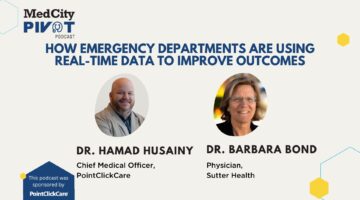
MedCity News Pivot Podcast: How Emergency Departments Are Using Real-Time Data to Improve Outcomes
How can AI benefit and improve patient outcome in the emergency department? Watch the latest episode to find out.
Here is a good illustrative video from the American College of Physicians (ACP) that makes this point quite starkly:
In the case of clinical care, this problem can be further amplified by the oddly persistent power relationship that occurs between physicians and patients, which makes it hard for the patient to ask questions and admit they don’t understand. No such theoretical power relationship occurs between patient and insurer when reading an explanation of benefits (or, as the insurer would say, the EOB), except the kind of power that comes from being a big organization that doesn’t have to answer to its customers.
And in a global economy and a country that has more nationalities than even soda brands, the effect of cultural and language barriers amplify this health literacy problem even more.


RCM Outsourcing: Balancing Human Expertise & Smart Technology
Greenway Health blends smart technology with human expertise to elevate revenue cycle.
If you look at what all other industries focused on consumers do well, it’s marketing communications. They know the power of words and pictures to motivate behavior, create understanding, motivate behavior and drive consumer action.
Lord knows that soda companies and movie studios and car manufacturers spend all that money advertising because it makes people buy. But very few of those people exist in the healthcare world. Hell, we are still trying to convince healthcare companies that user-centered design is a good idea. So what’s a healthcare system to do when trying to become more and more consumer-focused?
Well in my view, the answer is to yell “Uncle!” stop trying to do it on our own, and turn to those industries that get it. Embrace those very “non-science-based” consumer industries that already know how to get information across to people such that they understand, act, and change behavior.
And by the way, if there are those among you who think effective consumer communication is not a real science, I submit to you the revenue figures for the top-selling consumer brands in America. Turning sugar water into Coca Cola may not be much on the science front, but getting people to spend $47 billion in 2013 to buy their products sure as hell is.
The current aspirational brand for healthcare seems to be Amazon.com (not Uber!), as in “I want my healthcare company to give a consumer experience that is exactly as simple and easily understood and enjoyed as Amazon.com.” This can be no coincidence, as Amazon.com is considered by many to be the number one most favored brand in America.
The problem is that most healthcare companies, unless they are in Seattle, rarely acquire the employees and skill sets that make Amazon tick. Healthcare companies tend to think they are “special” and thus spend a lot of time worrying about hiring people who have healthcare domain expertise and not a lot of time hiring people who have consumer domain expertise.
Well, if we can’t help our customers understand what’s going on, what they are buying with their insurance dollars, and what they need to do to stay healthy, then we are not hiring the right people. To put a fine point on it, what good are well-trained physicians (as defined by scientific acumen) if their patients can’t understand the directions they have been given? In case you are a physician and I have now offended you, go re-watch that ACP video up above.
And thus I was delighted to find an example of an exception that proves my rule. I just read an article about how Lilly, the pharmaceutical company, has hired The Walt Disney company to write books and videos that explain Type I diabetes to children. You can read all about it HERE.
I especially love that this series of books is written not for the ubiquitous “kid” but for all sorts of kids: young, teenage, boys, girls, sporty, fashion-y, in all kinds of kid language. In other words, it recognizes that there is no such thing as A consumer, but rather that there are all kinds of people who need all manner of personalized messaging and information packaging in order to be able to use it. The books also recognize that different brands within the Disney family will appeal to different consumers, and thus the books come with ESPN, Hannah Montana, Mickey Mouse and other relatable brands meant to speak to you in a form to which you will relate.
It is an interesting time, in that we are seeing many consumer brand companies enter the healthcare sector in unprecedented ways. Disney has actually been here for a while. They do brand loyalty and customer service training for hospital staffs, for instance.
But other companies that would never have been thought of as healthcare players—Apple, Ford, UnderArmour, L’Oreal, Virgin, Amazon—are finding their way in and making a name for themselves. And if they want to, they could probably eat the lunch of the traditional healthcare players by stealing away consumers who have grown up understanding what these companies are talking about.
While Amazon has not yet declared itself a health insurance exchange, they might just do so. Apple has already put its healthcare stake in the ground (and through the heart of many health wearables companies); with respect to Apple, a few companies have been smart enough to play along (Mayo, Epic). Walgreens is slowly becoming a full-fledged primary care delivery system.
I expect we are going to see a lot more collaborations between healthcare and consumer products companies like this Disney/Lilly one–unlikely alliances that go at the core of two of the most serious healthcare challenges: health literacy and behavior change.
If we could “fix” those two problems, I suspect that we could cut the costs of the healthcare system by at least a third by eliminating many of the medical errors, treatment compliance problems borne of lack of understanding and cultural medical miscues. Science is good, but without consumer understanding, not always useful.
Healthcare companies had better co-opt those consumer brand companies into helping them communicate with consumers or they may just end up working for them.
And anyway, it would be a lot more fun to get your medical care at Disneyland where people already willingly shell out $100+ a visit.
[Photo from Flickr user Jeff Christiansen]

Lisa Suennen has spent nearly 30 years as an entrepreneur, venture investor and advisor in the healthcare industry. She currently serves as Senior Managing Director at GE Ventures, leading the firm’s healthcare venture fund. Lisa is also co-founder of CSweetener, a not-for-profit company focused on matching women in and nearing the healthcare C-Suite with mentors who have been there and wish to give back. She is a member of the faculty at the UC Berkeley Haas School of
Business, where for 10 years she has taught classes on venture capital and the changing healthcare economy.
Prior to joining GE Ventures, Lisa operated Venture Valkyrie Consulting for 3 years, advising large corporations around corporate venture capital, new business creation and digital health strategy. Prior to that she spent 15 years as a Partner at Psilos Group, a successful healthcare-focused venture capital firm. Lisa is currently a Board Member of Evidation Health, Health Reveal, Gravie, the Dignity Health Foundation, and Heart To Heart International. She is also on the Advisory Boards of the California Health Care Foundation Innovation Fund, the
American Heart Association Innovation Think Tank, global digital health organization HealthXL and NASA’s Translational Research Institute. Lisa is a Fellow of the inaugural class of the Aspen Institute’s
Health Innovators Fellowship and a member of the Aspen Global Leadership Network. Through her Venture Valkyrie media company, Lisa writes a widely read blog on healthcare and healthcare investing at http://venturevalkyrie.com . She published her
first book in 2013: Tech Tonics, Can Passionate Entrepreneurs Heal Healthcare with Technology, coauthored with Dr. David Shaywitz. Together they also host a popular podcast, also called Tech Tonics, focused on the people and passion at the intersection
of technology and health.
Lisa an M.A. in political science, a B.A. in political science and a B.A. in mass communications, all from the University of California, Berkeley.
This post appears through the MedCity Influencers program. Anyone can publish their perspective on business and innovation in healthcare on MedCity News through MedCity Influencers. Click here to find out how.