
One night in July 1996, I woke up on my couch in my scrubs. I’d collapsed after a 36-hour shift in the ICU. My stomach rumbled, and I went to the kitchen to make myself something to eat. Within minutes, I had cut my wrist with a large chef’s knife. I remember thinking, “ER? In July? On a Friday? No.” Instead, I cleaned the wound, sutured myself, applied butterfly strips, and then ate dinner.
I don’t like going to the emergency department (ED) – to me, it’s only for true emergencies. While my story is clearly an extreme example, I want to emphasize how important it is for people to consider their situation and know their care options, regardless of their medical expertise, background, or age.
Post-pandemic, many of us still run to the ED when we need medical care, even when it’s not the best place for the treatment we need. When we consider this through a generational lens, baby boomers and Gen Z are disproportionately going to the ED when they have access to more convenient, affordable options. Let’s look at why this happens and how employers can make a difference.

The Power of One: Redefining Healthcare with an AI-Driven Unified Platform
In a landscape where complexity has long been the norm, the power of one lies not just in unification, but in intelligence and automation.
An opportunity to improve generational healthcare literacy
We’re at the point where the number of visits to the ED has exceeded population growth. At the same time, half of U.S. consumers have a low level of “system literacy” about their healthcare coverage. Together, Boomers and Gen Z make up 33% of the workforce, yet many simply don’t know how to use their benefits effectively, and it’s burdening a system bursting at the seams.
As they enter the U.S. workforce, Gen Z employees are trending toward overusing the ED as a quick fix for their healthcare needs, particularly for mental health conditions. They’re often unsure of how much their benefits cover and put off routine checkups and specialist visits. Baby boomers aren’t faring much better. Nearly half of Boomers are working past age 70 or planning to. This generation did not grow up with alternatives like urgent care or virtual visits. Instead, they went straight to the ED for medical emergencies. Because of this, boomers often go to the ED when they have better alternatives covered by their healthcare benefits.
Two generations in the workplace are struggling with healthcare literacy, which means employers have a unique opportunity to activate system-wide change, particularly when it comes to emergencies.

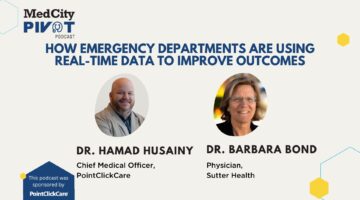
MedCity News Pivot Podcast: How Emergency Departments Are Using Real-Time Data to Improve Outcomes
How can AI benefit and improve patient outcome in the emergency department? Watch the latest episode to find out.
Making space for real emergencies
Increasing healthcare costs contribute to people skipping recommended medical treatment and delaying care. This can increase unnecessary ED visits and have a snowball effect on healthcare costs. On average, those ED visits cost an insured person $646 and their employer $1,807. One study even suggests that people with low health literacy are more likely to visit the ED and return within 14 days. That’s $1,292 in two weeks for an individual and $3,614 for their employer. By contrast, the average copay for a routine visit to a primary care provider or specialist ranges from $26 to $44.
Using the ED for non-emergencies isn’t just a cost issue. In our broken system, there will always be people who need to use the ED, such as those who are unhoused, people relying on Medicaid, and people who’ve experienced major life events like a heart attack, broken limb, or psychological episode. With a growing population of Medicare members visiting the ED more frequently, this cornerstone of our healthcare system is starting to crack under pressure. To keep our system functioning, we must make space in emergency care for these populations, which is why employers’ actions can have a powerful impact on people who do have other options.
Educating employees for better health utilization and outcomes
Employers can drive change by educating employees on when to use the emergency department and, more importantly, how to maximize their benefits. This includes guiding Gen Z employees as they navigate health insurance for the first time and reminding Baby Boomers how to manage chronic conditions.
Proactive employer communication can help employees use their healthcare benefits wisely through:
● Encouraging a care quarterback – Check in with employees to ensure they have a primary care provider they visit annually for age-appropriate screenings, blood tests, and prescription guidance. Relationships with PCPs can make a huge difference in long-term physical and mental health.
● Educating about alternatives – Make sure every employee understands how to use urgent care centers and telehealth benefits. These visits are usually less costly and time-consuming than the ED.
● Embracing online resources – Give members access to accessible online resources, like search tools for finding a PCP and quick cost estimators for specialist visits. Introduce these tools during onboarding.
Using the ED for non-emergencies costs more than many people’s monthly student loan payments and strains an already fragile system. Employers who bridge knowledge gaps and educate employees in engaging ways can foster a healthier workforce and reduce ED strain. The ED will always be there for us, but employers should take steps towards affordable, lifelong health, not just paying up when costly ED visits arise.
Picture: Ekspansio, Getty Images

Personify Health's chief medical officer, Dr. Jeff Jacques, is a physician executive leader and entrepreneur with more than 20 years of experience building solutions that deliver personalized support for individuals experiencing complex care journeys. At Personify Health, he focuses on ensuring alignment with member and market needs, enhancing the company’s behavior science approach, and exploring additional ways our unique capabilities can further simplify and support the member journey.Jeff’s commitment is fueled by personal experiences and frustrations with the healthcare system, which drove him to innovate and bring change to the industry. He was previously CEO and co-founder of CareTribe, a digital health platform for family caregivers (acquired by Cleo). He also held leadership roles at CVS Health/Aetna, including as the founder of NeoCare Solutions, supporting the parents of premature infants in the NICU.Jeff has held several non-profit board positions. He trained in Internal Medicine at St. Luke’s-Roosevelt Hospital, part of the Mount Sinai system in NYC.
This post appears through the MedCity Influencers program. Anyone can publish their perspective on business and innovation in healthcare on MedCity News through MedCity Influencers. Click here to find out how.