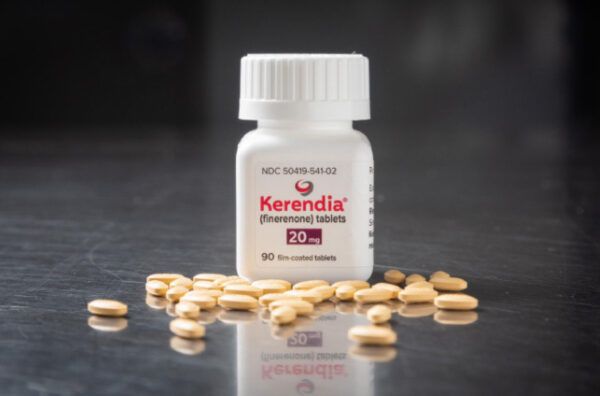
A Bayer drug the company frames as key to growing its cardiovascular portfolio has expanded its FDA approval to a type of heart failure, a new indication that keeps this pill on the path to achieving blockbuster sales to help offset declining revenue of top overall product Xarelto, now facing patent expirations.
Bayer said Monday that the FDA approved Kerendia for treating heart failure with mildly reduced ejection fraction, or HFmrEF. The approval specifically covers patients whose left ventricular ejection fraction (LVEF) is measured at 40% or greater. LVEF, how much blood the pumps with each heartbeat, is measured as a percentage. The normal range is between 50% and 70%. But as that percentage drops to the HFmrEF range of 40% to 49%, a patient faces a greater risk of developing heart failure.
Older cardiovascular drugs are available for treating patients who have HFmrEF. But despite these treatments, Bayer says that about 3.7 million adults in the U.S. with mildly reduced ejection fraction still face high risks of hospitalization for heart failure. Kerendia introduces a new approach to treating the condition.


Esperion Sets Its Sights on New Areas While Maintaining Commitment to Cardiovascular Health
In a recent interview, Esperion president and CEO, Sheldon Koenig talks about the reality of statin intolerance and his company’s expansion into new diseases
Kerendia is a nonsteroidal, oral small molecule designed to block the mineralocorticoid receptor, stopping excessive activation of this receptor that is thought to contribute to fibrosis and inflammation. The drug, taken as a once-daily pill, was first approved in 2021 for reducing the risk of kidney function decline and hospitalization for heart failure in patients with chronic kidney disease associated with type 2 diabetes.
Within its pharmaceuticals division, Bayer has identified cardiovascular indications as one of four core therapeutic areas for the company. The others are oncology; neurology and rare diseases; and immunology. Xarelto, an anticoagulant with regulatory approvals in several cardiovascular indications, is Bayer’s top overall product accounting for €3.4 billion in sales in 2024. But that figure is a 14.7% decrease from the prior year. Patents for Xarelto have started to expire and the product already faces generic competition in some markets. Like its big pharma peers, Bayer needs to find other products to make up for declining revenue for drugs that fall over the patent cliff.
Bayer reported €463 million (about $539.9 million) in sales for Kerendia in 2024, a more than 71% increase from sales in the prior year. In its annual report, Bayer attributed much of the revenue increase to growth of the product in the U.S. and China. In the first quarter of this year, Bayer reported €161 million (about $187.7 million) in Kerendia revenue, an 87% increase compared to the same period in 2024. Bayer has also identified the prostate cancer drug Nubeqa as a key driver for future revenue growth. The company has projected that Kerendia and Nubeqa can each top €3 billion (about $3.5 billion) in peak sales.
“Nubeqa and Kerendia continued their exceptional momentum,” CEO Bill Anderson said during a May conference call to discuss first quarter 2025 financial results. “Together, they grew 80% year-over-year. These gains more than offset the declines we’re seeing on Xarelto.”

The Power of One: Redefining Healthcare with an AI-Driven Unified Platform
In a landscape where complexity has long been the norm, the power of one lies not just in unification, but in intelligence and automation.
Kerendia’s new FDA approval is based on the results of a placebo-controlled Phase 3 test in heart failure. The main goal was a composite measure of cardiovascular death and total heart failure events, defined as hospitalizations for heart failure or urgent heart failure visits. The study enrolled about 6,000 patients randomly assigned to receive Kerendia or a placebo for up to 42 months. All participants continued to take the other heart failure drugs they used prior to starting the clinical trial.
Trial results showed participants treated with Kerendia experienced a lower rate of composite heart failure events and death compared to a placebo. This lower rate was statistically significant. Detailed results from the pivotal study were published last September in the New England Journal of Medicine.
“Even with current treatments, 21% of patients with symptomatic heart failure escalate to hospitalization for heart failure or [cardiovascular] death, and 25% who experience hospitalization are readmitted due to heart failure within one year of discharge,” Alanna Morris-Simon, senior medical director of U.S. medical affairs at Bayer, said in a prepared statement. “Now, as a core pillar of treatment, Kerendia can help patients reduce these risks.”
Photo by Bayer