Takeda Pharmaceutical is bolstering its pipeline in a big way, committing $1.2 billion for rights to two late-stage Innovent Biologics cancer drugs and securing an exclusive option to license an early-stage program, all of which have potential applications for treating a range of solid tumors.
The deal is important because like other big pharmaceutical companies, Takeda needs new products to make up for the coming drop-off in revenue as it faces the patent cliff. Patents for Takeda’s top-seller, the ulcerative colitis and Crohn’s disease drug Entyvio, have expired in Europe and will expire in the U.S. and Japan in 2026. While it’s unclear when biosimilars to Entyvio, an antibody drug, will enter the market, patent expirations open the door to competition that will erode revenue of the blockbuster product.
Takeda is trying to ease the fall over the patent cliff with a mix of internally discovered and developed drugs as well as assets that come from business deals. In Wednesday’s announcement of the licensing agreement with Innovent, Teresa Bitetti, president, global oncology business unit at Takeda, said the two drugs coming from the China-based biotech “have the potential to be transformative for our oncology portfolio and significantly enhance Takeda’s growth potential post-2030.”

The Power of One: Redefining Healthcare with an AI-Driven Unified Platform
In a landscape where complexity has long been the norm, the power of one lies not just in unification, but in intelligence and automation.
The first drug Takeda is picking up from Innovent is IBI363. This bispecific antibody fusion protein is designed to block the checkpoint protein PD-1 and activate the IL-2 pathway, sparking activity from tumor-specific T cells that express both targets. The companies say this approach is intended to lead to more effective activation and expansion of this subpopulation of T cells without triggering toxic effects that come from activating peripheral T cells.
Global Phase 2 tests of IBI363 are ongoing in non-small cell lung cancer as well as microsatellite stable colorectal cancer, which represents the majority of colorectal cancer cases. A global Phase 3 study in second-line squamous non-small cell lung cancer is expected to begin in the coming months. The two companies will co-develop this drug globally, with the costs and potential profits/losses split 60% to Takeda and 40% to Innovent. The agreement also makes Takeda the lead in co-commercialization of IBI363 in the U.S. and gives the Japanese pharma giant the exclusive right to commercialize the drug outside of the U.S. and Greater China.
The second drug is IBI343, an antibody-drug conjugate (ADC) that targets claudin 18.2, a protein highly expressed by cells in gastric and pancreatic cancers. It’s a validated target. Last year, FDA approval of Astellas Pharma’s Vyloy for gastric or gastroesophageal junction adenocarcinoma made the antibody the first approved drug targeting claudin 18.2. AstraZeneca is pursuing claudin 18.2 with sonesitatug vedotin (formerly AZD0901); an ongoing Phase 3 test is evaluating this ADC as a second-line treatment for advanced or metastatic gastric cancers that express the target protein. A Phase 3 test of the Innovent ADC is ongoing in Japan and China enrolling patients with previously treated gastric cancer. Takeda plans further clinical development, expanding into first-line gastric and pancreatic cancers.
Takeda’s agreement with Innovent gives the pharma giant the option to license IBI3001. This drug is a bispecific ADC designed to target the proteins EGFR and B7H3. A Phase 1 test of IBI3001 is ongoing in the U.S., China, and Australia enrolling patients with locally advanced or metastatic solid tumors. Innovent is responsible for clinical development of this ADC until Takeda exercises its option to license the asset. Exercising the option would make Takeda responsible for developing, manufacturing, and commercializing IBI3001 worldwide, outside of Greater China.


5 High-Impact Tax Strategies Every Physician Should Use in 2026 to Reduce Their Tax Bill
AI-native tax firm Gelt combines top human tax experts with AI to help physicians and healthcare practices use data-driven tax strategies to lower liabilities, improve profitability, and future-proof their finances.
Takeda said it plans U.S. manufacturing of the drugs covered under the Innovent agreement, continuing the trend of big pharma companies expanding their U.S. manufacturing capabilities as a way to avoid President Trump’s threat of pharmaceutical tariffs. In the deal announcement, Andy Plump, president, research and development at Takeda, said the Innovent programs strengthen Takeda’s late-stage oncology pipeline.
“Drawing from our deep experience in oncology and the modalities leveraged by IBI363 and IBI343, we are uniquely positioned to partner with Innovent to accelerate and expand the potential of these investigational medicines in a range of solid tumors,” he said. “We are encouraged by the clinical results these investigational medicines have shown and look forward to working with Innovent to deliver these potentially best-in-class medicines to patients with longstanding unmet needs across a wide range of cancers.”
Takeda’s $1.2 billion upfront payment to Innovent includes a $100 million equity investment in the biotech. Innovent is eligible to receive up to $10.2 billion in milestone payments tied to the progress of the licensed assets. Innovent would also receive royalties from sales of each molecule commercialized outside of Greater China, except for IBI363 in the U.S., where the two companies will share in profits and losses. If Takeda exercises the option for IBI3001, Innovent would receive an option exercise fee and additional potential milestone and royalty payments. Details of those potential payments were not disclosed.
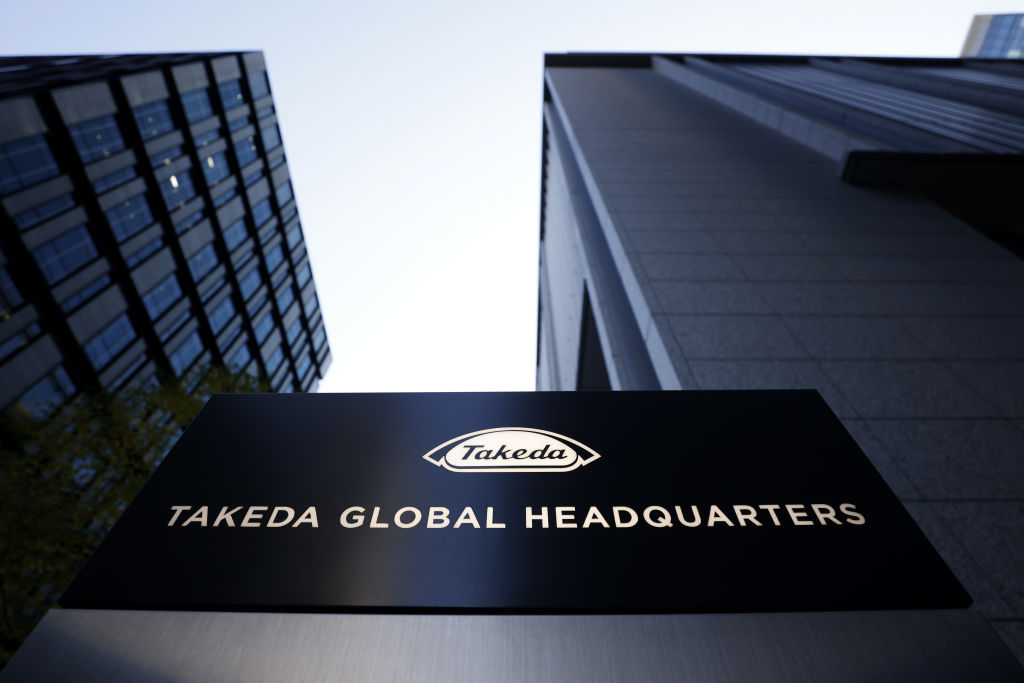
Photo: Kiyoshi Ota/Bloomberg, via Getty Images