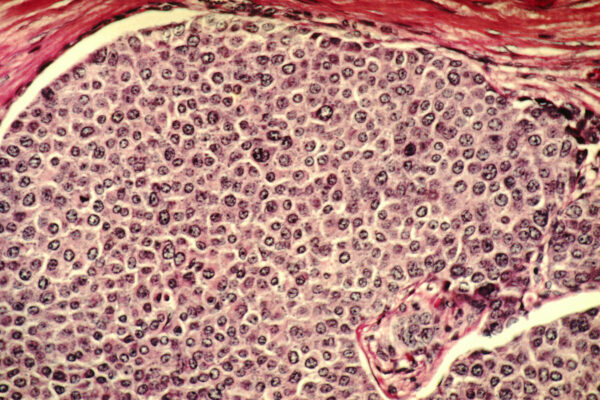
Enhertu, a targeted cancer therapy from partners AstraZeneca and Daiichi Sankyo, may now be used as a first-line treatment for advanced cases of breast cancer, making it the first new approved treatment option in this setting in a decade.
Enhertu targets HER2, a protein that can be overexpressed on the surface of cancer cells. The expanded regulatory approval is important for breast cancer patients because HER2 makes tumors aggressive and harder to control, so many patients do not live long enough to receive a second line of treatment. The regulatory decision announced Monday covers the treatment of adults whose unresectable or metastatic breast cancer is HER2 positive. The FDA also approved two companion diagnostics to select patients eligible for treatment with this drug, part of the antibody drug conjugate (ADC) class of therapies.
“With this approval, we are bringing Enhertu to the earliest setting for HER2-positive metastatic breast cancer, where optimizing efficacy has an important impact on long-term outcomes,” Dave Fredrickson, executive vice president, oncology hematology business unit, AstraZeneca, said in a prepared statement.

The Power of One: Redefining Healthcare with an AI-Driven Unified Platform
In a landscape where complexity has long been the norm, the power of one lies not just in unification, but in intelligence and automation.
The standard first-line treatment for HER2-positive breast cancer has been the three-drug regimen taxane, trastuzumab (brand name Herceptin), and pertuzumab (Perjeta) — a combination often shortened to as THP. Enhertu’s new approval is based on the results of a three-arm Phase 3 study that randomly assigned patients to receive Enhertu, Enhertu plus Perjeta, or THP.
On the main goal of measuring progression-free survival, the median was 40.7 months in the Enhertu plus Perjeta arm compared to 26.9 months in the THP arm. At the time of this analysis, overall survival was not mature with 126 patients reported to have died across both of these study arms. Detailed results were presented earlier this year during the annual meeting of the American Society of Clinical Oncology and published in the New England Journal of Medicine.
The FDA approval of Enhertu in the first-line setting covers use of the drug alongside Perjeta. Initially approved as a third-line treatment for HER2-positive breast cancer in 2019, the ADC moved up to second-line treatment in 2022. In the companies’ announcement of Enhertu’s new approval, Dr. Sara Tolaney, chief of the division of breast oncology at Dana-Farber Cancer Institute and principal investigator foe the drug’s pivotal study, said Enhertu plus Perjeta should become a new first-line standard of care treatment for HER2-positive metastatic breast cancer.
Enhertu was discovered by Daiichi Sankyo. In 2019, prior to the drug’s first FDA approval, AstraZeneca and Daiichi Sankyo began a collaboration on the ADC. The two companies share in development and commercialization of Enhertu globally, except for Japan where Daiichi Sankyo holds all rights to the drug. In 2024, the partners reported $3.7 billion in combined Enhertu sales, a more than 46% increase compared to the prior year.


Enhanced Direct Enrollment: Georgia Access and the Power of Partnership
Across the nation, state-based health insurance exchanges are searching for ways to better serve their communities while making enrollment easier, more personal, and more accessible for everyone.
Following Enhertu’s U.S. approval for first-line use in unresectable or metastatic HER2-positive breast cancer, Daiichi Sankyo said it is due a $150 million milestone payment from AstraZeneca.
Public domain image by the National Cancer Institute