
Growth and sustainability are often seen as competing priorities, as if progress in one must come at the expense of the other. Yet the truth is, growth can – and must – fuel sustainability. With the discovery of breakthrough innovative medicines, the pharmaceutical industry faces a significant challenge: how to meet people’s urgent health needs while protecting the planet that sustains us.
Discovery is only a part of the equation. Innovative medicine is only beneficial when it reaches people who need it. For our industry, this means building manufacturing capacity and a robust supply chain. We do that by optimizing existing facilities and investing in new facilities designed not just to expand capacity but also to redefine modern, sustainable manufacturing. Each new site begins with a clean slate and a guiding question: “How can we meet tomorrow’s demand with today’s cleanest, most efficient technology?”
Building smarter, scaling sustainably

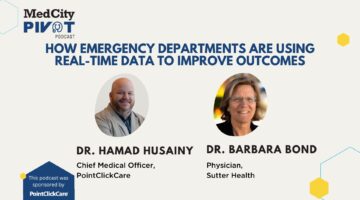
MedCity News Pivot Podcast: How Emergency Departments Are Using Real-Time Data to Improve Outcomes
How can AI benefit and improve patient outcome in the emergency department? Watch the latest episode to find out.
The future of manufacturing is being built on accountability, innovation and lasting impact. Our industry can drive measurable progress toward a more sustainable future by setting ambitious environmental goals and clear timelines. Yet real change requires more than promises – it calls for rethinking operations from the ground up and embedding sustainability into every stage of production.
Designing every new manufacturing facility is an opportunity to integrate sustainable solutions from day one. By choosing cleaner energy, smarter systems and more adaptable production lines, we can maximize output while minimizing environmental impact. When done right, growth can become a sustainability multiplier – where every gain in productivity strengthens both business performance and environmental outcomes.
Here’s how that can come to life:
- Investing in renewable energy: From wind farms to rooftop solar, companies are powering growth without increasing their carbon footprint. New facilities are designed with efficiency at their core, integrating smart systems, automation and LED lighting to cut energy use.
- Leveraging AI and data analytics: Advanced technologies such as AI and data analytics are transforming what sustainable manufacturing looks like. By revealing inefficiencies that once went unnoticed, these tools enable smarter decisions that reduce waste, energy use and emissions – and can increase output from the same capacity. Machine learning and predictive analytics help drive “right-first-time” execution and support a more reliable, responsible supply of medicines.
- Reimagining production through flexible design: Sustainability thrives on adaptability. Modern facilities are designed for multi-purpose use, capable of producing a range of medicines under one roof. This minimizes the need for additional infrastructure, conserves resources and ensures that every square foot drives faster, more sustainable production.


RCM Outsourcing: Balancing Human Expertise & Smart Technology
Greenway Health blends smart technology with human expertise to elevate revenue cycle.
The path forward
Our industry is at a pivotal moment where purpose and progress must coexist. Global demand for medicines is growing with an equally urgent call to protect the planet that sustains us. Through intentional design, renewable energy investments and a deep commitment to innovation and efficiency, we can redefine what responsible growth looks like.
Collectively, we must build smarter systems that last; produce more, not waste more; and stay true to the sustainability goals that guide us, no matter how fast we grow. Because sustainability isn’t the opposite of progress. It’s the foundation that makes lasting progress possible.
Photo: Petmal, Getty Images

Jim Greffet is Vice President of Sustainability at Eli Lilly and Company, where he leads the implementation of the company’s sustainability strategy and oversees stakeholder engagement and communications. Since taking on the role in 2020, Jim has advanced Lilly’s approach by launching its sustainability portal and chairing the cross-functional Sustainability Operations Committee.
Prior to this role, Jim served as VP of Investor Relations at Elanco Animal Health during its IPO and was named the top IR leader for mid-cap pharma by Institutional Investor in 2020. Over his 20+ year career at Lilly, he has held leadership roles across finance, investor relations, business development, and HR, including CFO of Lilly Canada. Jim holds an MBA from the University of Chicago and a bachelor’s degree in accounting from Indiana University. He passed the CPA exam in 1991.
This post appears through the MedCity Influencers program. Anyone can publish their perspective on business and innovation in healthcare on MedCity News through MedCity Influencers. Click here to find out how.