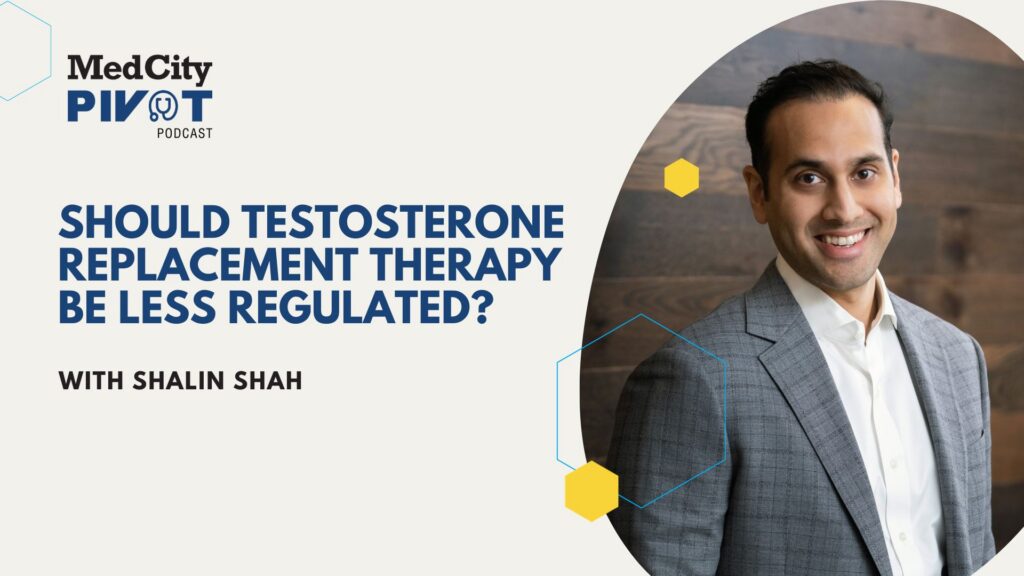
Shalin Shah, CEO of Marius Pharmaceuticals, has been advocating for less stringent regulation of TRT therapy, arguing that the evidence is clear about clinical benefits for men who either produce less testosterone or none at all due to some medical conditions. Marius makes an FDA-approved oral TRT drug called Kyzatrex that people with prescriptions can buy directly without insurance.
In this episode of the MedCity Pivot Podcast, Shah looks back at the history of TRT therapy as well as some misconceptions tied to its risks.
He testified at an FDA hearing led by Commissioner Marty Makary in early December on the subject.


RCM Outsourcing: Balancing Human Expertise & Smart Technology
Greenway Health blends smart technology with human expertise to elevate revenue cycle.
Here’s the video of the episode:
Here’s an AI-generated transcript of our interview:


MedCity News Pivot Podcast: How Emergency Departments Are Using Real-Time Data to Improve Outcomes
How can AI benefit and improve patient outcome in the emergency department? Watch the latest episode to find out.
Arundhati Parmar: Hello and welcome to MedCity’s Pivot podcast. I’m your host Arundhati Parmar. At MedCity News, we have devoted resources to covering women’s health fairly extensively. In fact, we have another podcast hosted by our reporter, Marissa Plescia called FemForward. So in this episode of the Pivot Podcast, I thought, why not do a story on something that we don’t cover very often, and that is men’s health.
Arundhati Parmar: What’s more masculine and integral to men’s health than testosterone? My guest today is Shalin Shah, CEO of Marius Pharmaceuticals, that makes an FDA-approved oral drug that is approved to treat adult men with low or no testosterone levels due to certain medical conditions. He was recently invited to an FDA hearing convened by Commissioner Marty Makary, so that officials could learn about testosterone replacement therapy and whether changes should be made in the regulatory schedule of this type of therapy.
Arundhati Parmar: Hello and Welcome to the Pivot Podcast, Shalin.
Shalin Shah: Thank you for having me. Excited to be here.
Arundhati Parmar: So let’s, um, talk a little bit about testosterone replacement therapy and sort of go right to the beginning, I feel. Can you tell me a little bit about the history behind why TRT, uh, or testosterone replacement therapy is regulated as a controlled substance in the United States?
Shalin Shah: Yeah, absolutely. So that actually goes back, uh, over 30 years now. So this happened in 1990. Congress actually went ahead and scheduled, uh, testosterone as a Schedule three substance. And this is mainly after, um, a backlash around the Olympics. There was a doping scandal in the Olympics, and again, it. It was sort of a baby out with the bath water thing as testosterone got roped into the broader class of anabolics.
Shalin Shah: And what was interesting though, at the time of this decision, the DEA opposed it. The FDA opposed it as well as the a MA. Right. Mm-hmm. So the Physicians Association as well. So again, it was very political, uh, back then. Mm-hmm. I think they were trying to, um, sort of save face and protect what was thought as young, you know, high school kids that were gonna get interested in this.
Shalin Shah: Um, but you know, naturally again, you look at the data and the regulation and what’s happened, it really hasn’t done its intended purpose and, and frankly, at this point has caused more harm than good.
Arundhati Parmar: Hmm. Um, so why do you think it’s time to change that policy?
Shalin Shah: So again, testosterone is the only hormone that is controlled, right?
Shalin Shah: Estrogen’s, a hormone, not controlled. Uh, insulin is also a hormone with anabolic properties also not controlled. Um, and, and coincidentally enough things like human growth hormone. Which are, are more potent than testosterone for the effects that we’re talking about. Also not controlled. Um,
Arundhati Parmar: but they don’t have, uh, sorry to interrupt, but they, those don’t have as controversial a history as testosterone does.
Arundhati Parmar: Right?
Shalin Shah: Sure. But I think controversy doesn’t equal science. So I think we want to be thoughtful about what is the metabolic role of testosterone. You know, there’s an androgen receptor on nearly every organ in the body. Mm-hmm. So it plays a physiologic process across our entire body, and the data’s very clear.
Shalin Shah: Low testosterone in in a human body causes a lot of downstream negative consequences, right? Mm-hmm. Whether that’s related to our glucose metabolism, whether that’s related to cognitive function, cardiovascular health. Bone, muscle, et cetera. So you know when you have something that is that critical to have physiologic levels across the body having a controlled status.
Shalin Shah: You know, is gonna have a, a negative ramification on so many parts of that medical system that are gonna drive people away from care.
Arundhati Parmar: Mm-hmm. So you mentioned some of the, the, the benefits, right. But there is a big concern from what, from what I understand, is the impact on the cardio cardiovascular and the blood clotting system in our body.
Arundhati Parmar: So is that risk overblown or is it misunderstood?
Shalin Shah: So two things there. Yeah. So the, the Traverse study, which was the largest randomized placebo controlled. Trial ever done on testosterone therapy. This was published in the New England Journal of Medicine in June of 23. Right. This came out firmly showed there is no cardiovascular risk tied to testosterone therapy.
Shalin Shah: Okay. And that also includes prostate cancer risk. So I think the data is clear now that there is no cardiovascular risk as you’re, you know, relating to blood clots and so forth. You know, like most things, there’s physiologic and then there’s non physiologic or super physiologic, so, right. You know. If you have too much, too much of a good thing can be a bad thing.
Shalin Shah: Right? Right. And I think that that frankly, you know, uh, applies to all hormones and, and most things across, you know, our body and this falls into that category.
Arundhati Parmar: Okay. Makes sense. So if you were to deregulate it, um, and I don’t know that we have the, the political will in or whatever regulatory will in the FDA to do that, how would it be.
Arundhati Parmar: How would it change things, uh, for the benefit of patients?
Shalin Shah: So mainly from a logistical perspective and then also a stigma perspective. Right. So what happens now is a patient who may be a candidate for testosterone therapy, um, often they’re having to discover this themselves, right? Because the medical system, traditional medical system is a largely, um, neglected this part of care.
Shalin Shah: Mm-hmm. And that’s why you see hormone therapy primarily delivered through concierge medicine. Wellness, uh, you know, wellness clinics, TRT clinics, etcetera, they’ve kind of gone out that traditional, traditional system,
Arundhati Parmar: right?
Shalin Shah: But again, patients can come back into that system, have this problem addressed.
Shalin Shah: Comfortably confidently from their providers. Providers also feel a lot better doing it because right now they are tracked in, in sort of national databases effectively when they’re writing these prescriptions. Right? Right. They’re registered with the state boards and so forth. Um, and then, you know, you look at the pharmacy, so there are a lot of restrictions as it relates to dispensing in the pharmacy around a controlled substance.
Shalin Shah: Okay. So there’s also that level of. Logistic and stigma that can be removed, okay. From that process, which again, for a patient that’s going through multiple hoops to get on a therapy that he or she may need,
Arundhati Parmar: mm-hmm.
Shalin Shah: You, you wanna reduce basically every checkpoint that discourages them starting therapy.
Arundhati Parmar: Okay. Okay. But you don’t, you know, you talked about, uh, the doping scandal and, and all of that. Isn’t there a chance of, um, those becoming worse if it does become descheduled?
Shalin Shah: So I actually, I, I don’t think so because at the end of the day, this is still prescription medicine, right? Okay. So you still need to go to a provider, and this is often lab based labs plus symptoms, but you’re getting a blood test to determine your levels.
Shalin Shah: So any competent provider is gonna use those and think about. Their liability. Right? So if you have a very high testosterone level, say I came in there with a thousand nanograms per deciliter for a provider to then give me testosterone.
Arundhati Parmar: Mm-hmm.
Shalin Shah: I don’t think it’s gonna happen because they’re thinking about their license and how they practice medicine.
Shalin Shah: So you have these real checkpoints. It’s not just, um, I mean, frankly you look at GLP ones and, and the ease of obtaining them today. Mm-hmm. Right. Via async. Telehealth, you don’t even have to meet with a provider, right? And you can fudge your numbers. You don’t have to get lab tests. I think that’s actually, frankly, you know, uh, something that’s abused a lot more interesting than what is testosterone.
Arundhati Parmar: Okay. Okay. So you mentioned GLP ones. I think in your hearing you talked about, you know, uh, the, obviously we all know the benefit of GLP-1s in rapid reduction of weight, and of course other, you know. A good effects on for diabetes patients and, and obviously cardiac patients. But I’m curious because there are a lot of companies that are now talking about, okay, you’re providing, you’re prescribing a GLP-1, doctor prescribe my drug too.
Arundhati Parmar: ’cause it’ll do A, B, C, D, and E. And I think in your, in the testimony you also said that given the rapid weight loss that occurs in many cases through not just fat loss, but muscle loss too, then you should prescribe, uh, you know, uh, TRT therapy. To help patients rebuild that, you know, lost muscle mass,
Shalin Shah: preserve the muscle.
Shalin Shah: Right. Rebuilding is, is again, even, even more difficult, which is where most patients end up. Right. The data is very clear. 18 months post cessation of GLP ones, most of the patients have regained all the weight that they’ve lost.
Arundhati Parmar: Right, right.
Shalin Shah: But that weight would be fat, not muscle.
Arundhati Parmar: Right. Okay. Makes sense.
Arundhati Parmar: But would that, but would that be just for men? Or would it be men and women? If you, even in that ideal world when the prescriber is prescribing, you know, a TRT with a GLP-1, doesn’t gender matter?
Shalin Shah: So in ideal world, it would not matter because fe again, testosterone is a female hormone as well. Right?
Shalin Shah: True. True. Females make testosterone independently and they also convert estrogen to testosterone. So I think there’s a lot of data. The data’s also clear in all the ways that it can support female health as well, right? From muscle. To bone, to cognition, to cardiovascular, same things. Okay. So I mean, the question is really why would we ignore half of our population?
Arundhati Parmar: Right.
Shalin Shah: Uh, that can benefit from it as well.
Arundhati Parmar: Makes sense. So let’s talk a little bit about your company, Marus. You obviously have an FDA approved drug, uh, in the marketplace. Um, I wanna talk about competition.
Arundhati Parmar: I understand if my research is correct and correct me if I’m, I’m wrong. There are two other approved oral TRTs in the United States, but the vast majority of the competition for you is not those companies is injectables, which is how most people take, um, TRT. So. If, have you done any studies comparing, uh, you know, your drug, oral drug to the injectables?
Arundhati Parmar: And if so, uh, what, why would people switch from injectables to your, uh, drugs?
Shalin Shah: There’s, there’s a good question, and, and you’re right, the majority of the market is injectables. It’s not, it’s not orals. Today, orals are just becoming better understood or, or better known, right? Mm-hmm. That they exist. Um, so a couple things.
Shalin Shah: We have, we have not run head-to-head trials against injections, but I will share some of the. Mechanisms that differ. Right. Okay. So typically in an injection protocol, patients are taking, uh, an injection at a once a week or once every two week interval. Right. So you have to think about what is most physiologic for a body.
Shalin Shah: Our bodies make testosterone on a daily basis. Mm-hmm. So the, you know, a simple analogy that we like to use is if you’re on a one week injection protocol, that’s like waking up on Monday morning and having 10 cups of coffee. For your entire week, right? Mm-hmm.
Arundhati Parmar: Mm-hmm.
Shalin Shah: Doesn’t make a lot of sense. Right? And that’s really what sends patients on this roller coaster high, super physiologic, high often, right?
Shalin Shah: And then a crash at the second half of their, their sort of dosing schedule.
Arundhati Parmar: Right?
Shalin Shah: Now you look at oral and, and products like Rex. So again, this is indicated and right now this is indicated for just men with, with low testosterone due to certain medical conditions,
Arundhati Parmar: right?
Shalin Shah: But we’re taking. Tre on a daily basis, and this is most, this is the way to most clinic, um, most mimic your national diurnal rhythm.
Shalin Shah: Right. Okay. So I think that’s one basis that we look at, and then you look at what is happening from a super physiological level.
Arundhati Parmar: Mm-hmm.
Shalin Shah: On an average, our patients are hitting a thousand nanograms per deciliter as a, as a intraday high, which is not super physiologic. And then it comes down throughout the day.
Shalin Shah: So what you see, I think what’s important here is the side effect profile.
Arundhati Parmar: Okay?
Shalin Shah: Now. Data and studies show up to 66% of injection patients have elevated hematocrit levels, which will require blood donation, whether that’s every four weeks or every eight weeks,
Arundhati Parmar: okay?
Shalin Shah: If you look at our phase three data on Rex sub, 2% of patients had an elevated hematocrit level, and those patients resolved when you decrease the dose.
Arundhati Parmar: Okay?
Shalin Shah: So nobody left the trial because of that, and that’s a massive delta. That you think about, um, a physician or a patient having to think about elevated hematocrit levels and what is that impact, right? Mm-hmm. Mm-hmm. Um, also, if you think about things like LH and FSH, which are the signaling hormones coming from our pituitary for Rex, they stay at the lower end of the normal range.
Arundhati Parmar: Mm-hmm.
Shalin Shah: Versus often in injectables. They are zero undetectable levels. Okay? Because again, your body, when you’re going to sleep that that night. On an injection, generally your levels are high,
Arundhati Parmar: right?
Shalin Shah: So your pituitary is saying, I have no work to do. We do not need to send these signals off. Um. The testicles are often not working, and that’s why you see testicular atrophy in injection patients as well.
Shalin Shah: I see. It’s very rare on Rex. We have not had that reported in our phase three datas and, and anecdotally it just doesn’t come up.
Arundhati Parmar: And how large was your sample in, in phase two?
Shalin Shah: So we had about 160 patients in our phase three trial.
Arundhati Parmar: Okay. So that’s not a whole lot.
Shalin Shah: It’s not, I mean, it’s, it’s, it’s in line with what, uh, testosterone trials are for FDA approved products.
Arundhati Parmar: I see. Okay.
Shalin Shah: Fair in reality. Okay. So, but again, now, you know, we have thousands and thousands of patients on Rex. So anecdotally we still, you know, we will get. Back from providers. Okay. I mean, this is a, I’ll share a tidbit in terms of a paper that’s to be published soon. Mm-hmm. By one of our, one of our providers.
Shalin Shah: Um, if you look at a patient pre Kaiser Rex, so they would be on injection therapy. Let’s say this is a, this is about 75 patients, 20 odd 20 low, 20% had elevated hematocrit issues.
Arundhati Parmar: Mm-hmm.
Shalin Shah: That number cut in half on a transition to Kaiser trucks.
Arundhati Parmar: Hmm. Interesting.
Shalin Shah: Right. So that’s, you know, in apples to apples comparison, ’cause these are the same patients and similarly they had, you know, 20 odd percent of the patients had elevated estrogen levels and required anastrozole to control that conversion.
Arundhati Parmar: I see.
Shalin Shah: Less than half, actually, I think it went down to almost 4% needed. That anastrozole or estrogen blocker on Rex. Okay. So these are interesting, um, points that I think we’re starting to unfold. Mm-hmm. Uh, again, as more of the population moves to oral. But I think it goes back to this physiologic rhythm discussion, right?
Shalin Shah: What is the most physiologic thing we can do or replace? And if we’re able to mimic that, then our bodies should stay in a a better equilibrium.
Arundhati Parmar: So I’m, I’m curious about, and you explained the, obviously the, the clinical side of it. I’m curious about sort of your go-to-market strategy. If this is as good as you say it is, and your clinical trials are sort of pointing in that direction, then why not pursue an insurance strategy, whether government or commercial, or both, instead of going this direct to consumer route.
Arundhati Parmar: I don’t know that, do you do ads on television? Like, how do people even know that this is a therapy that’s available to me if
Shalin Shah: it’s, so, it’s so, we, we do have a fair, uh, I mean, I’ll share a couple points, right? So again, remember we launched this in 2023, right? So if you look at the categories still, it, it, again, heavily stigmatized and, and not viewed as essential by payers, right?
Shalin Shah: Right. So, so for us at, at our launch time, it would make sense to go cash where. The benefits of the product. Mm-hmm. And the providers that you’re dealing with also understand that, right. So they can adopt this much quicker than trying to convince a payer that, Hey, look, I have a new product in a category that you don’t love and.
Shalin Shah: You know, are you gonna pay for it? Right,
Arundhati Parmar: right.
Shalin Shah: That, that, so we, we went straight to the consumer then. And, and I think that makes sense, but
Arundhati Parmar: one, let me stop you one second. The other two companies that are in the oral TRT space, they are insurance covered.
Shalin Shah: Correct. That was their base. So you also have to remember, so the main one, um, one of the other ones, they went bankrupt doing so, so I think writing was on the wall.
Shalin Shah: You know, they had 30 people in the field. Uh, it was an insurance strategy and doctors are very, um. I guess rightfully so, these practices are busy, they’re unforgiving if that product is not covered Right. They can’t continue to write it and waste staff time
Arundhati Parmar: Right.
Shalin Shah: Uh, on this. Right. They’re busy. Sure. And, and that was really one of the benefits for Kaiser Tre out of the gate was we are saving your staff time and we’ve made this at a price point that’s accessible for patients.
Arundhati Parmar: Okay. And how much is that, if I may ask?
Shalin Shah: So on average, around $170 per month. Okay. For Kaiser Rex, and again, it could be a little bit more if you have. The provider visit included, labs included, et cetera, like a subscription price, which you’ve seen with some of the telehealth models.
Arundhati Parmar: Right.
Shalin Shah: Um, but no, I do think the future does hold, um, a, a payer strategy.
Shalin Shah: Okay. Because, again, as you saw with the panel and, you know, the regulatory tailwind behind testosterone, the, I think the broadening knowledge of, of hormone therapy, how important it’s for males and females. Right. Again, the patient voice has been huge here. So I think when patients speak up. You know, inversely medical community does listen and I think they do follow.
Shalin Shah: So, yeah. And again, I think as this goes back to primary care, then yes, an insurance strategy does make sense, um, over the long term. So I wouldn’t say we are, I think for Launch it makes sense and what we’re doing, but similar to again, look at, look what, uh, GLP-1drugs have done. So what they’re instituting now is what we did three years ago.
Arundhati Parmar: Right.
Shalin Shah: Because that, that, that was, that was writings on the wall. Patients have sort of taken this back, empowered themselves. Look at the knowledge that they can get. I mean a physician’s always gonna be necessary, but look at what, like the power of the LLMs today and doing their research. It’s not just Dr. Google anymore.
Arundhati Parmar: Sure.
Shalin Shah: Right. Sure. Simple search and putting together webpage. I think.
Arundhati Parmar: Yeah. It, Gemini, Chad, GPT, and all of the above.
Shalin Shah: Yeah. Yeah. It’s incredibly powerful and it’s good for everyone. Right? I think it’s good for patients, it’s good for providers. Mm-hmm. Um. But yeah, so I think a broader access strategy is important to us.
Shalin Shah: Okay. As we think, uh, you know, there’s 25 million hypogonadal men in the US alone and 2 million on therapy, that number can easily go to 10 million.
Arundhati Parmar: Okay. And then I’ll ask a quick clinical question, then we’ll come back to the regulatory aspect. Your product is approved in men, um, that have low or no, that are not producing any or have of low testosterone production.
Arundhati Parmar: Does the label expand to include more people ever? Or is it this, or is this it?
Shalin Shah: I think the label does expand. Absolutely. Um, to who, because if you, so two, two things. One is it, it goes back to sort of an idiopathic hypogonadism. So you could have testosterone deficiency for. Whatever reason. Right? Right.
Shalin Shah: Now, there are very limited reasons why you can have this and be on label.
Arundhati Parmar: Okay?
Shalin Shah: Now, in 2014, and before it was called idiopathic was on the label, so just like you have high blood pressure or high cholesterol, right? A doctor doesn’t figure out exactly what’s driving this, whether it’s genetic, whether it’s lifestyle.
Shalin Shah: You get treated for that condition. Right. So that’s really where I see the label shifting for testosterone therapy for the male population. And, and I do see a female testosterone on the horizon for, um, again, for females, an FDA approved version for similar construct. I mean, again, there’s, this is a physiologic hormone, so if you are deficient in it
Arundhati Parmar: mm-hmm.
Shalin Shah: I think it’s been very. Clearly shown that there are benefits to be in a physiologic range versus range versus a deficient range.
Arundhati Parmar: Um, and then let’s end with sort of full circle, going back to the regulatory question. Um, do you think that this current administration, because they have, for lack of a better word, unconventional leaders leading, leading various health agencies, do you think this idea of.
Arundhati Parmar: Um, you know, removing it from such a strict way to monitor how these drugs are prescribed. Do you think that might happen in the next three years?
Shalin Shah: So I do think there’s a good chance of it happening. Uh, okay. Like, as you said, the, the, this administration has unconventional leadership, but, you know, look at what happened to female HRT.
Shalin Shah: Right? WHI was a flawed study. From the get go basically caused, uh, hysteria around female hormones. Right. And two decades of females have lost out on hormone therapy. Mm-hmm. Because of the flawed headlines that came out there. Any other administration could have changed this. Right. But this one did for the benefit of the female population,
Arundhati Parmar: unless we clarify that there was an elevated cancer, people thought there was an elevated cancer risk to women who went through HRT therapy and that was.
Arundhati Parmar: A flawed study.
Shalin Shah: Correct. Exactly right. So again, scared two decades of females off. Right. So this administration went and did that. So I, I don’t like to look at it honestly as a political thing. I think this is truly better patient care. Mm-hmm. And now them. Putting the same light on testosterone therapy, which has been stigmatized and, um, face these issues through the Controlled Substance Act and so forth.
Shalin Shah: Now they are being, you know, now they’re taking actions to write that and, but patients are the ultimate beneficiaries and our country’s healthcare system is a beneficiary.
Arundhati Parmar: So, and you, you would say that both for the HRT and potentially for the TRT science is what is making help making those. Decisions
Shalin Shah: there is the clinical data that can back it up, right?
Shalin Shah: These are not, these are not, they’re, they’re. They’re not shooting from the hip. Right. Right. The data is there and I think the more, I mean, I’ve seen some amazing studies even around diabetes and testosterone therapy and the prevention of di you know, prevention of, uh, diabetes or the remission of diabetes.
Shalin Shah: These studies had not caught the attention that they should mm-hmm. Because of this stigmatized category. So the data’s there. Okay. Um, I think it’s shining a light.
Arundhati Parmar: Alright, perfect. Well, Shalin, thank you so much for spending some time with us today.
Shalin Shah: I appreciate you having me.