A Revolution Medicines drug helped pancreatic cancer patients live nearly six months longer compared to those treated with standard of care chemotherapy, meeting the goals of a pivotal study in this aggressive malignancy with limited treatment options.
With these preliminary results in hand, Revolution said Monday it plans to seek regulatory approval for the drug, daraxonrasib. Once the FDA accepts the submission, the agency’s review could happen quickly. The FDA has already named Revolution’s once-daily pill as one of the medicines selected for a pilot program that cuts the review time down to one or two months for products that address national health priorities, such as cancers with few available therapies.
The cancer community could get a closer look at daraxonrasib’s results soon. Revolution plans to submit the data for presentation during the upcoming annual meeting of the American Society of Clinical Oncology.

The Power Behind Enterprise EHR Software for Large Healthcare Systems
Enterprise EHR boosts scalability, interoperability, and governance for large healthcare systems.
Daraxonrasib, formerly RMC-6236, belongs to a class of drugs called RAS inhibitors. While RAS proteins act like an on/off switch to regulate cell growth, mutations can result in RAS being stuck in the “on” position, contributing to the uncontrolled cell proliferation that drives certain cancers, including pancreatic cancer.
The first RAS inhibitors to reach the market, marketed by Amgen and Bristol Myers Squibb, treat non-small cell lung cancers and colorectal cancers driven by a specific RAS mutation. These drugs inhibit RAS when this protein is in the inactive or “off” state, preventing it from switching to “on.” Daraxonrasib is an oral small molecule designed to inhibit multiple cancer-driving variants of RAS that are in the active state. While RAS mutations are associated with lung and colorectal cancers, its role is particularly pronounced in pancreatic cancer. According to Revolution’s estimates, more than 90% of cases of pancreatic ductal adenocarcinoma (PDAC), the most common form of pancreatic cancer, are RAS driven.
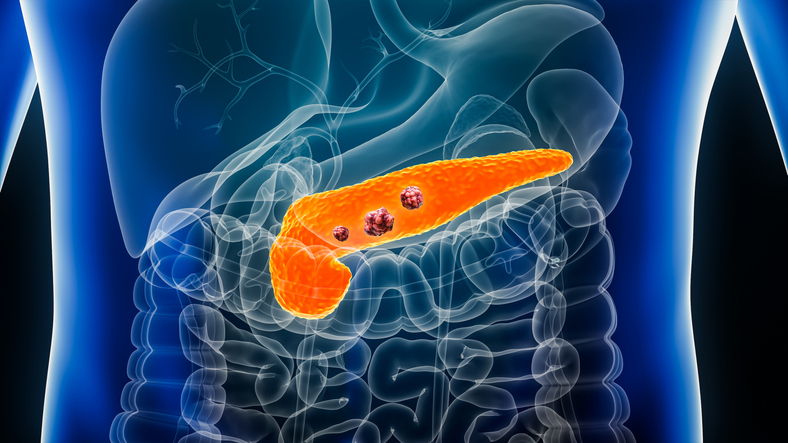
PDAC does not show many early symptoms and it’s a difficult cancer to detect. Consequently, many patients aren’t diagnosed with this cancer until after it has already advanced. Many of these cases continue to progress following treatment with the chemotherapies that are the first line of treatment.
Revolution evaluated daraxonrasib in patients with previously treated metastatic PDAC, spanning those who had a wide range of RAS variants as well as patients without an identified RAS mutation. The Phase 3 study randomly assigned participants to receive the study drug once daily as a monotherapy or the investigator’s choice of chemotherapy. Revolution reported its drug achieved statistically significant and clinically meaningful improvement in progression-free survival and “unpredecedented overall survival benefit,” which were the main trial goals. Median overall survival in the daraxonrasib arm was 13.2 months compared to a median 6.7 months for the chemotherapy arm. The company did not disclose figures for progression-free survival.

Beyond Analytics: How Sellers Dorsey is Hard-Coding Value into Medicaid Policy [Video]
How to turn analytics into actual policy outcomes.
One of daraxonrasib’s side effects is rash that leads to bleeding. That adverse effect was evident in former Nebraska Senator Ben Sasse, who disclosed last December that he was diagnosed with stage 4 pancreatic cancer. In a video interview and story from The New York Times, Sasse said he is a participant in the Revolution drug’s clinical trial. Revolution did not go into detail about daraxonrasib’s side effects, saying only that the results to date show the drug was generally well tolerated with a manageable safety profile and no new safety signals.
In a statement included in Revolution’s announcement of the results, Dr. Brian Wolpin, professor of medicine at Harvard Medical School, director of the Hale Family Center for Pancreatic Cancer Research at Dana-Farber Cancer Institute, and principal investigator for the Phase 3 trial, said the results indicate daraxonrasib provides a step forward for patients.
“I believe that this new approach is a very important advance for the field that I expect will be practice changing for physicians and improve the care for patients with previously treated metastatic pancreatic cancer,” he said.
Two additional Phase 3 tests are ongoing for daraxonrasib in PDAC, one as a first-line treatment and the other as an adjuvant therapy following surgery. A pivotal study is also underway in metastatic non-small cell lung cancer. Leerink has estimated daraxonrasib could achieve about $7.6 billion in peak global revenue as a first- and second-line treatment for metastatic pancreatic cancer. In a research note, Leerink analyst Andrew Berens said the Revolution drug’s results set an achievable bar in second-line treatment of PDAC and validate the company’s approach to drugging RAS.
The PDAC results also have positive readthrough to other companies developing drugs for PDAC. Berens pointed to Adlai Nortye, which is developing a small molecule and an antibody drug conjugate, both designed to block multiple RAS variants. BridgeBio Oncology Therapeutics is developing a KRAS ON/OFF inhibitor for PDAC. Immuneering is taking a different approach with atebimetinib, which works by offering deep but intermittent inhibition of the cancer-driving protein MEK. Atebimetinib is in Phase 3 testing as a first-line pancreatic cancer treatment.
“The data for dara[xonrasib] look encouraging, with a clear benefit over [standard of care] chemo, but could leave room for other novel approaches to improve on efficacy and/or tolerability,” Berens wrote.
Illustration by libre de droit via Getty Images