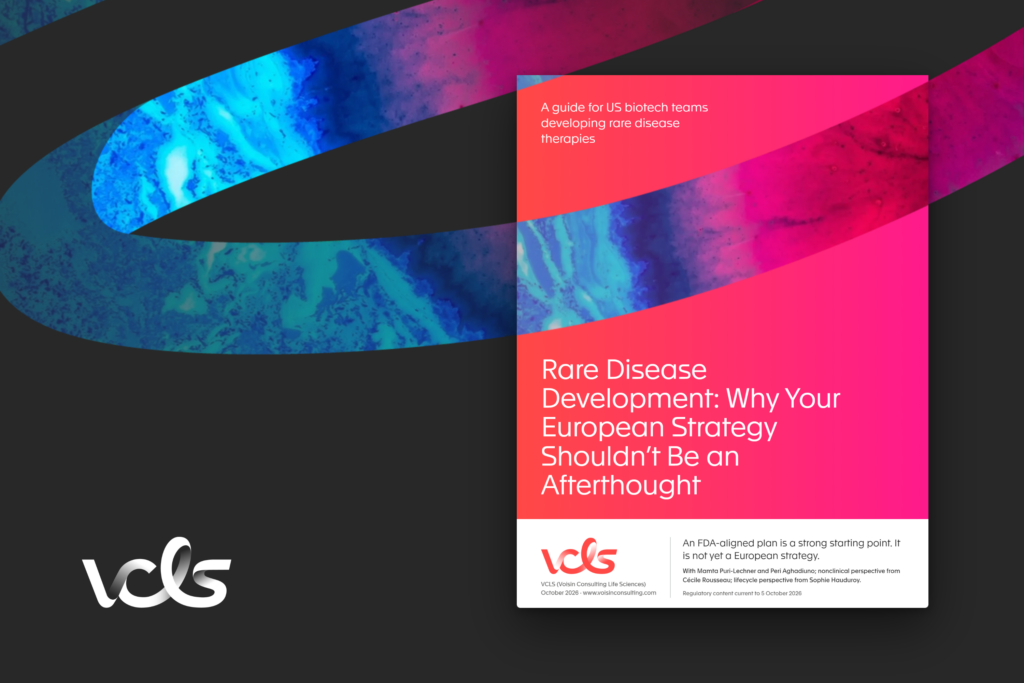
Life science companies developing treatments for rare diseases for the U.S. market would be well advised to consider the scientific evidence needed for securing European market approval when they design clinical trials. That’s the primary message from a new guide by VCLS (Voisin Consulting Life Sciences). It provides a comprehensive overview for not only mapping a clinical design strategy that anticipates questions from both European and U.S. regulators, but also addresses nonclinical evidence, European scientific advice, orphan designation, pediatric planning and future Health Technology Assessment (HTA) requirements.
Rare disease presents challenges to the FDA and European regulatory landscape. Because the patient population is much smaller than for other diseases, there are less data available and fewer opportunities to create new datasets. Additionally, uncertainty around endpoints can make differences in regulatory expectations particularly consequential. Progression of disease is different for each patient, which means there may be neither a validated endpoint nor a dataset that describes untreated patients well enough to serve as a useful comparison, according to the guide.
The source of the problem is often when an FDA-aligned plan becomes a global rare disease program with assumptions that have not been tested in Europe.
“A pivotal trial is a bet on the future treatment landscape,” said Peri Aghadiuno, Head of Clinical, VCLS. “The question is not whether the study is relevant today, but whether it will still answer the most important clinical and regulatory questions at the time of approval.”
So what does alignment mean?
One example highlighted in the guide looks at a Phase 1/2 anonymized study in the U.S. and EU. The FDA aligned on the Phase 2 study design and on the nonclinical and Chemistry, Manufacturing and Controls (CMC) packages, and the study began in the U.S. However, the same study was submitted in Europe but without scientific advice interaction. The German regulator didn’t agree with the toxicology profile and the study was delayed in Europe. A European scientific advice interaction before submission could have brought to light the toxicology issue at an earlier stage when it was cheaper to address.
“The biggest mistake sponsors make is treating alignment on one topic as alignment on the entire program,” observed Mamta Puri-Lechner, Head of Regulatory Affairs US, VCLS, in the guide.
VCLS is a specialist life sciences product development partner that helps biotech, pharmaceutical, and medical device innovators.
The company’s regulatory, clinical and nonclinical specialists work with and support rare disease sponsors across FDA interactions, European scientific advice, orphan and pediatric planning, and the design and evidence questions that sit between them.
Among the key issues addressed in the guide:
- What does FDA agreement actually establish?
- What still needs to be discussed in Europe?
- Which development decisions become difficult and expensive to change once pivotal trials begin?
- When should a US-led rare disease program seek European advice?
To download the VCLS guide, Rare Disease Development: Why Your European Strategy Shouldn’t Be an Afterthought, fill in the form below:
Photo: Narumon Bowonkitwanchai, Getty Images