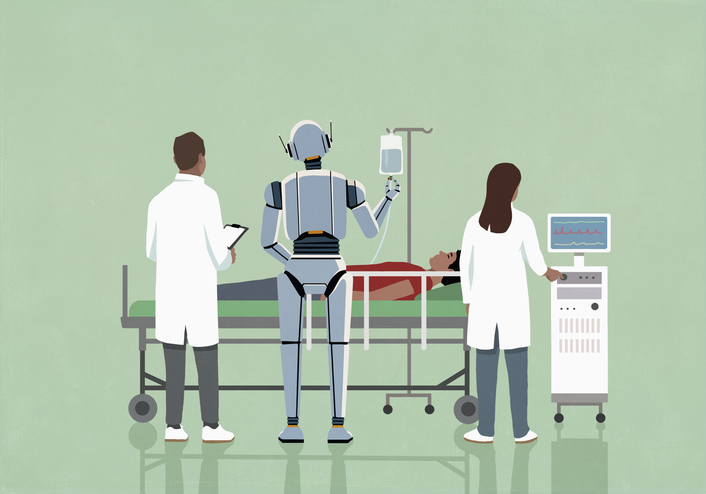
Every few years, the medicine industry convinces itself that the next great disruption will either save or destroy how we train physicians. We’ve said it about duty hour restrictions, about the United States Medical Licensing Examination (USMLE) pass/fail Step 1, and even about the rise of virtual care. In our latest rendition of forward-looking doubt, the question we keep asking is whether AI will transform medical education for better or worse.
I’d argue we’re asking the wrong question.
The question isn’t whether AI belongs in medical education. It’s already there, in the pocket of every resident on rounds, in the hands of the patients sitting across from us in exam rooms, embedded in the workflows of nearly every major health system in the country. The real question is whether we’re being honest with ourselves about what medical education was designed to produce, and whether our current system is still doing that job.


Closing the Quality-Affordability Gap in Workplace Mental Health
In an interview, Kyan Health Co-Founder and Chief Commercial Officer Konstantin Struck discussed how Kyan gives mid-market and enterprise employers access to premium workforce mental healthcare, at a price point that is affordable.
I don’t think it fully is. And that’s not AI’s fault. That’s ours.
The gap between passing and practicing
It’s tempting to point to benchmarks and declare progress. Large language models (LLMs) can now pass the USMLE, which is truly remarkable. But it’s also largely beside the point. A patient doesn’t walk into an exam room and hand you a well-formatted clinical vignette with five answer choices and a clear stem. They walk in carrying decades of life experience, incomplete histories, and communication shaped by everything that’s happened to them before they ever found their way to you.
Research has begun to illuminate this gap in uncomfortable detail. Early studies showing AI performing well on isolated clinical scenarios look quite different when a real human with all the messiness of actual communication is put back into the loop. Accuracy drops significantly. Context, it turns out, is everything, and context is something we learn through years of human interaction, not through optimizing for test performance. Medicine is a human endeavor at its core.


The Healthcare Payments Industry Faces a Perception Challenge
Healthcare payments are no longer about transactions. It’s about controlling the revenue cycle. And increasingly, that control is not sitting with ISOs.
What we’re training physicians to do and what we’re testing them on have drifted apart, and AI is exposing that drift in ways that are worth taking seriously.
The case for rethinking, not retreating
None of this means AI should be pushed out of training environments. That ship has sailed and frankly, that’s a good thing. Teaching physicians to practice without AI tools would be like training pilots without flight simulators. The goal isn’t to eliminate AI from the learning environment; it’s to teach physicians to use it the way skilled clinicians use any resource: with judgment, skepticism, and a clear sense of its limits.
That means attending physicians need to model to trainees what responsible AI use actually looks like. Not performing digital abstinence on rounds, but demonstrating how to stress-test an output, trace a reference back to the primary literature, and recognize when a tool is hallucinating with confidence. Clinical reasoning doesn’t disappear in an AI-enabled world. It has become more important, not less because now someone must decide whether to trust the machine.
There’s also a real opportunity here that we risk missing while we’re busy worrying. A medical student today can use an LLM to simulate patient encounters, run through clinical scenarios, and get thousands of additional reps that simply weren’t available to previous generations. That’s not deskilling. That can be an extraordinary equalizer if we build it into training intentionally rather than letting it happen around us.
The structural problems AI didn’t create
Here’s what concerns me more than any particular technology: we have structural problems in physician training that predate any LLM by decades, and AI is now arriving at a system that was already straining.
Medical literature is doubling roughly every 73 days. Our curricula haven’t kept pace. We’re still largely selecting medical students based on individual academic achievement at a moment when medicine is fundamentally a team sport. We’re graduating some physicians into specialties and geographies where they aren’t needed while other communities that desperately need primary care or specialty care go underserved. We’re loading trainees with $300,000, $400,000 in debt and then expressing surprise when financial pressure shapes their specialty choices and their willingness to practice in shortage areas.
AI isn’t the cause of any of that. But it does force the question of whether the return on that investment in time, money, and multiple years of a physician’s life is being maximized by a system designed in a different era.
What the next version looks like
I’m an optimist about what’s possible. But optimism requires honesty about the starting point.
A reimagined medical education system would select the qualities that make great physicians: empathy, curiosity, resilience, and the ability to function on a team; not just the ability to survive a gauntlet of standardized metrics. It would integrate AI as a teaching tool from day one, with faculty modeling how to use it responsibly rather than pretending it doesn’t exist. It would lean into microlearning, case-based reasoning, and the kind of contextual, human-centered problem-solving that no model has figured out yet how to replicate.
The physicians who will thrive in the next decade aren’t the ones who memorized the most or scored the highest. They’re the ones who know how to learn continuously, use tools critically, and do something AI genuinely cannot: walk into a room, read a face, and make a person feel seen.
The technology will keep changing. The mission doesn’t.
Photo: Malte Mueller, Getty Images

Michael Jerkins, M.D., M.Ed., is the president and co-founder of Panacea Financial and is also a practicing physician in Little Rock, Arkansas. After earning his bachelor’s degree in economics, he deferred his medical school acceptance to teach middle school science in the Phoenix area while also earning his master’s degree in education from Arizona State University. He then completed medical school at the University of Tennessee Health Science Center before finishing his residency at the University of Cincinnati Medical Center and Cincinnati Children’s Hospital. With a faculty position and board certifications in both internal medicine and pediatrics, Michael is able to treat patients of all ages and teach medical trainees in both inpatient and outpatient settings.
This post appears through the MedCity Influencers program. Anyone can publish their perspective on business and innovation in healthcare on MedCity News through MedCity Influencers. Click here to find out how.