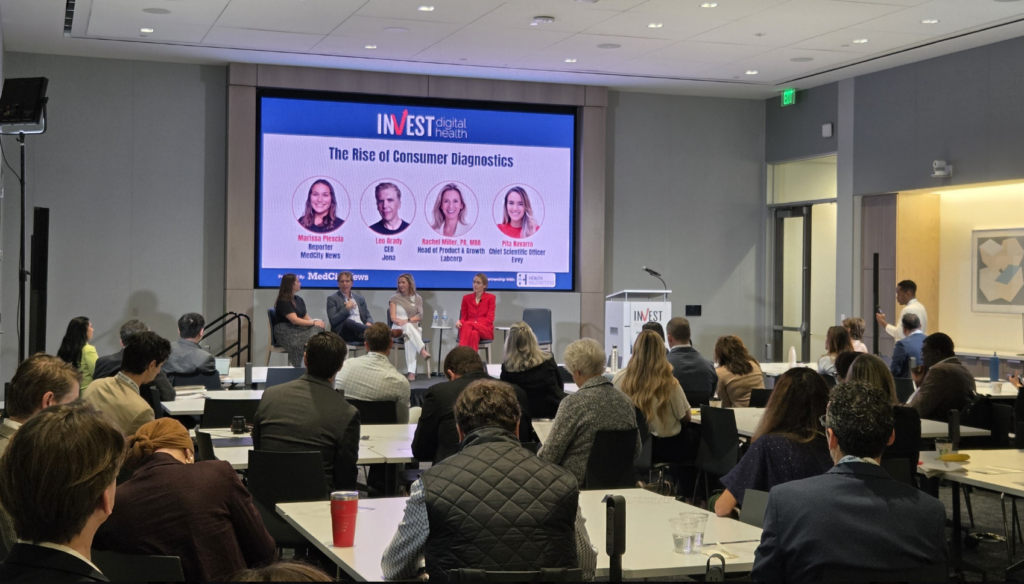
Direct-to-consumer diagnostics are becoming increasingly popular. But what’s driving the rise of consumer diagnostics? This was the topic of conversation during a Thursday panel at the MedCity INVEST Digital Health conference in Dallas.
One panelist — Leo Grady, CEO of gut microbiome testing company Jona — noted that people have been interested in analyzing themselves for a long time. Genetic testing company 23andMe started about 20 years ago, and Everlywell made home testing mainstream, he said. But Covid-19 really drove the rise in at-home diagnostics.
“I think it was partly driven by the fact that everybody was home, partly because health became more on your mind, and also partly because of some of the regulatory relaxations that happened that made it more possible to ship tests across state borders, to have more clinical-grade tests prescribed without having them to come from your doctor,” he said. “That really standardized and made more mainstream the ability for people to access tests and to then be able to get those results and even talk to medical professionals online.”


The Power of Real World Data to Study Women’s Health at Scale
Veradigm examines key clinical trends, comorbidity profiles, and treatment trends across adolescence, reproductive years, and peri-/post-menopause. Download it today!
Another panelist said the consumer diagnostics sector has grown quickly due to three main factors: a primed market, good product-market fit and a compressed adoption curve from Covid.
“[For] the primed market, as a healthcare provider myself, I can say for decades we’ve been telling patients you need to take control of your health, but not really giving patients the data that they need to do that,” said Rachel Miller, head of product and growth at Labcorp. “[For] good product-market fit, you’ve got these diagnostics that can be done at home, or just on your own terms. You can schedule your own appointment. The fit of that experience is really good. And then the compressed adoption curve. Covid, of course, changed regulation and people stumbled into testing themselves because they had to.”
Pita Navarro, chief scientific officer of Evvy, noted that the women’s health space has seen slower growth than other areas. Evvy is a vaginal microbiome testing company.
“I think for me as a scientist and going through Covid specifically, I was watching the vaccine develop within months, the causing agent identified within months as well. And yet, I was going to the OB/GYN, and they were counting shapes under a microscope. And so we thought, ‘We have this new technology; why isn’t it being applied in women’s health as it’s being applied across the healthcare system?’”
The Power Behind Enterprise EHR Software for Large Healthcare Systems
Enterprise EHR boosts scalability, interoperability, and governance for large healthcare systems.
She added that this was a major driver for the creation of Evvy. Vaginal health is a leading reason that women seek healthcare advice, and if a female goes to an OB/GYN, they’re more likely to get misdiagnosed than correctly diagnosed, Navarro said. The vaginal microbiome is also predictive of numerous outcomes across the lifespan, including cervical cancer, sexually transmitted infection and infertility.
“I think through consumer diagnostics, you’re able to acquire data sets that aren’t being gathered in the healthcare system. … And I think the doctors today in the healthcare system are so focused on what patients need, and completely ignore what patients want,” she said. “And so I think as a consumer health company, you have the opportunity to actually find where those two mix.”
Grady of Jona agreed with the idea of finding what patients want, noting that in the traditional healthcare system, diagnostics used to be considered a bad word. He argued that doctors were worried about tests showing something they’d have to act on and payers didn’t want to pay for them.
“You know who really loves diagnostics? Patients, consumers,” he said. “Thinking about what patients want and what they now have access to, people love data about themselves. People love understanding more about themselves, and a lot of people do feel really underserved by the healthcare system. They’ve bounced around to a bunch of doctors, and felt they weren’t getting answers, and so they wanted to take matters into their own hands.”
Photo: Nick Fanion