
Rapidly evolving consumer expectations are changing how we need to practice medicine. There is a virtual treasure trove of data to back this up.
Here are just a few recent statistics I found:

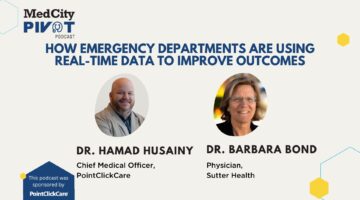
MedCity News Pivot Podcast: How Emergency Departments Are Using Real-Time Data to Improve Outcomes
How can AI benefit and improve patient outcome in the emergency department? Watch the latest episode to find out.
- 92 percent of patients believe they should have full access to their EHR (Accenture);
- 67 percent of consumers are interested in video conferencing for follow-up visits (Deloitte); and
- 76 percent of wearables users are interested in sharing data with their own doctor (iTriage).
The needs and desires of today’s, digital consumers are quickly reshaping how we need to communicate with and meet the needs of patients.
As we kick off 2017, I wanted to better understand how all of this change was affecting providers and how they’re engaging with consumers. So I asked several healthcare marketing experts one question: What is the biggest trend in digital marketing for providers as we start 2017?
Here’s how they weighed in:

The Power of One: Redefining Healthcare with an AI-Driven Unified Platform
In a landscape where complexity has long been the norm, the power of one lies not just in unification, but in intelligence and automation.
Tanya Andreadis, Associate Chief Marketing Officer, University of Pennsylvania Health System
Access and ease of making appointments are more important than ever. Individuals are coming to us with health issues and have an expectation of getting their needs addressed quickly. While marketers can drive interest in services, an increasingly important, digital challenge will be their ability to partner with the clinical staff to make healthcare services more accessible and convenient.
Another critical trend is our ability to rapidly respond to market changes. It’s never been more essential to create a digital marketing organization that is nimble and can accept and adapt to changes, especially in consumer behavior. This starts with hiring people who have a broad skill set, are open-minded, and have confidence.
Kathy Divis, President at Greystone.net
The biggest change impacting healthcare marketing in 2017 will be the continued transition of marketing from a communications focus to a technology focus. The movement from MarCom to MarTech is happening rapidly as organizations gain an understanding of the need to better apply science to healthcare marketing. There is a need to more precisely target customers, better track effectiveness and to show value and ROI. The impact on providers includes the need to better use customer relationship management (CRM) techniques, to shift resources (both budget and FTEs) to more data-driven activities, and to develop standard reporting to show effectiveness.
Andy Gradel, System Director, Digital Marketing at Main Line Health
Content personalization is at the top of our list over the next 12 – 18 months. With people consuming more content than ever, yet spending less time on any individual sites, it’s essential that our visitors are presented with options and calls to action that are relevant to what they need. Plus, from an empathetic design perspective, presenting users with fewer, more relevant choices will make for a much more satisfying experience in times of crisis.
Niko Skievaski, President at Redox
Content is still king. Many patients are surfing the web for answers before they roll into the clinic. You’re sitting on a wealth of information in the brains of your providers. Focus on the common questions of the season, local and regional health (allergies, that flu going around, etc.) or spotlight inspiring provider or patient stories. This goes far beyond simply building and humanizing your brand in your community. Most of the articles could conclude with a call to action to come in for that flu shot or that annual checkup. Once you have their attention, suggest action. And please make it easy to take that action. Let patients schedule appointments online. Let them choose a video visit. Let them see wait times at urgent care. We want to use our technology. You’ll win if you let us use it to improve access and efficiency.
Telehealth is also something we’re keeping an eye on. There will be a shift at some point where the big national brands will be competing head-to-head with the local and regional providers in the telehealth space. Once that happens, our next generation of patients may not have the same type of relationship with or affinity for their providers that current patients have, which will make an already competitive space that much more challenging.

Chris Riegger is Chief Operating Officer for Modea, where he uses his background in product management and growth to help improve the digital patient experience for large healthcare organizations. He is responsible for Modea’s U/X design and analytics teams.
Chris spent years working in New York City and London for American Express before moving into the digital space where he helped to grow several, consumer-focused companies, including two that were successfully acquired. Chris holds a Bachelor of Music from The University of North Texas and an MBA from Brigham Young University.
This post appears through the MedCity Influencers program. Anyone can publish their perspective on business and innovation in healthcare on MedCity News through MedCity Influencers. Click here to find out how.