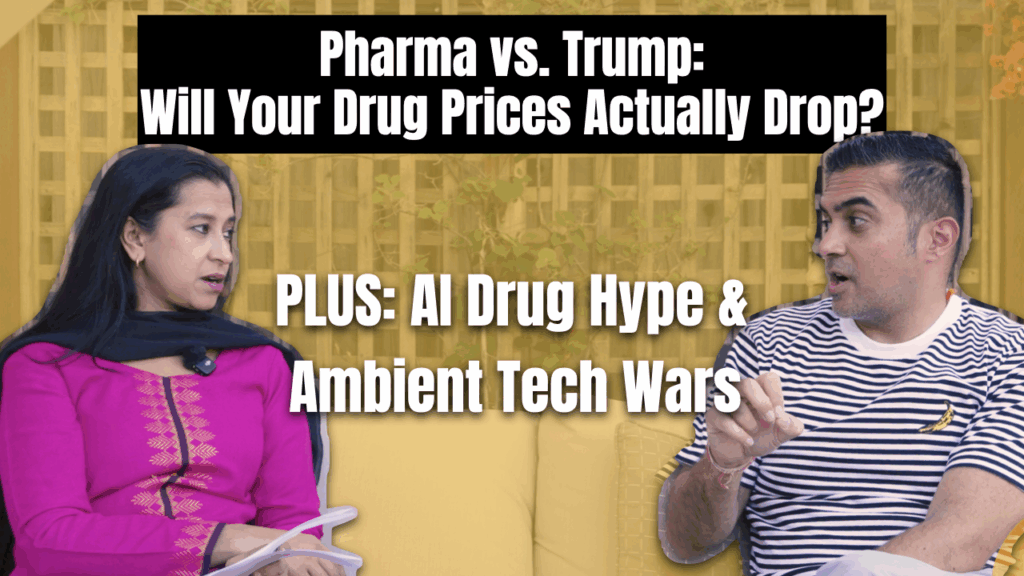
An exploration of the AI companies in healthcare, the drug price debate and the latest twist in the Trump Administration’s allegation that Tylenol is linked to autism were the hot topics on the latest episode of the Debunked Podcast hosted by Arundhati Parmar, editor-in-chief of MedCity News, and Samir Batra, managing partner of Health Innovation Pitch.
Part of the conversation focused on TrumpRx, a platform the Trump administration announced this summer that is being designed to reduce drug prices for Americans. So far, two drug makers have committed to support TrumpRx. Pfizer was the first and published an announcement at the end of September.
“Pfizer has voluntarily agreed to implement measures designed to ensure Americans receive comparable drug prices to those available in other developed countries and pricing newly launched medicines at parity with other key developed markets,” the company said in a press release, adding that “Pfizer will also participate in a direct purchasing platform, TrumpRx.gov, that will allow American patients to purchase medicines from Pfizer at a significant discount. The large majority of the company’s primary care treatments and some select specialty brands will be offered at savings that will range as high as 85% and on average 50%.” One caveat: “specific terms of the agreement remain confidential”.
AstraZeneca also committed to reducing prices on many of its drugs, as well as supporting domestic manufacturing.
Much of the conversation focused on the outlook for companies jockeying for position in the race to adopt AI in healthcare. Ambient AI and Abridge are major players that have raised millions to advance and grow their AI software applications. Nabla has grabbed attention for streamlining clinical documentation for electronic health records (EHRs). Nvidia is working with Eli Lilly on using AI to identify drug development targets and other applications. Arundhati and Samir also offered their outlook on AI. Samir said he expects a lot of consolidation across the sector in the next 12-18 months. He said he expects 70% of the smaller AI businesses, including startups, to either be absorbed by the larger players through M&A deals or fade away.
The conversation also touched on HHS and the drama over HHS Secretary Robert F Kennedy Jr’s allegations tying the active ingredient in Tylenol, acetaminophen, to autism before clarifying he has no sufficient evidence of a causal link. Texas Attorney General Ken Paxton recently filed a lawsuit against Johnson & Johnson, which owns the Tylenol brand.
Watch the full episode: