Alcohol use disorder kills more Americans than opioids or car crashes. Yet for decades, medicine ignored an FDA-approved pill that significantly reduces relapse risk and heavy-drinking days.
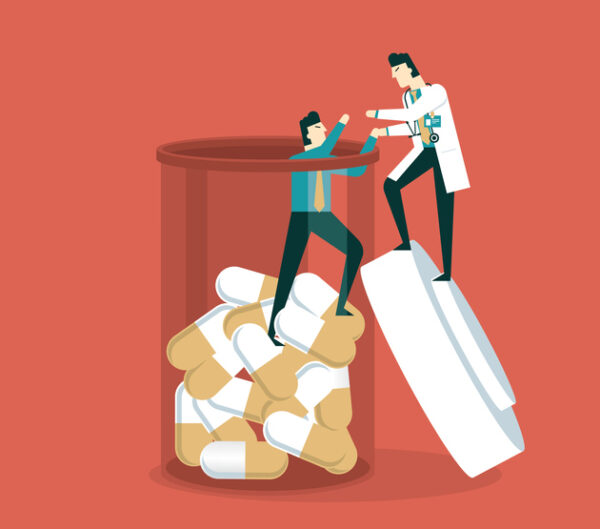
That pill, naltrexone, survived not because doctors prescribed it, but because patients and communities kept it alive.
Most medical innovations follow a familiar arc: scientists develop a drug, doctors prescribe it, patients’ lives improve. Naltrexone tells the opposite story.

Where Will AI Deployment Benefit Payers the Most?
We are taking a look at how health insurers are using AI, defining success, and managing cybersecurity risks. Give us your opinions by completing our brief, anonymous survey.
When the drug was rolled out in 1995, DuPont believed it had a breakthrough. Naltrexone reduced cravings, dulled alcohol’s “buzz,” and carried no risk of addiction.
By every measure, naltrexone should have been a major triumph. Instead, it flopped.
Not because it failed people — the data showed otherwise — but because the institutions charged with treating addiction refused to use it.
That paradox sits at the heart of Katie Herzog’s forthcoming book Drink Your Way Sober. She argues that breakthroughs often don’t begin in institutions at all. They start in communities that refuse to wait.


Closing the Quality-Affordability Gap in Workplace Mental Health
In an interview, Kyan Health Co-Founder and Chief Commercial Officer Konstantin Struck discussed how Kyan gives mid-market and enterprise employers access to premium workforce mental healthcare, at a price point that is affordable.
Naltrexone is her case in point.
Pharma’s great miscalculation
In 1995, DuPont assumed addiction physicians, treatment programs, and national leaders would embrace naltrexone. That strategy had worked for countless other drugs. But addiction medicine was different.
In the 1990s, recovery was defined by abstinence-only programs rooted in Alcoholics Anonymous. At the Philadelphia VA, where I ran the Alcohol Treatment Unit, counselors — many themselves in recovery — saw medication as heresy. “I got sober without a pill,” one told me, “why should my patients need one?”
Major programs like Hazelden and the Betty Ford Center dismissed it outright. Even ASAM physicians hesitated. Some doubted the effect size. Others feared it looked like “replacing one drug with another.”
DuPont poured millions into brochures, booths, and free samples. But by the late 1990s, executives stated they couldn’t give it away.
Communities refused to wait
Yet what failed in boardrooms found life in unlikely places.
In Arizona, a homeless shelter used direct observed therapy to give naltrexone nightly. People long written off as “hopeless alcoholics” were suddenly sober, working, and reuniting with families. In California, Judge Darrell Stevens ordered repeat DUI offenders to take naltrexone under supervision. The results were distinctly promising.
These efforts spread not because they were sanctioned from above, but because case managers, judges, and local communities took matters into their own hands.
From TED talks to telemedicine
If the 1990s were the era of rejection, the mid-2010s marked a turning point. In 2016, actress
Claudia Christian delivered a TEDx talk describing how “The Sinclair Method” — taking naltrexone before drinking —had freed her from alcohol dependence. Millions watched. For many, it was the first time they had ever heard the drug’s name.
Then came the pandemic. Telemedicine, once peripheral, suddenly became mainstream. For the first time, people in small towns and rural counties could log into a video visit and connect with a doctor willing to prescribe naltrexone. Barriers that had persisted for decades — geography, stigma, ignorance — collapsed almost overnight.
Viewers turned to Google, Facebook groups, and online forums for information. Karen Dion and Katie Lain, two women who successfully recovered through the use of naltrexone, built their own peer-support systems in the vacuum left by professionals. Others, like Steve Wagner, did the same with moderating Reddit subgroups and Discord channels. From these online communities, people traded dosing strategies, documented outcomes, and encouraged one another.
Together, TED talks, online communities, and telemedicine created what pharma never could: a bottom-up infrastructure for access.
The establishment’s blind spot
In any other field, ignoring an FDA-approved treatment with proven efficacy would be malpractice. Imagine cardiologists refusing to prescribe statins because they didn’t fit their philosophy. In addiction medicine, this became business as usual.
Programs blamed relapse on patient weakness, not on ineffective treatment models. Institutions were insulated from accountability, but at enormous cost.
A decade ago, a small fraction of Americans with alcohol use disorder received any medication at all — even though naltrexone and similar drugs can reduce relapse risk by up to 50 percent. Every untreated case is a preventable failure.
Why grassroots efforts succeeded
Communities had no investment in abstinence dogma or institutional turf. They weren’t defending revenue streams. They just wanted to stop drinking, avoid jail, and rebuild their lives.
And they were pragmatic. Shelters used supervised dosing. Courts paired the pill with accountability. Online groups offered daily encouragement. Telemedicine made it possible for someone in a remote town to get the same treatment once reserved for academic medical centers.
By adapting the drug to meet real-world needs instead of rejecting it for not fitting traditional standards, grassroots communities succeeded where glossy brochures and corporate campaigns failed.
A lesson for the future
As the first researcher to test naltrexone for alcohol use disorder, I assumed data would be enough. It wasn’t. The revolution came from below.
Herzog’s new book documents this pattern across medicine and society: institutions often resist, while communities innovate. Naltrexone’s story proves the point.
Today, the drug is finally recognized as a gold standard, with both oral and extended-release injections widely available. Importantly, surveys from addiction treatment programs and sales of the extended-release naltrexone (Vivitrol) show a nearly five-fold increase in real-world use over the past decade. Veterans Administration initiatives also expanded screening and medical management for unhealthy alcohol use, particularly in primary care settings.
Telemedicine programs have also seen a dramatic interest in the use of naltrexone. For example, Oar Health has now filled prescriptions for over 50,000 patients since its inception less than five years ago, and year-over-year growth of its online prescriptions has increased by (80%?). Despite this progress, most who could benefit still never hear about it. Most programs remain abstinence-only. Too many doctors still don’t prescribe it.
That is the unfinished business. Until evidence, not ideology, sets the standard of care, too many people who could benefit from naltrexone won’t hear about it.
Editor’s note: The author is an advisor to Oar Health and wrote the foreword to Katie Herzog’s book.
Author bio:
Dr. Joseph R Volpicelli, MD, PhD is Director of the Volpicelli Center for Addiction Treatment and a key clinical advisor to Oar Health. Dr. Volpicelli graduated from the University of Pennsylvania’s prestigious Medical Scientist Training Program. Through this program, he received both his doctorate of medicine and psychology. He also completed his medical residency at the University of Pennsylvania and a fellowship in Neuropsychopharmacology.
As a world-renowned scientist-clinician, Dr. Volpicelli’s research has led to many important discoveries in addiction treatment, notably, the use of naltrexone to treat alcohol dependence. Based on his early experimental research with an animal model of alcohol drinking, he designed and conducted the first clinical trial of naltrexone in the treatment of alcohol dependence. Based on the results of this research, the FDA approved the use of naltrexone to treat alcohol dependence, the first new medication to be FDA approved for this condition in nearly 50 years. Dr. Volpicelli’s research also led to the development of a psychosocial approach designed to improve treatment engagement and retention: The BRENDA Approach.
Photo: sorbetto, Getty Images