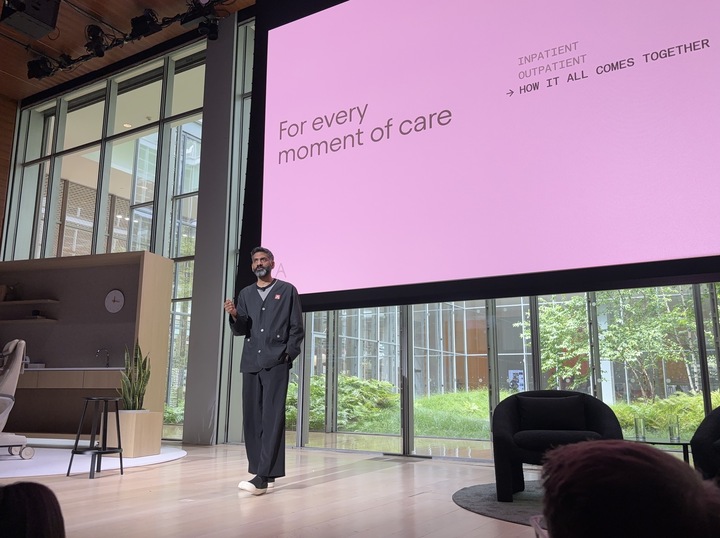
Clinical AI startup Abridge is one of the most well-funded health tech startups in the nation, having raised $830 million since its founding in 2018. On Thursday, the startup held an event in New York City to demonstrate how it’s been putting those funds to work, announcing several new partnerships and platform capabilities.
The company’s announcements signal a deliberate push beyond AI documentation into the broader infrastructure of how care is delivered and paid for. During his keynote address, CEO Shiv Rao said Abridge’s vision centers on shifting administrative work upstream, as well as using the clinical conversation as the connective layer between providers, payers and pharma companies.
“Our opportunity right now is to use AI to actually rethink the system, redesign the system. Can we compress workflows? Can we let agents attend the lunch-and-learn about compliant documentation and rely on that? Can we let AI figure out how to get all that clerical work done, so I can spend more time with my patients?” he asked.


Closing the Quality-Affordability Gap in Workplace Mental Health
In an interview, Kyan Health Co-Founder and Chief Commercial Officer Konstantin Struck discussed how Kyan gives mid-market and enterprise employers access to premium workforce mental healthcare, at a price point that is affordable.
Rao then detailed the new features and initiatives being rolled out to help actualize this audacious vision — below are the most notable updates he shared during the event.
A revamped clinical intelligence platform
Abridge unveiled its new-and-improved clinician intelligence platform, which seeks to support clinicians before, during and after every patient visit rather than just inside the exam room.
Before the appointment, the platform prepares clinicians with concise patient summaries pulled from the EHR, and during the encounter, it offers decision support and captures the conversation in more than 28 languages. Afterward, it generates clinical documentation, billing codes and lab orders for clinicians to review and send off.

Inside an Automated Healthcare Practice: Redesigning Care Around People, Not Paperwork
By reducing administrative burden and redesigning workflows around human needs, it creates space for what matters most: connection between clinicians and patients.
Rao said more than 300 health systems will have gone live with the new platform in the next 12 months, adding that Northwestern Medicine is the latest health system to adopt the platform enterprise-wide.
Teaming up with Nvidia
Most clinical AI today starts with a general-purpose model that then learns medicine — but Abridge and AI powerhouse Nvidia debuted a partnership that’s taking a different approach. They’re working together to build what the companies say is the first AI foundation model designed specifically for clinical conversations.
The model aims to apply clinical knowledge at every stage of AI training so that it can reason like a clinician rather than mimicking one, explained Kimberly Powell, vice president of healthcare at Nvidia. She said generic AI models aren’t sufficient for clinical workflows.
“Imagine you try to throw a generic AI model into healthcare — it doesn’t understand the clinical language, it doesn’t have the clinical reasoning, and it surely doesn’t have the domain expertise of all of the long-running tasks and interconnected work that has to happen for workflows to be completely transformed,” Powell remarked during an on-stage conversation with Rao.
Investment from Eli Lilly
Abridge announced a strategic investment from pharma giant Eli Lilly, though the financial terms were not disclosed.
This investment is focused on a specific use case: tapping Abridge’s platform to help identify patients who may be eligible for clinical trials directly at the point of care. Abridge’s life sciences module can surface trial eligibility based on the clinical conversation, and Lilly is betting that this could provide the kind of patient-facing pipeline it needs to accelerate enrollment for new treatments.
Seeking to be a bridge — get it? — between payers and providers
Both Aetna and Cigna executives sat onstage with health system leaders to discuss the oftentimes adversarial relationship between payers and providers.
Rao said that going forward, he hopes Abridge’s technology can be somewhat of a mediator. All three sides agreed — if clinical documentation is grounded in the actual conversation at the moment care is delivered, providers and payers can stop relitigating what happened after the fact and start agreeing on it in real time.
It’s an appealing vision — but getting rivals to share data and play nice is, of course, easier said than done.
Photo: Katie Adams, MedCity News