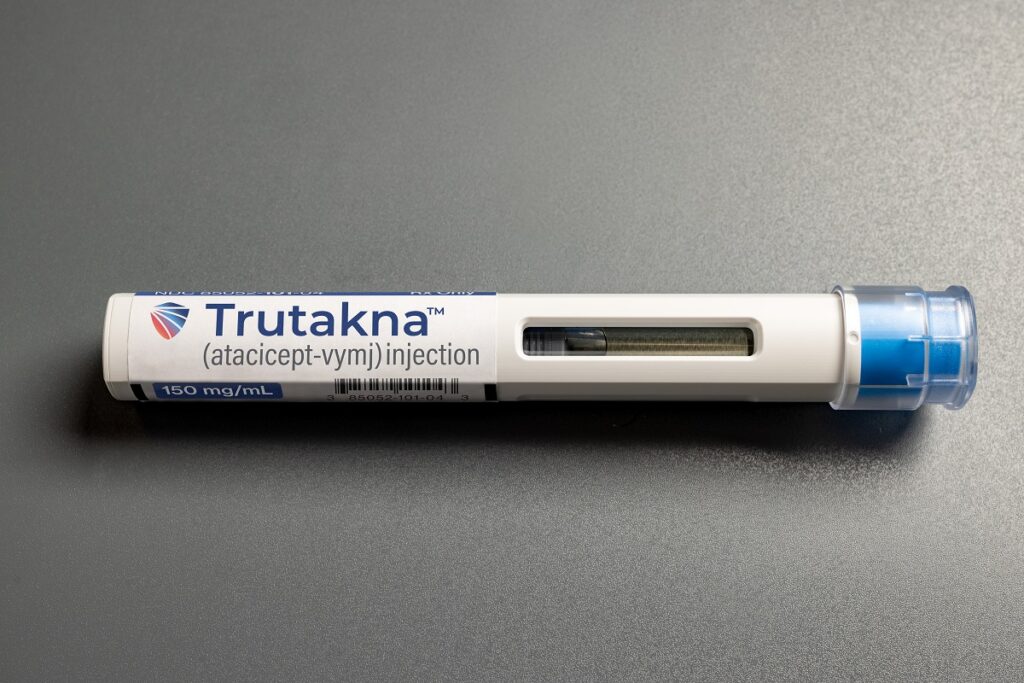
A rare autoimmune disease affecting the kidneys has a new FDA approved treatment, a first-in-class Vera Therapeutics drug whose approach of hitting two targets sets it apart from the medicines already available for treating this life-threatening condition.
The Tuesday regulatory decision covers the treatment of adults with primary immunoglobulin A nephropathy (IgAN) who are at risk of disease progression. The drug, atacicept, is the first commercial product for Brisbane, California-based Vera. This once-weekly injection will reach the market under the brand name Trutakna.
IgAN develops as the body produces antibodies that build up in the kidneys, causing inflammation and organ damage. The decline in kidney function can progress to end-stage renal disease. For decades, IgAN was treated with blood pressure drugs and inflammation-reducing corticosteroids that were used to slow disease progression. While these older medicines became the IgAN standard of care, they were never intended for this disease and were technically used off-label. In recent years, research has produced new therapies that take targeted approaches to the kidney disorder.


Top 7 Modern AI-Powered EAP Providers for Global Workforces in 2026
Discover the top AI-powered EAP providers for 2026. Compare platforms like Kyan Health and Spring Health on triage speed, global reach, and clinical quality to transform workforce wellbeing.
Vera’s Trutakna is designed to block B-cell activating factor (BAFF) and A proliferation-inducing ligand (APRIL), proteins that stimulate the production of autoantibodies underlying some autoimmune diseases, including IgAN. Under Merck KGaA, this fusion protein reached mid-stage clinical testing in several autoimmune disorders. Vera licensed global rights to the molecule in 2020, when there were not yet any drugs developed and approved specifically for treating IgAN.
Vera advanced Trutakna to a placebo-controlled Phase 3 clinical trial in IgAN. The main goal was to show the change in proteinuria, levels of protein in the urine that indicate kidney disease. Data at nine months showed patients in the Trutakna arm achieved an average 42% reduction in proteinuria relative to the placebo group, results that were statistically significant and clinically meaningful. The study drug was generally well tolerated, with the most common adverse reactions reported to be infections and local injection site reactions. Detailed Phase 3 results were published last November in the New England Journal of Medicine.
Measuring the change in proteinuria is a surrogate endpoint that supported accelerated approval for Trutakna. It’s the same endpoint used to support accelerated FDA approvals of other IgAN therapies. Calliditas Therapeutics’ Tarpeyo, a corticosteroid, was first, winning its initial FDA approval in 2021. The targeted therapies that have since won speedy FDA nods include Filspari from Travere Therapeutics and Fabhalta and Vanrafia from Novartis.
The commercialized therapy closest to Trutakna is Otsuka’s Voyxact, which received its accelerated FDA approval last November. Voyxact is a monoclonal antibody designed to block APRIL. It’s administered as an injection once a month. Vera set a $425,000 annual list price for Trutakna, which is a premium to Voyxact’s $390,000 list price and reflects the biotech’s belief that blocking two targets is superior to just one. But a more direct competitor is on the way. Vertex Pharmaceuticals’ povetacicept, a fusion protein designed to block both BAFF and APRIL, is under FDA review in IgAN with a Nov. 30 target date for a regulatory decision. FDA approval of povetacicept would introduce new competition and pricing pressure on the new Vera product. Povetacicept came from Vertex’s 2024 acquisition of Alpine Immune Sciences.


From Blind Spots to Better Outcomes: How SNF Data Transparency Strengthens LTSS
What if health plans could identify member decline before an avoidable hospitalization occurs? Real-time clinical visibility into long-stay SNF members uncovers risk earlier and drives better outcomes.
In a Wednesday research note, William Blair analyst Myles Minter said Trutakna’s direct competition for market share will be Otsuka’s IgAN drug. While the drugs were not tested head to head, Minter noted that Trutakna’s results suggest higher rates of injection site reactions. He added that while Voyxact has the advantage of being first to the market, there’s ongoing investor debate about whether the lower volume of a Trutakna injection will give it an edge, even if it has a higher incidence of injection site reactions.
“Ultimately, we still believe the profiles of Voyxact and Trutakna leave room for better follow-on IgAN therapies with improved efficacy and patient convenience, including Vertex’s dual BAFF/APRIL inhibitor povetacicept, and the half-life extended APRIL antibodies from Jade Bio (JADE101) and Climb Bio (CLYM116),” Minter wrote.
IgAN is the first of potentially several autoimmune diseases addressed by Trutakna. Vera has ongoing mid-stage studies in primary membranous nephropathy, focal segmental glomerulosclerosis, and minimal change disease — all kidney disorders. In an investor presentation, Vera said dual inhibition of BAFF and APRIL represents a $10 billion market opportunity spanning at least 11 autoimmune diseases, including some outside of nephrology.
An accelerated FDA approval requires a company to provide additional clinical data to verify safety and clinical benefit. An ongoing placebo-controlled Phase 3 clinical trial will serve as this confirmatory study. The main goal is showing change in estimated glomerular filtration rate (eFGR), a measure of kidney function. Vera said results from this study are expected later in the current quarter.
Photo by Vera Therapeutics