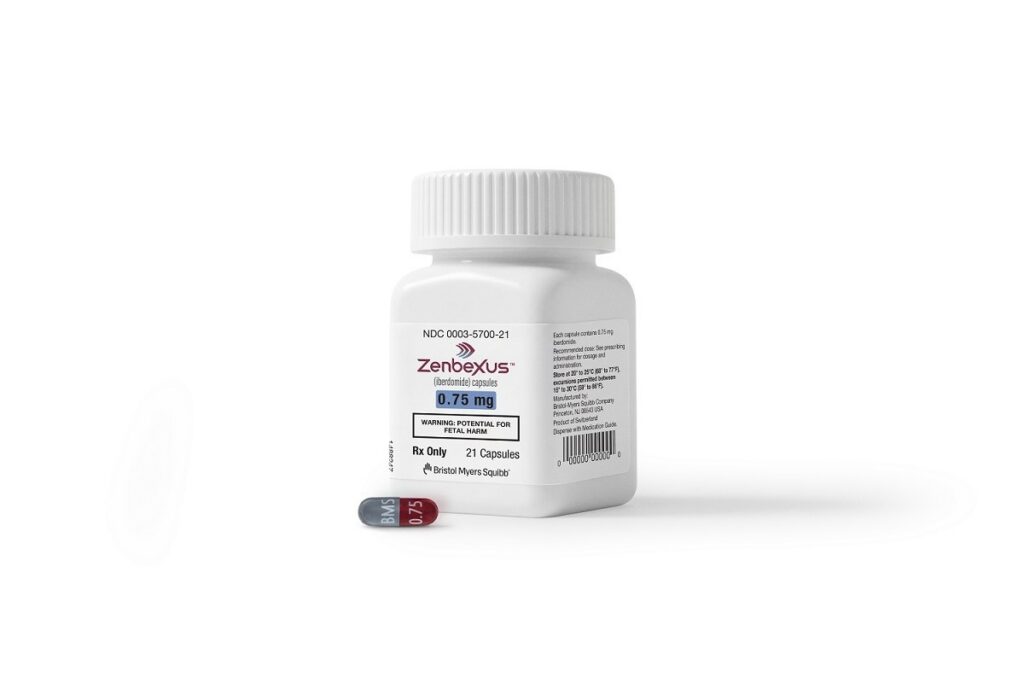
A Bristol Myers Squibb drug has received accelerated FDA approval for treating multiple myeloma, a decision that introduces a new class of medicines and establishes a new regulatory benchmark for evaluating therapies for this type of blood cancer.
The Thursday approval of the drug, iberdomide, covers the treatment of adults who have received at least one prior line of therapy for multiple myeloma. BMS’s once-daily capsule is indicated for use alongside Johnson & Johnson’s Darzalex Faspro and dexamethasone, a standard multiple myeloma drug combination. BMS will commercialize its new multiple myeloma therapy under the brand name Zenbexus.
Zenbexus belongs to an emerging class of medicines called targeted protein degraders, which work by leveraging a cell’s built-in system for disposing of old or damaged proteins as a way to eliminate disease-driving proteins. The BMS small molecule binds to cereblon, a component of a particular enzyme that attaches a molecular tag to a protein, marking that protein for disposal. Zenbexus is the first FDA-approved cereblon-modulating (CELMoD) protein degrader approved by the FDA.


Automation Didn’t Dehumanize Care. Bad Systems Did.
We have the opportunity to design systems that give people greater capacity for the work where human presence matters most: listening, understanding, reassuring, deciding, and caring.
BMS’s regulatory submission for Zenbexus was based on results from a Phase 3 test that enrolled 939 patients with relapsed or refractory multiple myeloma. The study drug and the combination of Darzalex and dexamethasone were compared to another standard multiple myeloma drug combination of Darzalex, Velcade, and dexamethasone.
At a median follow-up of 16 months, the study drug cohort showed 41% of patients achieved minimal residual disease (MRD)-negative complete response, meaning cancer cell levels were reduced to a point where they could not be detected by ultra-sensitive tests. In the comparator arm, 21% of patients achieved this mark. MRD-negative complete response is one of two main goals for the study, and BMS said achieving it is considered indicative of progression-free survival, the other main goal. The study is continuing to assess this endpoint.
The approval announcement marks the first public disclosure of the MRD-negative complete response data from Zenbexus’s Phase 3 trial. BMS added that Zenbexus is the first drug approved based on this measure. Dr. Sagar Lonial, lead investigator in the drug’s Phase 3 study and chief medical officer of the Winship Cancer Institute of Emory University, said in BMS’s approval announcement that the regulatory decision marks the arrival of a new drug class with the opportunity to make a meaningful difference for patients.
“The strong results observed with the CELMoD-based combination within a familiar triplet approach creates the potential for a new treatment foundation in multiple myeloma,” he said.

The Hidden Administrative Tasks Draining Small Practices
Small practices play a critical role in healthcare delivery, but they cannot continue to absorb ever-increasing administrative demands without consequences.
The trial results showed 7.8% of patients discontinued the study drug combination due to adverse reactions. These risks include life threatening infections and severe neutropenia, low levels of a type of white blood cell called a neutrophil. The most common adverse reactions included respiratory tract infection, fatigue, muscle pain, pneumonia, and diarrhea. Adverse reactions that were ultimately fatal were reported in 10 patients.
Zenbexus’s mechanism of action is similar to that of thalidomide, a morning sickness drug that was approved in some countries (but not the U.S.) in the 1950s. Thalidomide was withdrawn from the market in 1961 after it was linked to severe birth defects and miscarriages. The Zenbexus label carries a black box warning stating the drug is contraindicated for pregnant patients. The warning also flags the risk of cardiovascular complications and advises clinicians to monitor for these problems and start anticoagulants as appropriate.
Zenbexus was originally discovered by Celgene, which BMS acquired in 2019. The acquisition brought other CELMoDs, including mezigdomide, which is under FDA review with a regulatory decision in multiple myeloma expected in May 2027. BMS’s presence in this blood cancer is anchored by the blockbuster products Pomalyst and Revlimid, both immunomodulating drugs that target cereblon. But CELMoDs offer tighter binding along with rapid degradation of the target. As generic competition erodes Pomalyst and Revlimid revenue, BMS is turning to CELMoDs as a new way to grow in multiple myeloma. Ongoing clinical trials are testing iberdomide and mezigdomide head to head against the two legacy BMS multiple myeloma drugs.
In a Friday research note, William Blair analyst Matt Phipps said Zenbexus’s near-doubling of improvement in MRD-negative complete response rate is highly encouraging. He added that the progression-free survival data expected later this year and additional data from an ongoing Phase 3 test as a maintenance treatment will help clarify the commercial positioning of this new BMS multiple myeloma drug.
Phipps said BMS set a list price of $29,500 per 28-day treatment cycle, which is higher than William Blair’s previous pricing estimate. The bank forecasts the drug’s annual U.S. sales will top $1 billion in 2031.
Photo by Bristol Myers Squibb