Let’s put it mildly — insurance companies are not exactly well-liked by the average American for a variety of reasons, not the least of which is a general lack of trust.
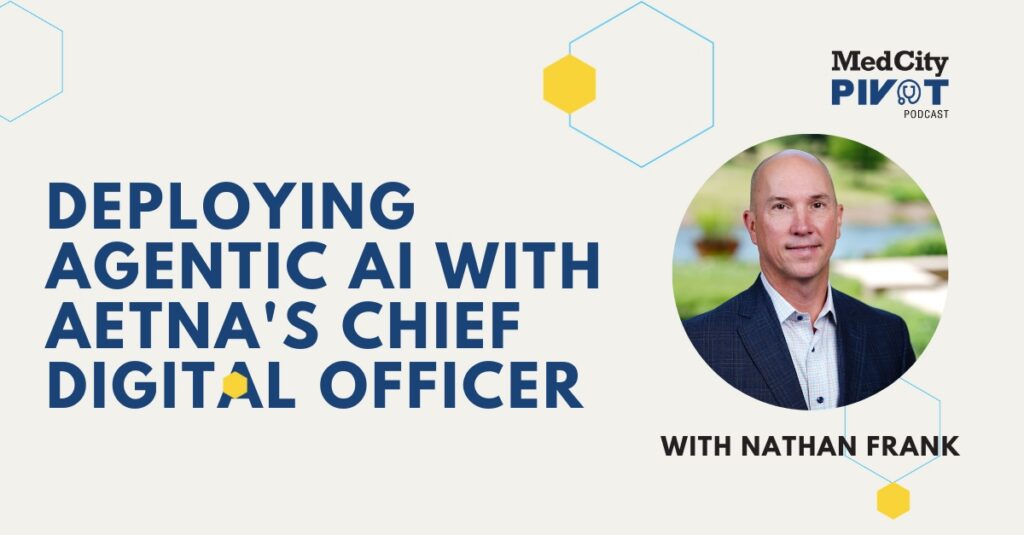
So in this context, how does Aetna, the insurance arm of retail health company CVS Health, responsibly adopt and deploy artificial intelligence? In this episode of the MedCity Pivot Podcast, Nathan Frank, chief digital and technology officer at CVS Health Aetna, says emphatically that no AI is used in automatic denials and then paints a picture of what is possible in the future: an AI agent deployed on the Aetna app that can help patients manage their health.
Here’s a video of our conversation:

Automation Didn’t Dehumanize Care. Bad Systems Did.
We have the opportunity to design systems that give people greater capacity for the work where human presence matters most: listening, understanding, reassuring, deciding, and caring.
Here’s the audio version:


The Healthcare Payments Industry Faces a Perception Challenge
Healthcare payments are no longer about transactions. It’s about controlling the revenue cycle. And increasingly, that control is not sitting with ISOs.
And here’s an AI-generated transcript
Arundhati Parmar: Hello, and welcome to MedCity’s Pivot podcast. Insurance companies are rapidly adopting machine learning and agentic AI to help reduce the administrative burden on physicians, and perhaps most importantly, to improve the member experience. How is Aetna achieving all of this as it deploys its agents across different workflows? Today, I’m talking to Nathan Frank, Chief Digital and Technology Officer at Aetna, the insurance business of CVS Health, who will shed light on this.
Arundhati Parmar: Hello and welcome, Nathan, to MedCity’s Pivot podcast.
Nathan Frank: Thank you. I’m excited to be here today. I’m excited to, uh, spend some time with you talking about everything healthcare technology.
Arundhati Parmar: Perfect. So as you know, the theme of this episode is sort of agentic AI, which is hard to get away from AI these days. So let’s just, you know, take the bull by the horns. Um—I just wanted to get a sense of how, um, Aetna is using agentic AI beyond sort of customer service phone calls, where voices has become such a huge, huge part. So agentic AI without voice, with voice, how are you using it? Um, where is, uh, there most value?
Nathan Frank: Yeah. ju—let me just start by, by acknowledging that healthcare is very complex. And there’s, uh, lots of opportunity, obviously, uh, in the US healthcare system. And where we believe that we, uh, have the right assets and the right technology and the right people to, to transform healthcare through technology. But I wanna start with where, where do we start at, as Aetna? Um, we look at those friction points in the process first, and we then, um, try to take those friction points out. And where we believe that agentic AI and AI and technology can really drive that transformation is the human experience combined with AI to actually deliver better outcomes.
And so, you know, we have tons of examples, um, where we’re using AI, uh, to reduce that friction. Um, we’re the only industry that assigns healthcare to consumers, if you just think about that for a moment. In no other industry do you, do you walk away from a visit and have homework. So, um, you’re right, there’s a lot of, uh, there’s a lot of use cases today that we have in production where we’re using, you know, voice, maybe that’s ambient listening. Um, I think one of the best examples we have combines some of that voice and ambient listening, uh, with our clinic—our clinicians, our nurses.
So we have over 12,000 nurses that, uh, work every day in our care management organization. And if you think about someone who was recently diagnosed with cancer, and we know that we have tons of data across many of our, our different platforms and, you know, providers and, and different EHRs. We use AI to pull all that information together, uh, from various sources. We have, uh, AI agents that do that, and they prepare those clinical notes for that, for that visit. That allows our, uh, clinicians, our nurses, who wanted to be in this profession, not to, you know, do a bunch of homework, um, and paperwork, to spend more time with that patient, to help them make sure they’re getting the right care, that they have, you know, the right team, that they have transportation to and back from, you know, that physician visit.
And then, of course, we’re using ambient listening during the call that takes all that information, summarizes it, and enables better outcomes, uh, in future visits or future conversations. That one, as an example, has given our clinicians 90 minutes back per day. And so this isn’t about reducing, um, you know, roles. This is about allowing us to spend more time with patients. I think that, to me, is a great example of we’re combining some of that ambient listening, but really using AI agents to go and pull out that information and, and really provide a better experience for, for, for our members.
Arundhati Parmar: So one of the key questions about AI is the issue of trust, right? How is this information being generated? What information is being left out? What information is deemed relevant by the AI algorithms, right? Is it hallucinating? So how do you approach the issue of trust? How often are you looking at these algorithms to make sure that there isn’t model drift or, you know, things like that?
Nathan Frank: Yeah. Absolutely. Uh, so you, you’re, you’re spot on. Uh, trust is, in healthcare is, uh, is paramount. And, you know, we believe that we’re in the best position to build that trust. We, um, we believe in providing the best consumer experience, and I, I tell this story all the time. You know, when I started this role three or four years ago, um, lots of my peers in the industry, I was trying to understand where we were making investments, and they were talking about cloud and talking about modernizing their platforms. And when, when I answered the question, it was around the member experience. So if you really do put the, the member or the patient at the center of that, you’re naturally building trust because you’re building the entire ecosystem around that experience.
And so we believe in transparency. Uh, how do you build trust? When you’re working with someone, you want them to know where AI is being used, and you want them to understand how it works in the process. So whether that’s through your IVR or your outbound calling or, you know, during the calls, we’re letting them know that we’re using the ambient listening to, to actually help with the experience. Uh, we also have a deep history of AI and machine learning and analytics at Aetna. Uh, we’ve been doing this for, you know, ten plus years. We have three thousand data scientists who have been hard at work on this. Um, we have always been sort of an early adopter, uh, in this space.
Um, if you think about the early days, it was more around using machine learning for fraud, waste, and abuse, and some of those less consumer-facing. Uh, but we also, um, if you think about where we sit in the CVS umbrella, CVS is one of the most trusted, you know, healthcare brands in the country. Uh, so I think we’re in a unique position there, uh, to make sure that, you know, we’re, we’re being that trusted partner. And, um, you know, our team works every day to make sure that the data that we’re using is used appropriately. We also do something, I think, um, something unique, um, in terms of our product model. Uh, we were—we’ve been a, a product-oriented, uh, organization for, for a number of years.
We have actually clinicians sitting in small pods with our UX and our, uh, customer experience, uh, designers and our software engineers. And those small pods of people are creating amazing experiences, but they’re also getting that expertise from the frontline clinicians. So we built in very early on the ability to help us every single interaction. Was that successful? What could change? And so we have that coming in from the clinicians and then all of the right responsible use guardrails, uh, you know, on the back end.
Arundhati Parmar: So you mentioned CVS Health being a trusted brand, and I don’t disagree with that. But the, the vertical that you work under, Aetna, and I don’t mean Aetna per se, but broadly, insurance companies are rev—you know, I, I almost wanna say insurance companies are hated. Um, Aetna is—doesn’t receive the same level of ire that UnitedHealthcare does. But when you look at consumer sentiment on insurance companies, it is not positive. So you’re starting from a deficit, and you’re bringing in a technology that the average person may not understand and is in—is generally afraid of. So you have a, you know, steep mountain to climb. So I’m wondering, uh, if you can give examples of how, um, how you’re approaching that.
I mean, are you aware? Because the reason I ask this is, I, I recently went to UnitedHealthcare. They had invited journalists in, and it seemed to me that they’re, they were projecting an image of they are so wonderful, and they are doing such good things, and people just don’t understand it. And so if we let all these journalists in and we let influencers in, that they will understand how, how dedicated we are, how compassionate we are. And I just think that that—You know, I don’t wanna say this ship has sailed on that, but it is just fundamentally misunderstanding where consumer sentiment lies when it comes to insurance companies. So just wanted you to address that.
Nathan Frank: Yeah, I don’t wanna comment on, uh, UnitedHealthcare. Uh, obviously they’re, uh, they’re a, you know, a competitor. Uh, but what, what I will say is, um, Aetna’s 170-plus-year-old company. We have a deep history, uh, in, in healthcare, and we have amazing clinicians and, and colleagues that work every single day, and we’ve spent, um, we’ve spent a lot of time and effort in our history differentiating ourselves with that member and clinical experience. And, you know, we think that, again, healthcare is really complex. If we can provide that human plus technology interaction, if we can, you know, help build that trust, you know, we will be the most trusted, you know, brand in healthcare. And, you know, we have, uh, the best, you know, app experience, uh, out of all the payers. We have the best web experience. And in each one of those interactions, I think you’re building the trust, and, you know, that’s the goal of, of our organization and, and the colleagues that work with us.
Arundhati Parmar: You also talk about, you talked about friction point in the beginning, and I think, um, the payer-provider push and pull has really come, come to the fore. And I’ve heard a lot of, um, angst over the payer AI versus the provider AI and, you know, and then this battle of AIs are happening. You have this agent, you have that agent. Um, where does the human being fit into all of this? And if, if AI is constantly flagging certain things for denial, for automatic denial because they don’t, you know, a member may not have a certain coverage, uh, in their, um, policy, w- where does the, um… How should I put it? Could it not create even more administrative burden because the technology’s so fast at maybe denying certain things?
Nathan Frank: So just to, to, before we get into the, to the answer here—you know, at, at Aetna and, and CVS Health, we, we don’t use AI to deny, uh, care. It’s, uh, that is deeply, you know, rooted in, in our, in our, uh, policies and in our strategy. So just to take that off the table, we don’t use AI to do, uh, any denials of care. So if, uh, if we’ll use AI for auto approvals, we’ll use it to help with administrative burden, we’ll use it to help with the experience. Um, but we do have our clinicians, you know, re- review cases that, uh, might have missing information or things like that.
You know, it’s interesting. We do, uh, an annual, uh, provider survey through Aetna and, uh, you know, what, what we’re seeing and what we’re hearing from the providers is that, you know, almost 84% of those providers believe that the advances in technology like AI and agentic AI will, will lead to better outcomes. So we know that the industry thinks this will be helpful to the experience. Um, and so where we come in, and I think we’ve done something unique over the past, uh, uh, two years. Like I said, when I started here, we were really focused on member experience and how do we really think about the consumer and at the heart of that.
Along the way, you know, we, we found ourselves talking to providers and, and members and patients, and the providers play a key role in the satisfaction of a member. If you as a patient or, or me as a consumer in healthcare, uh, go visit my, my provider and they’re not having a good experience with, you know, their health plan—it’s naturally gonna, gonna kind of cloud the, the visit. And so we, uh, have a very close relationship with, uh, our provider, uh, network. Uh, we actually, um, had our first annual, uh, Aetna provider forum, uh, last year where we brought in, um, a number of providers and very transparent in where we’re going with our strategy around interoperability, clinical data exchange.
How do we actually not have agent to agents, uh, to your point, going back and forth? How do we make this more seamless real-time experiences? And—Overwhelmingly, the, the group said, “Hey, this is really the first, uh, conversation of this type that we’ve had in the industry,” and it’s led to a lot of, uh, partnerships and a lot of, uh, innovative thinking and how do we connect and how do we have a, a better relationship in terms of, of sharing that data. I think that’s really the next, uh, you know, transformation for the industry. If you think about, you know, prior authorizations or clinical data exchange or claim status, you know, all of these things, they can be done, you know, have real-time information exchange.
Now, there has to be a two-way street there, and so we have, you know, the APIs and we have that connectivity, um, that we think is, you know, best in industry. And now it’s, you know, helping the providers, whether it’s through their EHR that they use or, you know, a direct connection to them to, to make that experience better for our members, you know, and their patients.
Arundhati Parmar: Let’s switch gears a little bit. MedCity News has a lot of, uh, writes a lot of, uh, lot about startups that are developing the next most interesting technology, and obviously there’s a glut of, uh, AI companies in healthcare now. How do you evaluate technologies? If a startup wants to work with you, what would be the best way to reach out?
Nathan Frank: Yeah. That’s, uh… You are right. There are tons of startups out there. Uh, and, and there’s some amazing innovation in healthcare. And, uh… But there’s also, there’s a lot to, to sort through. Um, if I told you how mu—There’s a lot of nonsense. Yeah… I’m sorry to interrupt, but there’s a lot of… Because the barrier to entry has become so low, you have companies that probably have zero experience in healthcare touting the next greatest tool, right?
Nathan Frank: That’s right. Couple of things. Uh, we have a CVS Health, uh, Ventures, uh, organization that does an amazing job in… We’ve been recognized in the industry for, for the work there. Uh, they are on the forefront of, uh, these, you know, startups and where the investments are going. So they are a great, um, uh, kind of funnel for, for, uh, innovation that comes in. And there’s lots of times that they bring amazing companies to us with amazing leadership teams, and then we decide if that’s the right fit for us in terms of do we build versus buy? Do we have something that we’d wanna, you know, uh, invest in and, and design our own product? Uh, that, that first and foremost is, is a great funnel.
Um, second, uh—You know, we have great relationships in, in the industry and, you know, we’re able to go out there and whether we’re investing in these startups or, um, you know, they’re coming through, you know, various forums and, and, uh, other, um, you know, other, other ways that we go out and, and take a look at them. What I find is they can have amazing ideas and amazing, you know, uh, products, but do they have the healthcare experience? And do they have the data? And do they have the interoperability to, to make this work? And so, uh, we do do a lot of test and learn opportunities with, um, the smaller startups, uh, and some of the bigger ones. And, uh, we have a, a structured way that we ensure that we’re, you know, doing the right, uh, bake offs. And, uh, um, we’ll actually have a couple in production, uh, at any given time to make sure that we’re doing sort of that AB testing. And you know this is moving so fast. Um, you know that some will, uh, some will, will make it through and, and some won’t.
Arundhati Parmar: Is there any particular technology that you’ve seen that you feel really excited about when it comes to AI or even agentic AI?
Nathan Frank: Yeah. I, I … You know, everything was about the, the frontier AI companies, and we, you know, we, we deal with all of them. I do think that, you know, the ability for us to, um, think about what model is best, and then how do you manage the cost of that? What, what, what I think, you know, all of us are struggling a little bit is, you know, we have the frontier AI companies with amazing technologies attempting to go out there and, and monetize now the investments they’ve made. And, you know, what we’re finding is you have to think about the cost in healthcare. We all wanna, you know, make sure that, that we’re managing that appropriately. So, you know, how do you use, you know, some of the, um, maybe lower cost models to do work that, you know, the higher cost models used to do?
And, uh, you know, to me, I think you’re gonna see a lot more of how do you route, uh, the workflows across to the right models, um, in the right use case, which adds another layer of complexity on, on how you’re doing all this. I also, you know, and, and I know we talked about voice, you know, inbound and ambient listening and all of those things, but, um, you know, what, what I’d like, like to see is, you know, actually AI agents out there doing work on behalf of you as the consumer. Right? We know that appointment scheduling is, is challenging. You’re gonna have to make the call. You’re gonna have to get, you know, someone on the phone with the provider. You’re gonna have to go through the EHR or their front end.
If we can take all that homework from you, and like I said in the beginning, we’re the only industry that assigns you that. If you need to go see a specialist, if you need to go see your primary care physician, it should be as easy as going into our app, using our AI, you know, uh, scheduler—selecting the day and times you think you’re gonna be available, and let the AI agent go do that matching for you, right? And whether that’s the AI agent actually doing the outbound calls or it’s the AI agent choosing to do that, um, bidirectional data exchange because we have it set up with a provider, you shouldn’t have to see that as a consumer. You should know that you trust us, you trust the AI agent, and then they’re gonna go do the homework to schedule that appointment for you.
Arundhati Parmar: How far away do you think, uh, we are from average, you know, people like me having an AI agent that talks to CVS’s AI agent and schedules call and things, schedules an appointment, and the calendar, uh, I mean, the appointment just shows up on my calendar?
Nathan Frank: We actually have that in production today. Um, we released, uh, an early version a couple of months ago, and now we’re gonna start to scale that. But I think a fully AI autonomous agent that helps you manage the, your healthcare—uh, that is something that, uh, we’re working on at CVS Health, and you’re gonna have that in your hands, uh, in the next year.
Arundhati Parmar: So wait, if I’m a CVS Health member, I will have an AI agent dedicated to my care?
Nathan Frank: Mm-hmm.
Arundhati Parmar: Where I don’t have to prompt it to do anything, or—
Nathan Frank: Well, you’re gonna have to interface with it either through voice—or, uh, or some level of prompting. But, uh, that agent’s gonna know about you. It’s gonna have your, not just your, you know, healthcare from a payer perspective, but it’s gonna understand who you are, your preferences. You’re gonna be able to load, you know, your medical records. And, you know, I think that’s where the future is. I will say, again, we went, we talked about trust earlier. We, we wanna be that trusted healthcare brand, right? We want to be transparent in where we’re using AI because we see the future of, of healthcare, and we know that members are going to naturally gravitate to the healthcare companies that they trust, who have the, the best combination of, uh, AI humans and, you know, in the CVS Health, you know, scenario, um, you know, physical presence as well.
Arundhati Parmar: You know, you paint a very tantalizing future, but I feel not just as a journalist where I’m designed to be skeptical, but, um, even as an observer of the healthcare system, uh, we are building a lot of amazing tools on top of very siloed systems that have structural issues. For an AI agent, AI healthcare agent for every person, everything underneath needs to be interoperable A+++ to get to the point where that agent has an entire view of the person’s health system. How do we build that on, on top of structures that are pretty siloed, even though we’ve made progress with HL7, with, you know, all these different, uh, interoperability measures that both the government and companies are making?
Nathan Frank: Um, so if you think about the, the history here of healthcare in America, you’re right. There’s lots of legacy systems. But I’d say that about, you know, lots of industries. If you think about finance and, and others, everyone has to deal with the legacy technology that’s been out there over time. And I think the amazing thing about AI and agentic AI is that it does provide the ability to either help you upgrade and help you transform, right? Now, especially with the advancements in AI coding and the, and the ability to, to use AI to actually translate, transform, and rebuild—you know, that’s one aspect. But there’s also, um, it’s also a necessity. You know, some of these platforms are built and designed specifically, claims processing as an example, right? We process over 500 million claims a year. Uh, I, I don’t know that AI’s gonna come in and do claim processing better, high transaction volume.
But when you have multiple systems and multiple records, and you have to traverse those and pull data out, AI is the perfect solution for that. And I think over time you’re gonna see, uh… And, and I’m, I’m, um, I’m not a believer in, in the software apocalypse. I do not think that AI is gonna replace all enterprise software. Uh, I believe that it’s gonna augment it. It’s gonna help us, uh, transform it, and it’s gonna help accelerate the modernization, but it’s not gonna replace, uh, every enterprise software out there in, in, in the world. I, I just don’t see that in the near term.
Arundhati Parmar: Well, on that hopeful note, um, Nathan, thank you so much for spending some time with us today.
Nathan Frank: Awesome. It was great. It was nice meeting you. Thank you so much.