
Across the United States, Medicaid and Medicare fraud cases are surfacing with increasing frequency — and scale. From improper billing and undocumented services to upcoding and duplicate claims, these cases span federal programs and state-administered Medicaid plans. Once perceived as isolated misconduct, these cases are now being exposed as a systemic challenge, revealing vulnerabilities in reimbursement oversight that affect payers, regulators, and ultimately taxpayers.
Material leakage tied to fraud, waste, and abuse (FWA) are drawing heightened regulatory scrutiny from CMS, state agencies, and oversight bodies. The focus is shifting beyond identifying suspicious claims to demonstrating measurable recovery outcomes, faster turnaround times, and defensible audit processes.
Nowhere is the pressure more acute than in California. Multiple, recent $100M+ Medi-Cal fraud cases (pharmacy + hospice) highlight significant gaps in reimbursement oversight and recovery — especially as state spending is projected to grow at twice the national average. Medi-Cal plans face mounting exposure as volume, complexity, and regulatory expectations rise in parallel. Plans will be under increasing pressure to respond quickly.


From Blind Spots to Better Outcomes: How SNF Data Transparency Strengthens LTSS
What if health plans could identify member decline before an avoidable hospitalization occurs? Real-time clinical visibility into long-stay SNF members uncovers risk earlier and drives better outcomes.
But scrutiny is nationwide, and the pace of investigation has outstripped many states’ ability to respond. Gaps in reimbursement oversight and recovery will only widen, unless plans modernize how they detect, investigate, and recoup improper payments. Organizations that respond quickly will be positioned to manage the financial and regulatory headwinds.
Operational shifts for plans nationwide
The converging of financial pressure and regulatory and enforcement expectations have resulted in three shifts to the operating environment for health plans nationwide, changing how payers are expected to manage risk, accountability, and payment integrity.
1) Financial leakage is becoming material at scale – Material financial leakage is now a structural issue across Medicaid and Medicare, not an outlier tied to a single state. Medicare and Medicaid fraud currently results in approximately $6-7 billion per year in confirmed losses and prevented payments, with enforcement agencies identifying over $14.6 billion annually in active fraud exposure. Figures represent confirmed recoveries, fraud prevented pre‑payment, and enforcement‑identified exposure, respectively.


Closing the Quality-Affordability Gap in Workplace Mental Health
In an interview, Kyan Health Co-Founder and Chief Commercial Officer Konstantin Struck discussed how Kyan gives mid-market and enterprise employers access to premium workforce mental healthcare, at a price point that is affordable.
2) Regulatory scrutiny is intensifying — faster than most plans can respond
Federal oversight of state Medicaid programs — particularly programs, with rapid spending growth — has accelerated sharply. States across the country are experiencing faster, more imposing interventions and higher standards for proactive detection. Plans that rely on retrospective audits alone will struggle to meet regulatory response timelines.
3) Recovery performance is becoming a core performance metric
Across Medicaid and Medicare, recovery performance — not just detection — is now a defining measure of payment integrity effectiveness. Regulators, oversight bodies, and state leaders are increasingly focused on what organizations can prove they’ve recovered, how quickly, and with what return on investment.
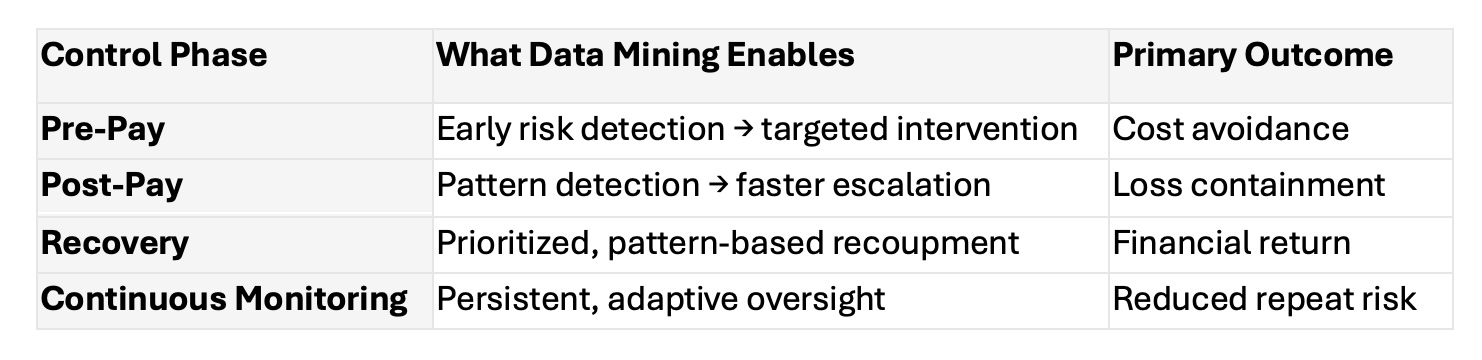
Recovery velocity — not detection volume — is becoming the defining KPI.
Why this matters now for plans
As Medicaid spending grows across states, even a 1-2% error rate translates into hundreds of millions in losses per state. Material leakage is now a board-level financial risk for Medicaid agencies and managed care plans nationwide.
The strategic gap: Identification without intervention
Payment integrity programs often operate retrospectively as the “pay-and-chase” model. Defined by an overreliance on retrospective or post-payment audits and periodic provider reviews, issues are often flagged weeks or months later if at all. If flagged, recovery efforts lag and seldom match the scale of risk. Finally, utilization management and care workflows are not integrated, causing silos and an increased chance of errors.
That model creates a predictable gap: Errors are detected after payment — but recovery is slow, partial, or missed.
The best way to address fraud oversight gaps is to integrate real-time data analytics, data mining, operational authority, and outcome-based accountability — so that detection leads directly to intervention, not investigation alone.
The next operating model: Embedded payment integrity
Modern payment integrity programs are moving toward an end-to-end approach designed to identify risk earlier, intervene faster, and accelerate recovery outcomes. Rather than focusing solely on detection, the next operating model integrates payment integrity into the operational fabric of claims and provider management workflows.
1) Proactive fraud detection and risk identification
Organizations must identify high-risk claims and providers before improper payments escalate, enabling early interventions. Deploying advanced claims analytics, data mining, anomaly detection and pre-payment claim validation can reduce high-risk claims from being processed, while provider risk scoring and monitoring systems can flag high-risk providers. Targeted audits for high-risk service categories can also be a great way to get ahead of fraudulent claims.
By leveraging advanced claims analytics, data mining, and anomaly detection and refining processes through constant calibration to reduce false positives, early detection becomes feasible and actionable.
Discovering suspicious billing patterns early reduces exposure to large-scale fraud events and improves oversight of provider networks.
2) Real-time payment controls and workflow integration
Effective payment integrity requires operational intervention — not just analysis. Embedding controls directly into claims and utilization workflows prevents improper payments before they occur. Embedded processes enable:
- Integration directly with claims systems
- Pre- and post-payment review workflows
- Clinical and coding validation
- Prior authorization and utilization oversight
- Continuous monitoring of billing activity
This approach reduces payment leakage, ensures faster response to emerging risks, and establishes stronger compliance readiness.
3) Accelerated recovery and financial resolution
To meet new performance metrics, programs must transition from identification to resolution through automated claims recovery and recoupment operations. This process can include provider communication and documentation management, appeals and dispute resolution support and recovery tracking and reporting.
Organizations realize higher recovery rates, shorter recovery cycles, and improved financial performance by introducing automation to their claim recovery operations.
4) Scalable program integrity operations
Sustainable growth requires the operational capacity and governance structure to scale. Dedicated investigation and audit teams should be equipped with automated workflows, learning feedback loops and detailed performance reporting dashboards to ensure both efficiency and oversight. Every detection is an opportunity not only for intervention, but refinement of the process.
Closing the gap between detection and recovery
The recent discovery of Medi-Cal fraud is an indicator of oversight vulnerabilities affecting health plans nationwide. As fraud risk increases and oversight accelerates, payment integrity programs must evolve from fragmented, retrospective controls to end-to-end operational models that prevent loss, contain exposure, and deliver measurable recovery.
As shown in the table below, data-driven payment integrity works best when applied across the full claim lifecycle: early intervention pre-payment, targeted escalation post-payment, accelerated recovery, and continuous monitoring to prevent repeat risk.
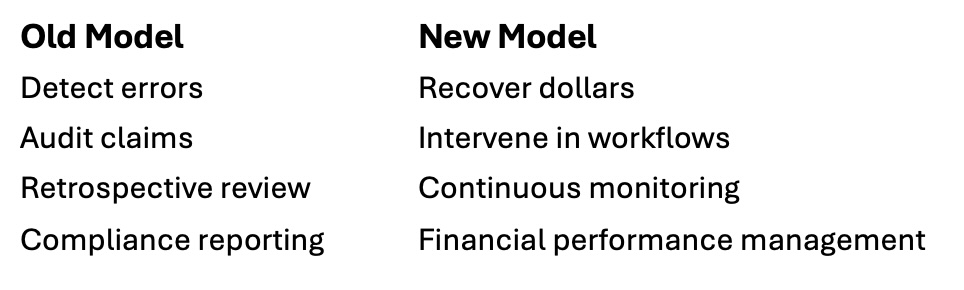
End-to-end view: One intelligence layer, three control points
As fraud risk increases and oversight accelerates, payment integrity programs must evolve from fragmented, retrospective controls to end-to-end operational models that prevent loss and deliver measurable recovery.
In today’s environment, the differentiator is not how many issues are detected, but how quickly dollars are protected and recovered. Plans that modernize these control points gain the speed and scale necessary to protect margins at scale.
Photo: Viorika, Getty Images

Christian Bass is Senior Vice President, Payment Integrity and Business Operations SPI at Sagility.
This post appears through the MedCity Influencers program. Anyone can publish their perspective on business and innovation in healthcare on MedCity News through MedCity Influencers. Click here to find out how.