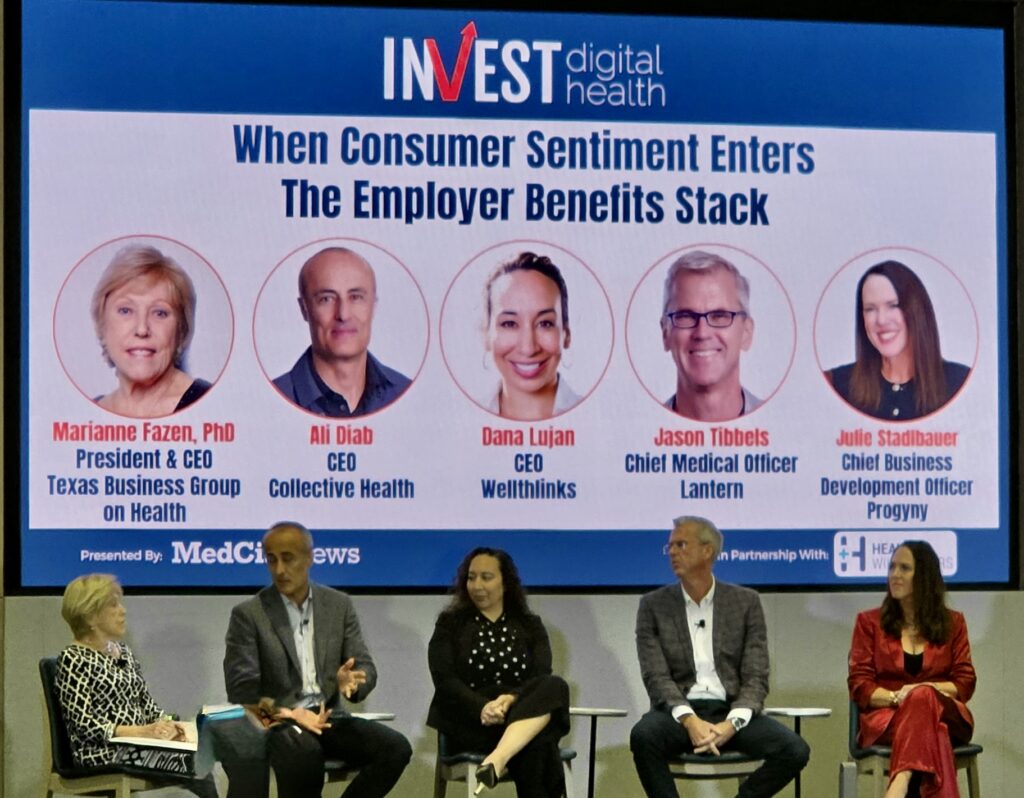
In 2023, employer-sponsored health insurance covered roughly 165 million Americans, according to the Government Accountability Office. Given the outsized role that employers play in providing health insurance, it should follow that they get their pick of solutions and programs to provide great benefits for their employees. But at a panel discussion at the INVEST Digital Health conference in Dallas last month, a panelist threw cold water on that assumption.
“There are a lot of market forces that are just purely economic, coin-operated, I would say, that preclude the best option from often being shown to an employer,” declared Ali Diab, CEO of Collective Health, an independent third-party benefits administration platform.
Calling out the likes of UnitedHealthcare and Cigna, Diab noted that Collective Health can’t spend millions of dollars on “transition credits” to keep competitors at bay the way those larger health insurers and third-party administrators do. He added that the system is set up to keep innovators with better benefits — both in terms of cost and outcomes — outside.

The Power of Real World Data to Study Women’s Health at Scale
Veradigm examines key clinical trends, comorbidity profiles, and treatment trends across adolescence, reproductive years, and peri-/post-menopause. Download it today!
“A lot of consulting firms make a lot of money from their PBM contracts,” Diab noted. “That is why you don’t see a lot of transparent PBM options when you’re going to sort of bid your PBM contract out every year. The same goes for TPA, the same goes for a lot of the sort of vertical specific point solutions. The networks want to keep the networks the way that they are, and they want to keep you [employer] in that walled garden.”
This is, of course, a source of deep consternation to Mark Cuban, who routinely uses X to exhort and even berate self-insured employers to leverage AI and delve deep into their PBM contracts. Cuban has launched Cost Plus Wellness to drive transparency into the employee benefits marketplace.
Alongside Diab on the panel was Julie Stadlbauer, chief development officer of Progyny. When the question of outcomes arose, she talked about savings an employer reaped through using Progyny’s fertility benefits program. The employer had embarked on a claims data warehouse analysis through a third party to see the program’s efficacy.
“Their conclusion was that we saved them $32 million over seven years and we helped them have thousands of babies on top of it,” Stadlbauer told the audience. “So to get to that human value, plus being able to be held accountable for the savings opportunities and ROI — [that’s] necessary these days.”
From Blind Spots to Better Outcomes: How SNF Data Transparency Strengthens LTSS
What if health plans could identify member decline before an avoidable hospitalization occurs? Real-time clinical visibility into long-stay SNF members uncovers risk earlier and drives better outcomes.
Jason Tibbels, chief medical officer of Lantern Health, added that the end customer is not just the employer, it’s also the employee using the program. And both need to be kept satisfied for the vendor to remain relevant.
“Your employee needs to be delighted,” Tibbels said. “It doesn’t matter how valuable your program is. If people don’t use it, it is not valuable. So you have to drive utilization. You can’t do that without an employee being delighted with it. It doesn’t matter how delighted they are and how much they use it if you’re not driving value for the buyer.”
He pointed to how the company’s sub 1% complication rate for surgeries is valuable to both the employer and employee. But another part of delighting employees can be simply about not making them fill out forms or asking questions that the employer/benefits vendor should already know. Tibbels talked about the routine questions people have to fill out to help the benefits provider have a better sense of their needs. Yet, they can be tiresome — questions like, where do you live, what’s your deductible, and what’s your health plan. It is here that AI can be leveraged, Tibbels said, to gather the info based on information already in an employer’s system.
” … people are so delighted when you don’t ask them,” he added. “You know where they live, and you know what the benefit design is, and you know what the next step is. And then you present them with not 10, but three choices on what to do next,” he said.
Building a compelling benefits solution is also about providing hard data to employers to show that the solution works. However, it is not always super easy for a smaller vendor to get at that data. Diab brought it back to the games that larger insurance companies play.
“And you see that in my world very clearly when you ask a traditional incumbent insurance company, ‘Hey, can I get a large claims file?’ Or, ‘Could you pull these claims for me so I can run analysis?’ ‘Sure, that’ll be $10,000. That’ll be $15,000. That’ll be whatever.’ Because in their mind, that’s like letting you into the castle. They don’t want to let you into the castle.”
It will be interesting to see what 2027 brings in terms of federal scrutiny of payers and their vertical integrations. Several bills are in place to break up companies that are payer, provider, PBM, pharmacy and insurance company. CVS made waves earlier this month when they split into two businesses, but experts declared that the core conflict remains.