Mental health carries a particular weight in many communities of color. In my family, we didn’t grow up talking about it; we were taught to work hard, push through, and survive. I know now that our silence came partly from stigma and a lack of knowledge. It also came from mental health care feeling like a privilege we didn’t know how to access. Seeking support meant letting others in and trusting systems that had already given us reasons to mistrust them. That silence is why I got into this work, and why I’ve spent my career trying to make mental health more accessible to people like my family.
But the psychology I was trained in wasn’t built with communities like mine in mind, and I have seen the consequences in clinical rooms throughout my career. Immigrant families were dismissed and pushed to the side, their distress misread and their needs left unmet. Black and Brown children were marked as problem children rather than offered support. Research shows they’re still more often diagnosed with conduct disorder than White children. It’s a diagnosis that shapes how every system meant to help a child reads them, before anyone has taken the time to understand what’s really going on.
These dismissals and labels have caused damage and mistrust in our field, but I’ve noticed a shift in the last 10 years, with more and more people identifying their needs and looking for care. Cost, access, and other barriers still make that care hard to find, leaving many of us turning to apps and, more recently, AI for support. Mental health companies are responding by developing AI specifically to guide people toward care, and as they do, these tools risk being built with the same exclusions that have kept support out of reach for the people who need it most.

The Power Behind Enterprise EHR Software for Large Healthcare Systems
Enterprise EHR boosts scalability, interoperability, and governance for large healthcare systems.
Beyond the inventory
A few years ago, after a life transition, I decided to seek therapy. It had taken me time to work through my own hesitation about asking for help, and by the time I logged on to that first session, I was excited.
We went through the intake, and I shared what had brought me there. About 20 minutes in, the therapist brought up my symptom inventory scores. She told me my scores were much lower than what she was seeing, and that my symptoms were more severe than I had reported, which caught me off guard. The inventory was used to challenge what I was ready to share, and it felt like a confrontation. With no rapport between us to fall back on, it damaged our therapeutic relationship, and I ended care.
I’ve realized that disclosure isn’t culturally neutral; in many marginalized communities, opening up on an intake before any relationship exists doesn’t come naturally. Inventories carry their own bias, too: research on the GAD-7 has found that Black respondents can score lower on the measure than White respondents with the same underlying level of anxiety, not because they feel less anxious, but because the tool was never properly calibrated across cultural groups.


The Healthcare Payments Industry Faces a Perception Challenge
Healthcare payments are no longer about transactions. It’s about controlling the revenue cycle. And increasingly, that control is not sitting with ISOs.
Inventories like the PHQ-9 and GAD-7 are already part of most medical appointments and therapy sessions, and now they’re being built into mental health AI. If those scores become the first and only way these tools decide who needs care and what kind, the people they already under-read will be screened out or misrouted.
Symptom inventories remain a useful starting point for AI tools, and pairing them with more inclusive measures can make the process more intentional and better equipped to guide people toward the right care. One tool that can complement them is the DSM-5’s Cultural Formulation Interview, which uses open-ended questions about a person’s background, what’s been weighing on them, who they lean on, and what they believe is behind what they’re feeling. Rather than asking people to rate their symptoms, it lets them explain what’s happening in their own words. That gives a fuller picture of how family, community, and circumstance shape what someone is going through.
Auditing mental health AI
What played out in my first session can now scale to millions as AI becomes part of how people seek care. Nearly a third of US adults have already used an AI chatbot for health information, and roughly one in six for mental health specifically. Within that shift, Black and Hispanic adults are turning to AI chatbots for mental health advice at higher rates than White adults.
Companies developing mental health AI are deciding how it’s structured, what it’s trained on, and who it’s designed for. By default, much of it is shaped by the same Eurocentric frameworks that have guided psychology for decades and by English-language internet text written from a dominant Western culture. A tool trained this way can recognize someone who describes their anxiety directly, names their symptoms, and asks for help explicitly, but may miss someone who expresses distress through cultural idioms, indirectness, or descriptions of how their family is being affected.
Understanding whether AI assesses and supports everyone equally starts with cultural bias auditing, before a tool ever reaches someone. Auditing tests how it responds to different cultural presentations of the same clinical picture, catching the assumptions built into it. Without auditing, a tool might offer guidance that clashes with someone’s values, like encouraging a person to set firm boundaries with family in a culture where that isn’t how disagreements are worked through. For companies, catching these gaps early also protects against the reputational risk of a tool that quietly works better for some groups than others.
Equally critical is equity benchmarking, tracking what happens once a tool is in people’s hands and whether outcomes hold up across different groups. That means looking at who stays engaged, who gets connected to care, and who leaves after the first conversation. When one group is leaving at a higher rate, reviewing those early interactions can show what the tool missed and whether the fix is retraining the model or giving it more cultural context.
A different foundation
The mental health I grew up with isn’t the one we have now. I’ve watched that change happen inside my own family, in the same rooms where it once went unspoken. The stigma hasn’t disappeared, but mental health has become something we talk about more openly, woven into everyday conversation in a way it never was. None of this happened on its own; it’s the work of advocates, community leaders, and clinicians who have kept fighting for accessibility and against systemic oppression. That progress is worth protecting, especially as more care moves to AI.
Companies aren’t slowing down to ask if AI is ready for mental health; they’re racing to build it in. Encoding the same unexamined standards into these tools means repeating the systemic issues marginalized groups have lived with for far too long. In our communities, it has taken years of small steps to get people through the door and earn their trust. If we don’t get this right, AI could undo that progress and leave people further from care than before.
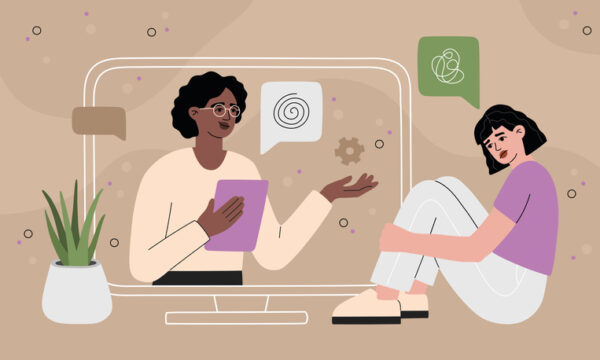
Photo: Alisa Zahoruiko, Getty Images

Dr. Josephine Mora is a first generation Latina and Licensed Marriage and Family Therapist with an EdD in Counseling Psychology. Licensed since 2017, her work has centered on supporting underserved and marginalized communities and breaking down barriers to mental health care. She has worked at the intersection of clinical practice and technology, including AI safety in mental health platforms, and is passionate about ensuring that the communities most often left out of these conversations are centered in how these tools are built.
This post appears through the MedCity Influencers program. Anyone can publish their perspective on business and innovation in healthcare on MedCity News through MedCity Influencers. Click here to find out how.