
Many are already turning to tools like ChatGPT to explain difficult concepts, summarize research, and generate study materials, often before their institutions have decided how, or whether, these technologies belong in medical education.
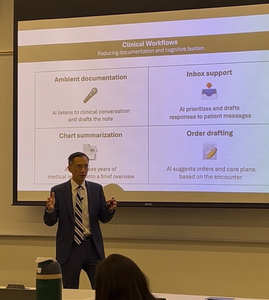
Health systems are moving at a similar pace. What began with ambient documentation has quickly expanded into coding support, chart preparation, patient communication, and clinical decision support. A resident starting their own practice in a few years may arrive to find the chart already summarized, relevant guidelines surfaced, AI drafting notes during the visit, and follow-up instructions prepared afterward. None of this replaces the physician, but it fundamentally changes what physicians are expected to do, and how they should be trained to do it.
Individually and institutionally, medicine is adopting AI faster than it is learning to teach it, and that gap should concern anyone invested in the future of patient care. The debate over whether physicians should use AI is effectively over. The real question is whether the next generation is being deliberately trained to evaluate AI-generated work with the same rigor applied to any other aspect of patient care. Closing that gap will require medical schools and residency programs to establish the educational foundation and health systems to reinforce those skills in clinical practice, with the same seriousness applied to any competency that affects patient safety.
AI Literacy Is No Longer Enough
Technology has always evolved alongside medicine, adapting to advances from diagnostic imaging to electronic health records and evidence-based practice. AI represents the next stage of that evolution, but unlike earlier tools, it does more than organize information or streamline existing work. It generates documentation, synthesizes information, and increasingly produces recommendations that clinicians must evaluate before acting.
That changes what it means to practice medicine. Physicians remain accountable for every clinical decision they make, and that accountability extends to the work AI performs on their behalf. The defining skill of this new era of medicine will be knowing how to use AI, but knowing when to trust it, when to question it, and when to override it.
Medical Schools Must Teach AI-Enabled Care
Medical schools should move beyond debating whether students ought to use AI and instead prepare them to practice safely and thoughtfully alongside it. That education should be integrated throughout clinical training rather than confined to a standalone lecture or elective.
The goal is not to teach students how to operate a particular AI product. It is to prepare them for a new set of clinical competencies, including:
- Understanding where AI adds value—and where it does not.
- Critically evaluating AI-generated documentation and recommendations.
- Recognizing omissions, inaccuracies, and hallucinations.
- Integrating AI into evidence-based clinical reasoning without becoming dependent on it.
Consider evidence-based medicine. Every year clinicians are expected to absorb an expanding body of literature, updated guidelines, and new treatment options. AI can increasingly synthesize that information at the point of care, helping clinicians navigate growing complexity. But it cannot determine whether a recommendation is appropriate for the patient sitting in front of them.
A resident may begin morning rounds with an AI-generated summary of the latest heart failure guidelines. The value isn’t reading that summary faster. It’s fitting that information into the clinical context and recognizing when the patient’s comorbidities, medication history, preferences, or social circumstances warrant a different course of action. That responsibility remains with the physician. Learning to interrogate AI-generated recommendations, rather than simply accept them, should become a core clinical competency.
Faculty development matters just as much. Educators need sufficient familiarity with these technologies to teach both their capabilities and their limitations. Like any other clinical skill, responsible AI use cannot be learned through lectures alone. It must be reinforced through supervised clinical experiences.
Health Systems Will Become the Next Classroom
Medical schools and residency programs can establish the foundation, but health systems ultimately determine how clinicians apply those skills in practice.
That responsibility extends well beyond deploying new technology or providing product training. Organizations must create the governance, workflows, and culture that enable clinicians to use AI safely and consistently. That includes thoughtful onboarding, specialty-specific guidance, continuing education, clinician champions, and governance frameworks that evolve alongside the technology itself.
Without this institutional support, organizations risk wide variation in how AI is incorporated into patient care, undermining safety, trust, and adoption. Like patient safety, quality improvement, or EHR proficiency, responsible AI use should become an ongoing professional competency that is reinforced throughout a clinician’s career rather than a one-time implementation effort.
The Future of Clinical Education Is Human + AI
Every major technological advance has reshaped the practice of medicine. AI is different because it is beginning to reshape how physicians evaluate information, make decisions, and exercise their expertise.
The challenge facing medicine is no longer adopting AI. The challenge is preparing clinicians to practice responsibly in an AI-enabled healthcare system. Medical schools and health systems must now treat AI competency as a core clinical skill, not an optional technical one.
AI will not diminish the role of physician judgment, it will make it more important than ever. Preparing physicians for that future is no longer a technology challenge. It is an educational imperative.
About Ed Lee:

Ed Lee, MD, MPH, is a practicing internal medicine physician, physician executive, and nationally recognized leader in clinical informatics and ambient AI. He currently serves as Chief Medical Officer at Nabla, where he drives strategy and clinical innovation for an AI-powered ambient documentation platform that enhances clinician well-being and care delivery.
Previously, Dr. Lee was Chief Information Officer and Associate Executive Director at Kaiser Permanente, where he led groundbreaking digital transformation efforts across one of the nation’s largest integrated healthcare systems. His leadership advanced AI governance, expanded access to care through telehealth, and improved clinician experience through smarter EHR tools and digital infrastructure.
In parallel with his executive roles, Dr. Lee recently served as Chair of Clinical Education and Director of Clinical Informatics at California Northstate University College of Medicine, where he oversaw a technology-enabled curriculum and clinical education strategy.