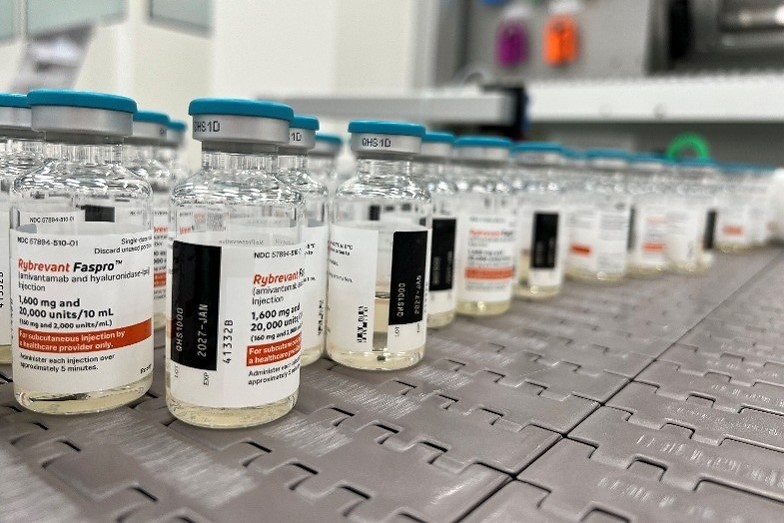
A Johnson & Johnson drug designed to hit two targets may now be used to treat head and neck squamous cell carcinoma, an aggressive cancer with limited treatment options.
The approval for the drug, Rybrevant Faspro, covers its use as a single-agent treatment for adults whose cancer has progressed on or after receiving the chemotherapies and immunotherapies that currently make up the standard of care. The regulatory decision announced after Thursday’s market close expands use of this J&J drug beyond its previous approvals in lung cancer.
Rybrevant is a bispecific antibody designed to block EGFR and MET, two receptors overexpressed in some cancers. Blocking both with a single therapy is intended to overcome the drug resistance that can develop by hitting just one of those targets. Intravenously infused Rybrevant was initially approved in 2021 as a treatment for non-small cell lung cancers harboring an EGFR mutation. In 2024, the FDA approved J&J’s Lazcluze, an oral small molecule EGFR inhibitor. This approval covered use of Lazcluze and Rybrevant together, which offers better coverage of EGFR to prevent drug resistance.


Top 7 Modern AI-Powered EAP Providers for Global Workforces in 2026
Discover the top AI-powered EAP providers for 2026. Compare platforms like Kyan Health and Spring Health on triage speed, global reach, and clinical quality to transform workforce wellbeing.
Rybrevant Faspro is made with technology from Halozyme that enables antibodies to be administered as subcutaneous injections. This injectable version of Rybrevant takes about five minutes to dose versus the two to five hours needed for a Rybrevant infusion. FDA approval of Rybrevant Faspro last December covered all of the indications at the time for IV-infused Rybrevant.
“Having redefined outcomes in EGFR+ non-small cell lung cancer, we are unlocking the next chapter of this treatment and bringing meaningful innovation to patients with certain head and neck cancers,” Yusri Elsayed, J&J’s global therapeutic head, oncology, said the in the head and neck cancer approval announcement.
The latest regulatory decision cancer is based on clinical trial results showing a 42% overall response rate in patients with head and neck cancer, including a complete response in 15% of patients. Results also showed 56% of those who responded to the therapy maintained that response for more than six months. The regulatory decision is an accelerated approval based on these Phase 1b/2 results.
A Phase 3 clinical trial is ongoing. In addition to serving as the confirmatory study for the accelerated approval, this trial could support expansion of the drug to first-line treatment of head and neck cancer. The FDA said the Rybrevant Faspro approval in head and neck cancer does not include the treatment of patients with oropharyngeal squamous cell carcinoma associated with human papillomavirus (HPV), which is a known driver of cancers in the mouth and throat.

Closing the Quality-Affordability Gap in Workplace Mental Health
In an interview, Kyan Health Co-Founder and Chief Commercial Officer Konstantin Struck discussed how Kyan gives mid-market and enterprise employers access to premium workforce mental healthcare, at a price point that is affordable.
The Rybrevant franchise is important to J&J’s growth strategy in oncology. For the first nine months of 2026, J&J reported $866 million in global Rybrevant/Lazcluze sales, a 67.4% increase compared to the same period in the prior year. J&J has previously projected Rybrevant could reach $5 billion in peak sales.
Here’s a recap of other recent regulatory activity:
More Cancer Drug Approvals
—GSK’s Jempeli expanded its label to include the treatment of with advanced cases of rectal cancer. The PD-1 inhibitor, GSK’s top cancer product, was first approved in 2021 for treating endometrial cancer.
—Pfizer’s Tukysa is now approved as a front-line treatment of HER2 metastatic breast cancer. The small molecule HER2 inhibitor was initially approved in 2020 as a second-line or later treatment for HE2-positive breast cancer. This drug came to Pfizer via the 2023 acquisition of Seagen.
—Eli Lilly’s pirtobrutinib, brand name Jaypirca, expanded its FDA approval to include first-line treatment of chronic lymphocytic leukemia or small lymphocytic lymphoma. The BTK inhibitor landed accelerated approval as a third-line treatment for this indication in 2023. Last year, the FDA moved the drug up to the second-line setting and converted the accelerated approval to a traditional one. Jaypirca was initially approved in 2023 as a treatment for mantle cell lymphoma.
—Elevar Therapeutics received an FDA nod for lirafugratinib, brand name Lyrfigtu, as a treatment for advanced cases of cholangiocarcinoma, a rare cancer affecting the bile ducts of the liver. The regulatory decision specifically covers treatment of cancers with the FGFR2 genetic signature. Elevar licensed Lyrfigtu from Relay Therapeutics.
Infectious Disease Drug Approvals
—The FDA granted tentative approval for Dr. Reddys Laboratories’ generic version of lenacapavir, a long-acting HIV drug developed by Gilead Sciences. The regulatory decision, made under the FDA’s President’s Emergency Plan for AIDS Relief (PEPFAR) program, will make the twice-year injectable drug available to patients in 120 countries outside the U.S. Gilead received FDA approval for lenacapvir last year and the company markets the drug as Yeztugo. Months after the FDA nod, Gilead granted Dr. Reddys a voluntary license to the drug.
—GSK received FDA approval for Hibsago as a treatment for chronic hepatitis B infection. The antisense oligonucleotide targets messenger RNA for the virus, reducing levels of viral DNA and viral proteins. Clinical trial results showed that some patients achieved a functional cure, where signs of the virus could no longer be detected.
—The FDA approved Asahi Kasei’s pritelivir, brand name Hovilpri, as a treatment for lesions caused by herpes simplex virus. The regulatory decision specifically covers the treatment of adults whose lesions have not responded to three other standard of care antivirals. Hovilpri came from the $919 million acquisition of AiCuris Anti-Infective Cures.
Regulatory Decisions in Neuroscience
—The FDA approved AbbVie’s tavapadon, brand name Juvmo, as a new treatment for Parkinson’s disease. The oral small molecule is a selective partial agonist of the D1 and D5 dopamine receptors, avoiding other dopamine receptors that can cause side effects. Juvmo came from AbbVie’s $8.7 billion acquisition of Cerevel Therapeutics in 2024.
—Click Therapeutics’ digital therapeutic CT-155, brand name Motvista, received FDA clearance for treating negative symptoms of schizophrenia, such as low motivation, reduced ability to experience and anticipate pleasure, and social withdrawal. Motvista is a smartphone app developed as an adjunct to drug therapy for schizophrenia.
Immunology & Inflammation Drug Approvals
—Sun Pharma’s Ilumya expanded its approval to include treatment of active psoriatic arthritis in adults. The antibody IL-23 inhibitor was first approved by the FDA in 2018 as a treatment for moderate-to-severe plaque psoriasis.
—AstraZeneca’s Ultomiris may now be used to treat immunoglobulin A nephropathy, a rare autoimmune disorder affecting the kidneys. The accelerated FDA approval marks the complement inhibitor’s fifth indication.
—Novartis’s Rhapsido received an additional FDA approval as a treatment for symptomatic dermographism, a form of chronic hives. The BTK inhibitor was initially approved last year as a second-line treatment for chronic spontaneous urticaria.
—Roche’s Gazyva expanded its label to include idiopathic nephrotic syndrome. It’s the drug’s second approval in the past year for an autoimmune indication. Last fall, the FDA approved Gazyva for lupus nephritis. Gazyva, an antibody inhibitor of CD20, was initially developed for and approved as a treatment for blood cancers.
Regulatory Decisions in Rare Disease
—Inovio Pharmaceuticals received FDA approval for Voceryq, a plasmid DNA-based immunotherapy for recurrent respiratory papillomatosis (RRP). It’s the first approved product for Inovio and the second immunotherapy for RRP, following last year’s FDA nod for Papzimeos from Precigen.
—Egetis Therapeutics’ tiratricol, brand name Emcitate, landed FDA approval for MCT8 deficiency, which leads to elevated thyroid hormone levels in the blood. It’s the first approved treatment for this rare inherited disease.
Cardiometabolic Drug Approvals
—The FDA approved Eli Lilly’s Onswik, a once-weekly injectable basal insulin for adults with type 2 diabetes. This product has received regulatory approvals in Europe, Mexico, and Japan. It will compete against Novo’s Awiqli, a once-weekly injectable basal insulin that received FDA approval for adults earlier this year.
—Camzyos, a Bristol Myers Squibb drug for obstructive hypertrophic cardiomyopathy (HCM), expanded its approval to include the treatment of pediatric patients weighing 30 kg (about 66 pounds) or more. The oral small molecule was initially approved for treating obstructive HCM in adults in 2022.
Regulatory Setbacks
—The FDA placed a partial clinical hold on Bright Minds Biosciences planned Phase 2 test of BMB-101, an experimental treatment for seizures related to developmental and epileptic encephalopathies. According to the company, the FDA cited toxicity identified in mouse studies and inadequate pharmacokinetic and juvenile toxicity data to support planned pediatric trial enrollment.
—Gilead Sciences disclosed a partial FDA clinical hold for KITE-753 while the company investigates safety differences noted between Phase 1 and 2 testing. The clinical trial pause covers tests of the autologous CAR T-cell therapy in relapsed or refractory diffuse large B cell lymphoma.
Photo by Johnson & Johnson