AliveCor’s medical devices capture about a million electrocardiograms each week from users all over the world. But Chief Clinical Officer Ben Green first saw the impact of collecting data with a personal device years ago before AliveCor was even a company.
Back in 2009, Green was a family physician. One of his patients was a woman whose atrial fibrillation symptoms led her to make frequent emergency room visits. At the hospital, physicians checked her heart rate, found it was normal, and sent her home. Green made house calls. He left this patient a handheld pulse oximeter so she could check her heart rate. She would call him, reporting the rate. Green said the ability for the patient to monitor her heart rate and report it gave her peace of mind and kept her from running to the ER.
“So for me at that time, that was kind of an aha moment that we can provide data to patients in concert with their clinicians to make really informed decisions that change care,” he said.


Closing the Quality-Affordability Gap in Workplace Mental Health
In an interview, Kyan Health Co-Founder and Chief Commercial Officer Konstantin Struck discussed how Kyan gives mid-market and enterprise employers access to premium workforce mental healthcare, at a price point that is affordable.
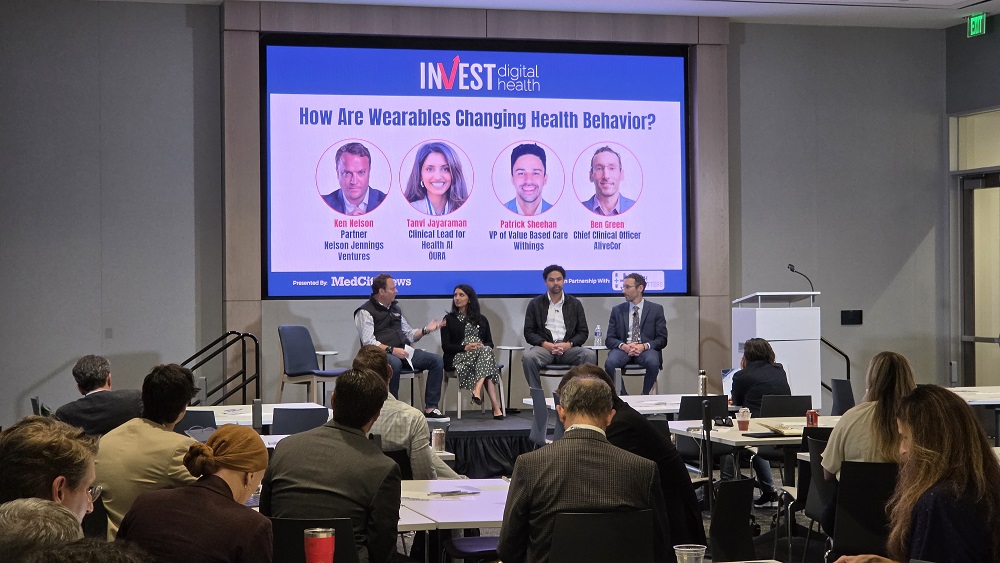
Green shared that patient story at MedCity News’ recent INVEST Digital Health event in Dallas, speaking on a panel about how wearable devices are changing patient behavior. He was joined by fellow panelists Tanvi Jayaraman, clinical lead for health AI, Oura, and Patrick Sheehan, VP of value-based care at Withings. Ken Nelson, partner at Nelson Ventures, moderated the discussion.
Technological advances have brought to the market many new kinds of wearable devices. But one of the challenges is getting patients to keep using them in the months and years that follow. Smart ring maker Oura keeps users engaged with features related to sleep, cardiovascular health, and metabolic health, Jayaraman said. Oura also has a partnership that integrates the smart ring with Stelo, a continuous glucose monitor made by Dexcom. Patients can see glucose levels in the Oura app. They can also take pictures of meals and view nutrition data mapped onto the glucose curve. Such features help with customer retention, Jayaraman said.
“The app is designed in a way where it’s not notifying you, it’s not blaring, it’s a screenless device,” she said. “You engage with the data on your own terms when you want. And I think that also makes a difference. You don’t feel pushed into the experience.”
Withings is medical device company that aims to offer a consumer-grade experience, Sheehan said. The company markets scales and smart watches with FDA approvals and authorizations. Once patients become part of this ecosystem, they can expand with additional technologies and monitoring capabilities. For example, a patient with hypertension is able to add a blood pressure monitor. But Sheehan said engagement also extends to medical professionals. The data collected by the devices are a resource for clinicians, helping them to prescribe medications and titrate them.


Inside an Automated Healthcare Practice: Redesigning Care Around People, Not Paperwork
By reducing administrative burden and redesigning workflows around human needs, it creates space for what matters most: connection between clinicians and patients.
“What we see with physician adoption and retention is incredible engagement on the data because we also bring it back into the [electronic medical record] as well,” Sheehan said. “So we think of engagement again twofold, the consumer, but also the clinician who’s reviewing the data.”
Green acknowledged that data generated by wearables can help users adjust their behaviors, but he said these data also become a resource for clinicians. However, some clinicians may not be comfortable with the data or may need guidance on what to do with a reading. AliveCor has a cardiologist network that provides asynchronous reviews of ECGs and can do live consults if requested. While the guidance does not always have to come from a human, Green said it’s important to provide clinicians with additional content and educational materials for both clinical data and wellness data.
Jayaraman said Oura’s physician team thinks a lot about prevention and identifying people who might be at risk of a medical condition years from now. Keeping patients engaged helps them better understand their health and adopt the behavior and lifestyle changes to prevent conditions from developing in the first place.
“As someone who is kind of really thinking about prevention and almost in some ways prediction, I think there’s a lot of power in the consumer wearable experience, kind of giving you ownership over your data and your health in a really personalized way,” Jayaraman said.
One limitation to wearables on the clinician side is that there are many physicians who are not digital natives, Sheehan said. Withings has a medical group comprised of digital-native physicians who know how to interpret data from the devices. He sees interactions between wearables companies and physicians as key to ramping up use of data produced by these devices. Green envisions a future where wearables enable patients to learn about their cardiovascular disease risk as easily as they can find their credit scores. AliveCor has ECG models that are able to predict mortality and heart disease, putting the company in the prediction business.
“I think in five years, everyone is going to know a quantifiable risk of themselves for cardiovascular disease and what they can do about it,” Green said.
Photo: Nick Fanion