
Seven Trends to Watch in Healthtech AI
As the role of AI in healthcare settings continues to evolve and generate debate, here are seven things to keep an eye on.
As the role of AI in healthcare settings continues to evolve and generate debate, here are seven things to keep an eye on.

When striving for health equity, organizations need to adopt new methods and a new mindset in order to steer clear of using SDoH as a buzzword, and instead hit the mark of health equity results.

In a landscape where complexity has long been the norm, the power of one lies not just in unification, but in intelligence and automation.

The integration of AI technologies holds promise for enhancing outreach efforts, streamlining recruitment processes, and addressing long-standing barriers and biases that hinder diversity and inclusion in clinical trials.

Equitable AI isn’t an aspiration; it’s an absolute necessity, particularly for the millions of older Americans who remain unseen within the current frameworks and miss out on algorithmic benefits such as risk profiles and early interventions for certain diseases.

Zus Health — Jonathan Bush's health data platform that provides patient information at the point of care — recently closed a $40 million funding round. It also announced a partnership with Elation Health, a company that sells its EHR and other technology solutions to primary care providers. Elation will be integrating Zus' API into its own data collaboration systems.

Through the alliance, the two organizations are sharing their extensive clinical data with one another, which will help identify diseases and treatment plans earlier.

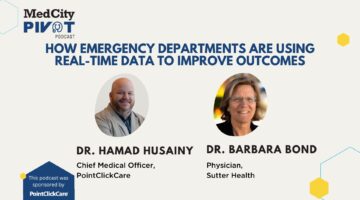
How can AI benefit and improve patient outcome in the emergency department? Watch the latest episode to find out.

Faculty Opinions brings together the comments and opinions of thousands of top researchers in life sciences and medicine. Combined with H1's extensive intel on healthcare providers, the acquisition expands H1's reach and opportunity to impact healthcare by bringing this data under one umbrella, H1 CEO Ariel Katz said.

The companies will build their claims processing platform on Google Cloud's infrastructure, leveraging artificial intelligence and machine learning capabilities. The goal of the collaboration is to improve patient and provider experience and reduce spending on administrative processes.

Brave Care leverages its technology and data platform to provide primary and urgent care for children. It provides care remotely and through its five brick-and-mortar clinics, which it plans to expand to 100 in the next few years.

The company, launched by SSM Health, Presbyterian Healthcare Services and Intermountain Healthcare, aims to create a marketplace for digital tools similar to the application stores on smartphones so that health systems can test and implement new solutions in weeks rather than months.


In a recent interview, Esperion president and CEO, Sheldon Koenig talks about the reality of statin intolerance and his company’s expansion into new diseases

At a recent panel discussion, healthcare executives agreed that telehealth will remain an important part of care delivery post-pandemic, so now is the time for providers to figure out how best to incorporate these services alongside in-person care. Actionable data will prove to be a key resource for providers as they tweak their strategies.

Empire members will gain access to three Mount Sinai Health System care models, which enable patients to opt for in-home care when medically appropriate. The agreement also includes a plan to improve bi-directional data exchange between the provider and payer.

Elligo Health Research uses EHR data, technology and services to expand patient access to clinical trials. It will use the new funds to further invest in its technology platform and purchase research practice management company ClinEdge.

In a new study, researchers suggest ACOs are not helping CMS save substantial amounts of money as they were expected to do, so the model should be eliminated. But other experts in the industry disagree, taking issue with the study's methods and conclusions.

The report, released by Kaiser Family Foundation and the Peterson Center on Healthcare, details the high cost of Covid care for the unvaccinated. In fact, the analysis indicates the figure could be even higher than $2.3 billion, as the authors did not take into account the cost of outpatient treatment for Covid-19.