
I’ve Practiced Medicine for 40 Years — AI Gave Me Back My Evenings
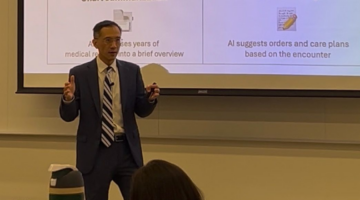
If you're a physician earlier in your career, the message is simple: whatever tools exist to get your evenings back, use them now, while you still have the evenings to spend them on.
If you're a physician earlier in your career, the message is simple: whatever tools exist to get your evenings back, use them now, while you still have the evenings to spend them on.
If health systems want to adopt AI at scale, they need evaluation that is open, reproducible, and continuously updated. That’s also much harder to build in healthcare than in general-purpose AI, for these 3 reasons.


By reducing administrative burden and redesigning workflows around human needs, it creates space for what matters most: connection between clinicians and patients.

The technology race gets the attention. Another race may determine what becomes the new standard of care.

The chart may be complete, and two parties may still reach different conclusions. The issue is not always what they know; it is how the organization interprets what it knows.

By applying proven and enforceable guardrails, coupled with smart financial incentives, we can ensure AI elevates medical care while maintaining the trust that holds our health system together.

Treating AI agents like contract nurses and minimizing their access to critical patient information certainly reduces potential risk. But, it also minimizes key opportunities.

Medical students, residents, and fellows are not waiting for formal guidance on artificial intelligence before putting it to use.

Typically, software placed on the market will undergo changes and updates after its initial release. In the case of healthcare AI, changes can occur, often unexpectedly, even when the developers have not updated the model.

Customer discovery is a well accepted idea in any innovation process. At the core of it, it means talking to potential customers about an invention. In reality, it is a more evolved process, and often less understood than it first appears.

Documentation tools have value. They solve a visible pain point well. But solving a visible pain point is not the same as solving the right one.

If we choose the quick fix, let us be honest about the consequences: when an unexamined algorithm leads to a fatal diagnostic error, the blame will not lie with the black box. It will lie with us, because we were too reckless to teach the fundamentals when we still had the chance.

BTK inhibitor has become an important treatment option for certain B-cell malignancies.

When verification fails and an eligible member loses coverage, treatment can be interrupted, medications can go unfilled and manageable conditions can become medical emergencies.

The U.S. Department of Health and Human Services (HHS) is rolling back several health IT certification requirements that could reduce certification costs for technology developers. But they may leave hospitals and health systems holding more responsibility for evaluating the safety and performance of the AI tools they purchase.

Companies aren't slowing down to ask if AI is ready for mental health; they're racing to build it in. Encoding the same unexamined standards into these tools means repeating the systemic issues marginalized groups have lived with for far too long.
By using existing data to better understand members and implementing retention strategies, plans can remain sustainable and members can get the care they need.
The MATCH IT Act aims to reduce patient matching errors. But a model used by vital records systems could provide a better solution.