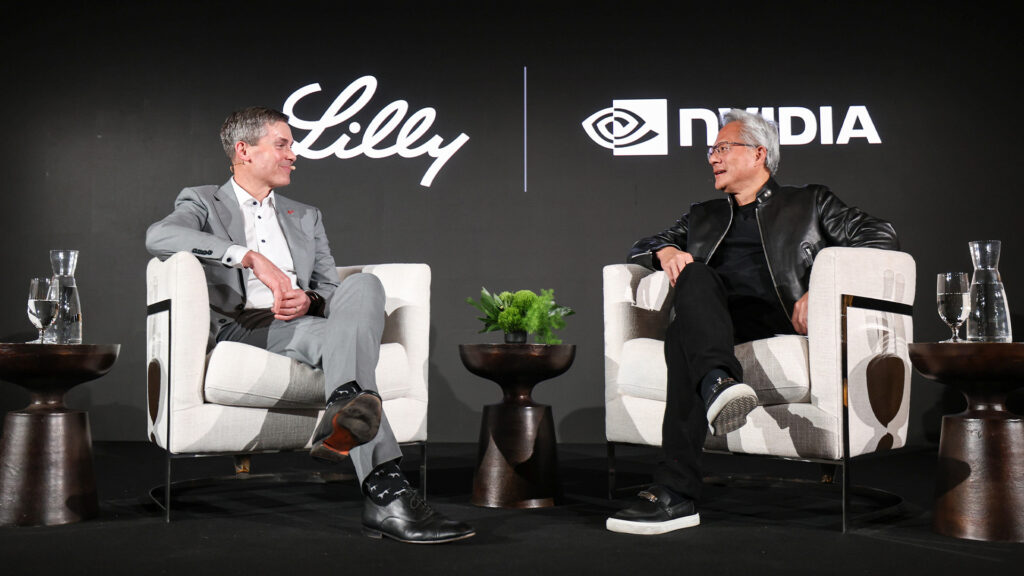
Last week, during the annual J.P. Morgan Healthcare Conference, also known as JPM Week, Nvidia announced a slew of healthcare-related partnerships. Perhaps the most notable was the joint, co-located innovation lab in South San Francisco that would unite Nvidia’s AI engineers with Eli Lilly’s medical researchers to turbocharge drug discovery. The two companies plan to invest up to a total of $1 billion over the next five years to support this effort.
At a fireside chat at the Fairmont hotel on January 12, Jensen Huang, Nvidia’s CEO, talked about the “landmark partnership” and introduced Lilly’s CEO, David Ricks, as a “really good friend.” With his trademark tongue-in-cheek humor, Huang held forth, interviewing Ricks while simultaneously entertaining the packed room.
“I am convinced. I am convinced. GLP-1s – it’s the second-best technology,” Huang declared as the audience guffawed at his not-so-subtle reference to what he believes is the no. 1 technology: Nvidia’s artificial technology stack that has catapulted the company from a gaming chipmaker to a $4-trillion juggernaut poised to transform multiple industries.
NEMT Partner Guide: Why Payers and Providers Should Choose MediDrive’s TMS
Alan Murray on improving access for medical transportation.
Huang may have been teasing, but if Ricks’ vision — aided by Nvidia’s AI — plays out, GLP-1s could have a transformative effect on multiple chronic diseases far beyond weight loss and diabetes.
“We know you lose weight. We take our Zepbound today, you lose 23% of your body weight on average,” Ricks explained. “But what we’re starting to uncover is a series of obvious things like reduced heart attack and other metabolic systems that improve diabetes, prediabetes. Conversion of diabetes drops by 93%.”
There are positives even beyond heart disease and prediabetes that are comorbidities of being overweight, and those are what Ricks classified as the “non-obvious” use cases for GLP-1s. The foremost among this group is the problem of inflammation.
“So being obese causes excess inflammation, not acutely like in response to an event, but chronically. And that’s not good for you. It’s not good for your cardiovascular system. It’s not good for your joints,” he said. And so spontaneously in our trials early on, people would report, ‘I just lost weight, but actually I can stand up from a sitting position for the first time in 10 years.’ Or some people with Crohn’s and colitis reported a kind of resolution of their symptoms.”


RCM Outsourcing: Balancing Human Expertise & Smart Technology
Greenway Health blends smart technology with human expertise to elevate revenue cycle.
Ricks added that the company is also starting brain studies and exploring how GLP-1s can address addiction. While details of which diseases will be addressed through the AI partnership were not discussed, it’s conceivable that Nvidia’s AI expertise could drive the design of future GLP-1 drugs or find new targets for GLP-1s. And that can have far-reaching effects on the overall field of drug discovery.
Huang talked about bringing massive raw computing power to bear on human biology – with the goal, hopefully, of driving deeper insights — such that the biopharma industry can evolve traditional “drug discovery, which is kind of like wandering around the forest looking for truffles.”
Ricks responded by harkening back to a time when Eli Lilly researchers did scour forests.
“We used to have a department of soil discovery, no seriously, where we would send people into tropical forests and scoop up soils and bring them back to Indianapolis, and we found what became [an] antibiotic,” Ricks recalled, talking about vancomycin hydrochloride, adding that it is still the world’s most important antibiotic. “It was discovered in Borneo in a soil sample by Lilly.”
As a class of drugs, antibiotics have represented one of the most significant discoveries, without which infections could not be staved off, and routine procedures like dentistry or surgery could not be performed. Antibiotics are tied to infections. But if Ricks is to be believed — and he certainly convinced Huang — GLP-1s could be equally significant, this time having a transformational effect on several burdensome chronic diseases. They could be a class of drugs that can deliver new treatments for the next half-century.
“One incredible discovery,” Huang raved. “One incredible – you were just running around the forest, and you discovered this stuff and you found this…just imagine you were digging up stuff and you found this incredible truffle.”
Will this partnership work? Only time will tell. No one goes to the forest to dig up miracles, but drug discovery is still slow, incredibly frustrating and expensive. So, computer vision, raw computing power and whatever AI tricks that Nvidia has up its sleeve can potentially create a new, faster paradigm for drug discovery. On the other hand, the term AI-driven drug discovery or AI-designed drug has been bandied about for a few years now and several companies are in the AI drug discovery space. Yet, we haven’t seen a fully AI-designed drug that has been commercialized.
Photo: Nvidia
Editor’s Note: Through an inheritance, the author owns Nvidia shares in a family trust.