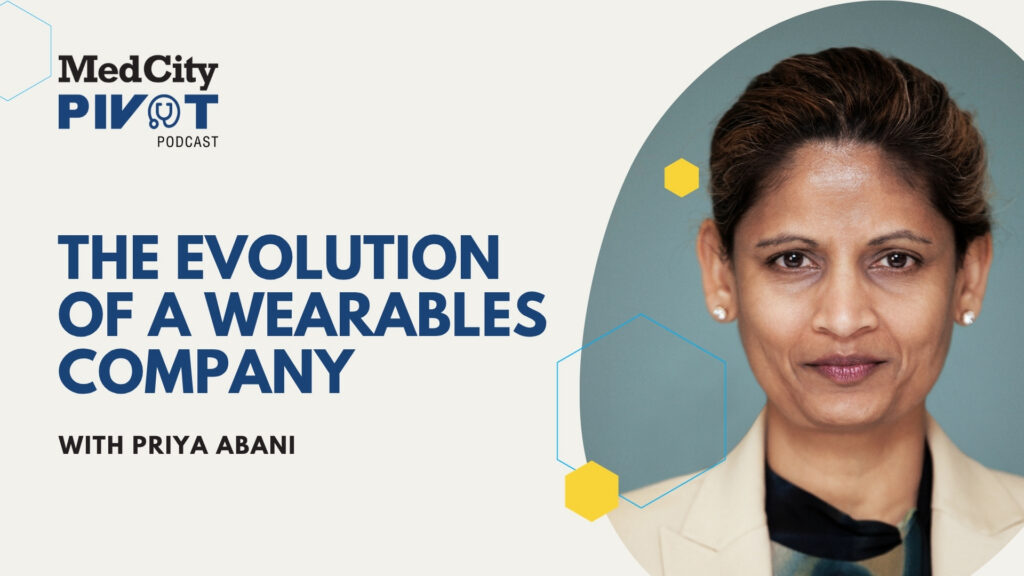
AliveCor has come a long way since 2010, when David Albert founded the San Francisco company to give licensed medical professionals the ability to do an EKG on the go — sometimes in unexpected situations. But what began as an iPhone-attached sensor with a single lead then evolved into a consumer wearable device — KardiaMobile — as a way for people to do EKGs.
Over time, the San Francisco company has transformed again to serve the healthcare industry, having developed a more clinically robust 12-lead EKG device. In a recent episode of the Pivot podcast, current CEO Priya Abani talked about that evolution, including addressing legal challenges like taking on consumer products behemoth Apple even though things haven’t fully gone its way.
Here’s a video of our Pivot podcast.


Closing the Quality-Affordability Gap in Workplace Mental Health
In an interview, Kyan Health Co-Founder and Chief Commercial Officer Konstantin Struck discussed how Kyan gives mid-market and enterprise employers access to premium workforce mental healthcare, at a price point that is affordable.
Here’s an AI-generated transcript of our interview.
Arundhati Parmar: Hello, and welcome to the MedCity Pivot Podcast. I’m your host, Arundhati Parmar. It’s the oldest story in healthcare when it comes to business models. What starts off with the consumer as the buyer slowly shifts towards the enterprise, and that is what we are witnessing at AliveCor, one of the early wearables companies that was founded on the principle of giving average people a glimpse into their heart health through its Kardia device.

Why Pharma Companies Should Look To Social Media For Better Patient Insight
Healthcare decision-makers, especially at pharmaceutical companies, must prioritize patient input. Data collected from social media listening is a significant step in the right direction.
But the company, founded in 2010, is no longer just a US consumer wearables company anymore. It has made big strides towards developing a 12-lead ECG device that will appeal to physicians. Many of its consumer devices are now also approved for sale in many overseas locations. In this episode, Priya Abani, the company’s CEO, describes that evolution, including responding to questions about its challenges.
For instance, AliveCor’s long legal battle with Apple, which is still ongoing
Arundhati Parmar: Hi, Priya. Welcome to the MedCity’s Pivot podcast
Priya Abani: Thank you so much for having me, Arundhati. I’m really excited to be here.
Arundhati Parmar: So, you know, it’s been quite a while since I have even written or thought about AliveCor, and a lot of things have happened, uh, in the interim period. So I was hoping you’d give a sort of a trajectory.
I feel like in my initial research what I’ve realized is it’s very much an enterprise company now from its early roots in, in sort of the consumer wearable side. So trace that path or, or that journey for me.
Priya Abani: Absolutely. Um, and that’s a journey that we’re living through every single day, right? So the company started off as a hardware-only company that had one device, which was a single-lead EKG device, which allowed you to take an EKG outside the hospital.
Um, so I’m gonna throw some numbers at you, and please stop me anytime where you think I’m, like, just overdoing this. But, uh, that’s- Sure … the best way probably to show you the trajectory. Yeah. So, um, from those early days, which I obviously, as you know, joined about a little bit over seven years back, so time has just flown.
Arundhati Parmar: Mm-hmm.
Priya Abani: Uh, we have over 400 million ECG recordings in our database. We collect about 1.3 million ECGs per week, and the only reason that statistics is important is it shows you the number of people using this technology.
Arundhati Parmar: Mm-hmm.
Priya Abani: Uh, over the last seven years, our patient outreach has grown, so 6.4 million patients have used our technology.
We have 1 million quarterly active users who are taking about 18 EKGs per quarter. Mm-hmm. Um, we also have a subscription service called Cardiac Care. Uh, we have about 350,000 people who are members of the Cardiac Care service. Uh, these people are taking, or these patients are taking about 30, 3-0, EKGs per quarter.
Arundhati Parmar: Mm-hmm. Uh, we have grown from having about 10 peer-reviewed publications back in the day- Right … now to about 250 peer-reviewed publications. Wow. It has come to a point is that there is always a day in a week when I wake up where we find about yet another study that’s happening, you know, in the world based on our technology.
Priya Abani: And I think the most, uh, important one is now we’re available in nearly 40 countries around the world.
Arundhati Parmar: Right.
Priya Abani: Um, and as you know, we have a single-lead device. We have a six-lead device.
Arundhati Parmar: Yes.
Priya Abani: And, uh, the most exciting thing for us is our 12-lead device- Mm-hmm … which just recently got, uh, you know, clearance, uh, for 39 different cardiac conditions- Mm-hmm
including basically life-threatening, every kind of heart attack, so MIs and ischemias. Uh, so you have the patient-facing device, which is the single-lead and six-lead. Right. And then, uh, more the physician and, you know, the healthcare worker-based device, which is a 12-lead. Mm-hmm. And between two of these things, we are now, you know, actively getting clearances and, you know, developing our global footprint.
So I know it’s a very long answer to your question- … but I hope it kind of, like, shapes it’s kind of what we were and what we are becoming now.
Arundhati Parmar: Yes. So I, I understand sort of the global aspect of it. You have approvals in many different countries now, I’m aware of that. Um, but I wanted you to drill down a little bit on that journey from, uh, being solidly and only on the consumer we- wearable side to having a device that is now aimed for professionals who are used to, you know, a 12-lead, uh, you know, EKG.
So talk a little bit about that journey. I know CPT codes have also been created, um- Yes … so help us understand where you are in that journey of, or, or in that evolution to, you know, having a pretty robust, uh, enterprise business to where are you on that? I mean, is that something that you’re still sort of achieving or you’re happy where you are?
Priya Abani: Yeah, no, uh, we’re never gonna be happy where we are or anything. So I can never, ever like, uh, admit to saying anything except that, because we have to truly believe in that. So it’s, it’s really interesting your question because there are two distinct categories we kind of compete in, right? So you have the traditional bulky medical grade equipment- Mm-hmm
like the 15 to $20,000 hospital carts, right? Right. That everybody sees. Yeah. And now we have clearly a new device, which is the 12 lead and every, all the services that we put on top of that, which kind of competes along those lines. Mm-hmm. But we’ve also expanded the TAM, because now that device, because it’s so tiny and it’s so easy to operate, can go in places like concierge medicine.
Can go in primary care, can go in dentist offices, can go in airplanes, cargo ships, schools, churches. Like, this is a whole different category of like TAM expansion that we have done. Mm-hmm. And that’s what we call, you know, a big part of our healthcare enterprise business. Um, now on the consumer side, which is obviously super fast-growing and thriving for us as well, uh, we have competition from like consumer wellness trackers.
You have like smart watches and rings- And some of them have like a baseline ECG, uh, you know, kind of available. Mm-hmm. Uh, but I think across both of these dimensions, our main differentiator as a company is our absolute uncompromising medical grade foundation. Uh, so we have always taken the longer, harder, painful road of rigorous clinical validation and making sure that everything that we put out there for customers, whether they are coming from the consumer side or, you know, like very, very seriously ill patients that are coming from more the hospital and, you know, or kind of the employer payer side. Mm-hmm. Both of these things, uh, through everything we put out there has gotten FDA clearances.
So we go after the hardest cardiac conditions, uh, and we go and make sure that we get the FDA clearances. We go and make sure that our, you know, sensitivity and specificity on what we are giving to patients at, at the highest level. Mm-hmm. Uh, and that’s why like going through the whole FDA process helps us a lot and, you know, like making sure that this is just like, you know, perfect and it is, you know, equivalent, uh, to something that used to exist in the hospital only before.
And if it’s outside the hospital, we’re just setting up a new benchmark. Um, so to be honest, like our healthcare enterprise business is now taking off nicely in all of these different segments that I’m talking about.
But what is, um- Traditional enterprise business for us is we are also taking the stack that we’ve been selling to consumers or the patients that come to us from the consumer side for the longest time.
We’re now creating, like, a full stack cardiology solutions, adding things like blood pressure management. Okay. Um, and now going and working with employers and payers, uh, to, you know, offer that as something that, you know, with good ROI studies, uh, with very, very good, like, ease of use kind of equipment. One app that matches, that kind of maps the whole clinical journey of the patient, um, on that side.
So that has also taken off, and it’s like, you know, it’s, like, giving me very, very good signs of, uh, this could be a thriving business or even a company in the future of its own.
Now, having said all this, in the end, our customer is always going to be the patient. Mm-hmm. So whether we get the patient via the consumer side, whether it is television ads or through a cardiologist recommendation, or through an employer, right?
Um, in the end, our goal and our job as a company is to service and provide the highest level of cardiology, of, you know, hospital-grade, like, diagnostic depth stuff to the patients, right? Mm-hmm. So no matter where the patient is coming from, uh, that’s what we want to be doing. Um, and then the healthcare enterprise business is great for us because the kinds of data we are collecting from that side, um, and, uh, getting the credibility of physicians using our technology , and, you know, recommending it to other physicians, other nurses, other technicians, i- is, is, like, is, is a very, very positive sign for us.
Arundhati Parmar: So I wanted to ask you a little bit about, uh, I will talk about the consumer wearables side a little bit, but let’s talk about more on the enterprise side. There are companies out there that came up with, you know, point of s- point of care ultrasound with the exact same thesis that you’re talking about, where that they can go into concierge medicines, they can go into urgent care situations, and they never truly scaled. I’m forgetting the name of the company right at the top of my head. Yes. But this is an Israeli company. There is a, uh, good amount of money, uh, and they have– Their whole idea was they were going to- You know, target, um, physicians and, and make it easy to do ultrasounds ver- uh, right at the point of care.
Yeah. And, and again, that company never truly, truly scaled. They’re still around. They have interesting technology. Mm-hmm. So I think the challenge for companies like yourselves that focuses on one sort of condition, I know there are 39 indications, but it’s certainly, it’s related to the heart, right? And, and I
My, my sense is that both on the software side and on the hardware side, you know, company, uh, uh, health systems, other organizations, don’t wanna deal with a point solution.
Priya Abani: Yeah.
Arundhati Parmar: How do you overcome that?
Priya Abani: Yeah, I think it is a brilliant question. We don’t want to be… I mean, the thing is our, our advantage is that we’re a full stacked, uh, cardiology solution.
Arundhati Parmar: Mm-hmm.
Priya Abani: But at the same time, we don’t want to be lost in the myriad of things that a hospital administrator has to choose, right? So one of the things that we have done, uh, like this is, we’ve done this even before we had the clearance, to be honest, is worked, uh, with companies like GE Healthcare. Right.
Where you have the Muse platform system, which exists in 87% of the US, you know, large US hospital systems.
Arundhati Parmar: Right.
Priya Abani: And we are in the process right now of getting integrated into Muse, which basically means that any healthcare provider that has this service pack that comes from GE Healthcare- Mm-hmm … which, you know, they all like, you know, obviously have it as a baseline, but then the new service pack, the KardiaMobile 12-lead integration will come by default.
Okay. We’ve already done that for our KardiaMobile six-lead device in that same GE Muse system- Nice … where a physician can actually recommend our device and the patient can walk out with the device- Mm … and the data keeps flowing back to the physician. So we have done, like, this first proof point with GE.
Arundhati Parmar: Mm-hmm.
Priya Abani: And it’s worked beautifully, and that is now being deployed in multiple hospital systems. But what is most exciting is that this 12-lead is also gonna be put in the same system. Now, having said that, obviously there is a lot of new markets that we’re going after. So the primary care market, as I mentioned, the concierge medicine.
So we are looking at EMR, EHR systems very, very carefully. Okay. And making, you know, the right choice. You have to pay, you know, you have to pay the price of doing those integrations. Mm-hmm. Not just for doing the work, but also the per month charge, but I think it’s all worth it. So we have actually learned, uh, I don’t know this one particular company you’re talking about, but I know there’s a lot of companies trying to do this where, you know, they, they have either a stethoscope or they have an ultrasound, or they have an, you know, a handle.
Like, all kinds of different technologies, but we’re, like, talking to all of these CEOs and we’re learning, right? And I think that EHR, you know, EMR kind of integration is what is gonna help us succeed. Mm-hmm. Um, now, when you go overseas, uh, you’ll be surprised that the footprint of some of these systems is actually far less in the overseas market.
So we have launched the 12-lead now in Canada, Australia, New Zealand, Vietnam- Mm-hmm … uh, and India. And we are finding that the price points that we can offer, because we build these devices, our devices from scratch, um, you know, the price points that we can offer are very, very competitive, even with- in the local market itself.
Yes. Um, and we are able to, like, you know, we have our own version of kind of the EHR that we offer for free along with, um, you know, our device and AI. But, uh, we have obviously SDKs and APIs available because as you know, the DNA of many of the people on my team is from Amazon. Right. So, and from Alexa, so we build stuff, like, before we even put something out there, we have an SDK and an API built for it for third-party consumption.
That’s how we think, and we kind of like, you know, dog food our own technology. So, um, I think that is where we will, um, you know, have an, uh, it’s– I, I won’t say it’s an advantage, but I think we have just learned from- Mm-hmm … what the market wants. Mm-hmm. Um, and that’s what we’re gonna do. Uh, the one thing I do wanna share with you, which I’m very excited about, is we were just announced, uh, we just announced a product called Kardia Access- Mm-hmm
uh, which is a Medicare- Medicare … covered program.
Arundhati Parmar: Yep.
Priya Abani: And in that particular, uh, program that we are doing with CMS, um- Mm-hmm … and super thankful, by the way, to get that channel and get that, you know, access to that set of patients. Uh, we are now expanding from just arrhythmia, right, on the patient side.
We’re, we’re, we’re going to… The program is built to improve blood pressure, diabetes, and heart health. Mm-hmm. Um, and I think in that we are going to learn so much.
Arundhati Parmar: Yeah.
Priya Abani: Um, and then that learning is obviously gonna… This is again, not the Twelli product, but this is gonna help us tremendously on the patient side to just expand the determinations of what we were able to do just with our devices.
Arundhati Parmar: So, in, in, y- you’re kind of moving from cardiac to cardio metabolism almost- Yeah … right? Yeah. Interesting. Interesting. Yeah. Okay.
Priya Abani: Yeah.
Arundhati Parmar: Yeah. Um, talk to me a little bit more about the GE integration. And the reason I ask is they do have carts, uh, and they do they do have, um, these devices. So where are they looking at more, uh, more affordable ways of bringing the similar technology to health systems when they’re fighting with, you know, capital budgets and things like that?
Priya Abani: Yeah,
Arundhati Parmar: I think- Not fighting, but they are contending with, you know- No … s- constrained health system budgets.
Priya Abani: Absolutely great question, and we obviously put a lot of thought in it in how we position this. Like, so there’s the traditional clinical equipment, which is the standard 12-lead ECG machine- Right
which potentially sits in, like, one room of, like, you know, three hospital buildings, sits in one room, and there’s a technician required to, you know, work on it, right? Because you’ll have to disrobe and all of those other things that happen. The way we have built our device, and if there’s nothing else you’re ever, uh, proud of me for, Arundhati, you should be proud of this.
The way we have built our 12-lead is a woman does not have to disrobe. Oh, wow. Right? So there’s only two pieces of, uh, two electrodes that go on the chest. Okay. And you will not believe in our research when we initially did, there are so many places in the world where pe- like, a lot of women actually don’t go to get their ECGs done because of that one requirement that they would have to disrobe in front of a stranger.
Arundhati Parmar: Right.
Priya Abani: So that’s how we have… Like, completely disrobe is what I mean. Mm-hmm. Uh, and that’s the way we have built it, right? So, um, I think we are not right now going after where, the world. Yeah. So the traditional clinical equipment is going into that one room in that hospital, you know, the set of hospital buildings.
Right. And then that patient is sent there. They have to normally take an appointment and go there. So we are going after, like, things like, or at least the goal is to go after, like, urgent care.
Arundhati Parmar: Mm-hmm.
Priya Abani: Hospital at home. Uh, you know, obviously you can imagine ER, right? Where instantly an ECG needs to be taken.
Yeah. Uh, we wanna be sitting in every nurse practitioner’s pocket. Um, so it’s, it’s, uh, when we are talking to the primary, uh, care physicians that, who are now buying our devices, uh, we obviously, you know, obviously always do a post, uh, you know, purchase survey because we wanna learn. Yeah. We wanna learn exactly how they’re using it, why they’re using it.
Yeah. And what we are finding it is that because it takes about, you know, 40 or 50 seconds to put on the device on the patient, and then another 10 seconds when you press the button for the AI to generate. Mm-hmm. Uh, even if they ultimately send that patient, uh, to that other room, the formal room, they still get a lot, a very good snapshot of what is happening with the patient.
Um, in the case of dentists, which is a brand-new market we have just uncovered- Okay … um, I did not even know when you have any kind of surgery that happens, uh, on your teeth and your gums, they want you to take an ECG- Mm-hmm … because there are other things that need to be checked, and that’s another place where you don’t have to leave that outfit and go to an outpatient center to get your ECG, and maybe, like, 50% of them will not even come back.
Uh, you can just do it there and then. Mm-hmm. So just, like, completely, I, I think of this mostly as a TAM expander- Mm-hmm … uh, versus of, you know, any replacement of what is happening right now- I see … in the current system.
Arundhati Parmar: Okay. Let’s talk a little bit a- about the consumer side. You obviously mentioned Oura Ring, their smart watches, and in that smart watch, obviously you have, um, Apple.
And my, um, understanding is that, uh, AliveCor has not had great outcome in terms of litigation with, with Apple. So how does that affect you? Apple in turn has now sued you as well. So- How do you look at that? Is it, if you lose that litigation where you, they are now saying that you infringed on their patents, how does it affect your, your device business as it relates to consumers?
Priya Abani: So I am not really going to make a comment on the particular lawsuit and just because everything is in action. But I do, I’m happy to talk about my journey of what happened between us and Apple, if that’s, if that’s okay with you. Sure. Sure. So I think when I took over as CEO, you know, in 2019, I knew that we were building, uh, we were helping build the digital health industry, but definitely I could not have predicted that we’d find ourselves in a high-stakes David versus Goliath situation against-
the largest corporation in the world. Yeah. Um, and the one thing with Goliaths, as you know, is they have endless resources. Um, and you know, they’ll try to outhire, outspend, use their market muscle to limit access, all of the things that, you know, just generally happen. Uh, and I think digital health is a very exciting space, so this is, like, the beginning of- A lot of places where these kind of, you know, discussions and litigations and conversations are gonna happen, because this is such an important space.
The TAM is so big. Um, and I think many startups just buckle under that pressure because, um, it, it just, you know, it, it is just the unlimited access on the other side. But to be honest, we chose to stand toe-to-toe or defend our IP and refuse to let innovation be overshadowed. So we’re a 180 person company that went up against the largest corporation in the world and kept shipping.
And I think my job, uh, as a CEO is that the way we compartmentalize our organization is like, you know, 90% of the organization does not have to deal with what is happening on this particular case. Right. And, uh, my job is to just focus on access, affordability, innovation- Mm-hmm … and keep pushing medical grade AI forward.
And these things are, these things are just going to, you know, they’re, they’re gonna go– they’re gonna happen. And you build something important. Um, and this is a, this is a lesson when I was in obviously the other companies, the larger companies in my life when I was on the other side, is like, if you, if you’re, if you’re not in these kind of fights, you’re probably not building something very important, which is kind of crazy to position it that way.
But, uh, we just, you know, this is, um, we have to take it in our stride, and we have to do the best we can. But our goal is to be the most exciting, most innovative company- Mm-hmm … in, uh, you know, our category. And a lot of watches are in the market now, a lot of rings are in the market. Right. They’re telling a lot of things to people about their life, but I don’t think anybody has the clinical backing and the, you know, clinical foundation that we have or we have worked very hard to build.
And, uh, to be honest, from this– from, from the side of the patient, as we are all also potentially gonna become patients in the future, you want every one of these people to invest in that clinical efficacy. Mm-hmm. Uh, and it’s really, really, it’s, it’s, it’s a priority. It’s a choice of priority on resources that you put, uh, but it’s a very important thing for the patients.
So just waking up morning and just sitting and thinking, “Okay, did I sleep well or not?” is not really gonna do much for me. But like, you know, going to the hospital at the right time because something really bad is gonna happen to my heart, is probably a very, very important tenet.
Arundhati Parmar: Fa- fair enough, and I understand your, your sentiment around, you know, large company with a lot of resources.
But as CEO, you also have to prepare for contingencies, right? Yes. So I understand that you don’t wanna comment on it, but I, I wouldn’t be wrong to assume that you are preparing for a scenario where the, uh, where the, uh, judge or the judicial system agrees with Apple’s lawsuit, right? There is a possibility that that might come to bear, and so you have some kind of plan as to how you’re going to progress in the United States with selling your products.
Priya Abani: We are always looking at every single option in front of us, and the goal is everything that we can do to make sure that we communicate that we do not infringe, and to make sure that we keep innovating to show to the world that that’s what our DNA is about.
Arundhati Parmar: Sounds good. And then you, in the beginning, you threw out a bunch of numbers at me, right?
Yes. So I wanted to ask you about this. Uh, there are a lot of wearables in the, in the market. In fact, one of the reasons, for example, Fitbit went from a consumer company to a more enterprise company, and ultimately Google bought it, is because people realized that you, people bought Fitbits and within six months they were not using it anymore.
Yeah. So how, when you provide information about, you know, products that are, that have been sel- uh, you know, CardioMobile products that have been sold, and that, that many m- million data points you have- Yeah … how are you, uh, convinced that- That each of those devices are being used on a regular basis.
Priya Abani: So we look at data, Arundhati, right?
This is not something I’m just, you know, sitting and ma- making up on what we sold. What we sold is a great metric because- Sure … it’s a one-time revenue. Mm-hmm. But what we do is we have a whole team in-house that looks at engagement, retention, engagement, retention. Like, that is their job. They wake up every single morning, and the reason and the way we can do that is just telling somebody what their current diagnosis is without showing them a path of what to do about it is just- Yeah
not gonna work. And that is the one thing I learned when I came to healthcare for the first time. We sat, me and my CPO, we sat and we printed every single piece of feedback that we had- Mm-hmm … you know, people had put on Amazon and whatever other forums, and we went through it, and we like, you know, took a highlighter and marked it.
And, like, the most important one was, like, okay, now I know that, now you’re telling me that I have an arrhythmia, but what do I do about it? Right. Right? So what we do to– did is we pull– we made this service, it’s called Cardiac Care. It’s of a baseline subscription service. Mm-hmm. And you get four cardiologist over reads-
Arundhati Parmar: Mm-hmm
Priya Abani: in a year. So four times where you’re feeling like you’re going through a palpitation, but the AI is telling you that you’re normal, you can send it to an actual physician. In many cases, 99% of the case, the AI is right, but it gives you peace of mind to get a human in the loop, right? Right. And in some cases, like, there will be a situation that we don’t have an AI determination yet cleared, and something is truly going on with your heart, and the physician will find it.
So that’s one thing we put out there as a subscription service. So as I mentioned, we have 350,000 subscribers. Mm-hmm. And these people are– they keep coming back into the app. They’re very vested into the app. They, you know, we keep, you know, bringing in new services. Mm-hmm. So for example, last year when we decided to introduce blood pressure management, um, these are the people we actually first went and pitched that service to and got a lot of feedback saying, “Would you even buy blood pressure management from a company like ours?”
Because we don’t make the blood pressure cuffs.
Arundhati Parmar: Cuffs. Right? Sure.
Priya Abani: And they were like, “Yes, because you’re already doing such a difficult thing for me in my life with helping me manage my arrhythmias.” Mm-hmm. So blood pressure is much more of a measure of like, you know, historically what’s going on and what is the outliers, and the standards have been set up very nicely, and it’s all about medication management.
Uh, now the third thing that we’re doing right now through the CMS Access program is also now bringing in more human knowledge about diabetes management. Nice. It’s also our way of learning about that-
Arundhati Parmar: Yeah …
Priya Abani: uh, before we, like, do a formal program and then pitch that to our consumer side of the business.
Mm-hmm. So we have this beautiful flywheel, right? Because we bring a lot of patients from the consumer side.
Arundhati Parmar: Mm-hmm.
Priya Abani: But, uh, many of them are buying our technology because physicians are recommending that to them. Mm-hmm. And then, you know, that helps us, like, take that data, understand what the patients are doing with it, come up with new subscription levels, and then depending on the consumer side or the employer side, because you obviously wanted Uh, you wanna make it available to the patient at, at-
Arundhati Parmar: Sure
Priya Abani: as low a price or a cost for them. Mm-hmm. Uh, which is why the CMS ac- access is great. It’s like Medicare patients, they have to pay $0-
Arundhati Parmar: Right.
Priya Abani: Okay … um, to make use of the technology.
Arundhati Parmar: You also mentioned a lot of peer-reviewed, um, studies that either you have done or independent groups have done on your particular product.
Have you done or do you know of other parties that have done sort of head-to-head comparisons between KardiaMobile and, say, iRhythm Technologies or some other arrhythmia company?
Priya Abani: Oh my God, there are so many. So if you go to, and I don’t want you to go to there right now, but if you go to alivecor.com/research, we, um, every one month try to put everything that we see out there.
So there are things on remote patient monitoring. Mm-hmm. Uh, there is arrhythmia assessment against Holter monitors and patches. As a matter of fact, one of the most recent studies showed, like, the efficacy of, like, the six-lead device versus, like, a standard Holter monitor and how much better we are, and very, very reputable, uh, you know, uh, sources and, uh, physicians and leaders involved in that.
Mm-hmm. Um, we also have studies on, like, you know, health economics research, uh, diagnosing A- AFib early, so, like, a screening, uh, you know, point of view. Uh, we have diagnosis of AFib early in high-risk patients. So I mean, this is like, I can go on and on and on. Uh, there is management of patients or post-ablation.
Okay. Because remember, like, once you get an ablation procedure- Yeah … it’s not like it’s 100% fixed, right? So how do you manage, uh, the patients there? So, and the best part for us is, and what I’m, like, enjoying watching, is this is not just happening in the United States. Obviously, a major part of the studies are here, but these studies are happening all throughout the world.
Mm-hmm. Um, and we just have created, and I give full credit to our founder, Dr. David Albert, or our co-founder.
Arundhati Parmar: Yeah.
Priya Abani: And, uh, he is a big proponen- proponent of, uh, you know, uh, clinical validation and clinical basis, and holds us very accountable as a team to make sure. Um, and I think that, that kind of credibility that he has built internally has also been seen by the outside world on our behalf, and we are, like, you know, really benefiting from that kind of a principled approach of doing everything.
Arundhati Parmar: and quick business question. Um, how many devices are out there, and are you profitable as a company today?
Priya Abani: So we, um, the profitability part is, so we have a D2C business- Mm-hmm … um, which, um, um, obviously is fueling a lot of the growth and ambition that we want to go in the enterprise side. Yeah. So we’re, we’re mostly striving not for profitability right now, but we obviously that’s an important tenet, so don’t get me wrong.
Yeah. But what we’re doing is taking the learning and the, uh, the, the revenue the site is generating, or the gross profit rather, in very simple P&L terms- Mm-hmm … and f- trying to use that to fuel the enterprise business. I see. Because we just, we just are now watching all these channels. There’s a biopharma channel, there’s a healthcare enterprise channel, there’s the employer/payer channel.
Arundhati Parmar: Right.
Priya Abani: So that’s what we’re trying to do.
Arundhati Parmar: Okay. Makes sense. And then final question. Um, there’s so much talk about AI these days. I’m sure you’re using AI in your products too, but given the, the news recently of uncontrollable AI or recursive self-improvement that we’ve, that we’ve been hearing so much over the last, um, you know, a month or so, how would you, you know, convince patients or physicians that this AI that you have embedded in your system is not gonna go haywire, is not gonna go out, not gonna start coloring beyond the lines, so to speak?
Priya Abani: Yeah. I think it’s a great question. By the way, when I woke up this morning and I went down and my mother asked, “I need to talk to you about AI.” So at that moment in my head, I thought, “Okay, this has actually arrived now. A 80-year-old, you know, um, uh, person is now asking me about this.” I told her, “I cannot explain this to you in the next two minutes, so I’ll sit in the evening at dinner and explain this to you.”
Exactly. So, um, the, the thing is, we mark things very clearly in the company. So what we call clinical AI, Arundhati, is what we get. These are all the determinations- Mm-hmm … which are the ECG determinations, and in the future there’ll be determinations about, you know, blood pressure and diabetes, and these are like all marked very typically by science and companies that have been doing this more from a algorithmic basis.
Mm-hmm. But we’re just doing this using DNNs, which is basically AI, and then putting it on new form factor devices, right? So every time we go to the FDA, we are like, “Okay, we have 33 more determinations for the 12 lead, and we have four more determinations for the six lead.” So that’s the way we think of it internally, and that clinical AI is what will always keep us ahead of the game as we go in these different channels.
Arundhati Parmar: Mm-hmm.
Priya Abani: Now, the other side, which you’re talking about, which is more LLM based- Right. So for example, we have a, we have a chatbot in our app. It’s called Ask Kardia. And when we first put it out, it’s based on whatever the latest engine is, but the first one that we put out is obviously, you know, OpenAI ChatGPT.
Mm-hmm. Um, and when we first put that out, and it is actually trained just to talk about heart health. So you go outside the bounds of heart health, it’ll just say, “I’m sorry, I don’t know the answer for this,” or, “I am not the best person to give you a response for this.” Okay. So that is the bounding training that we had to do.
Mm-hmm. So we have put in those bounds, and this is for, of course, our patients, because we wanna make sure that if they have any questions on like, you know, “How many cups of coffee should I drink because I’m getting palpitation today?” Or, you know, “I walk for an hour already, but my, you know, blood pressure number is still not going down.
What do you want me to do?” kind of thing. Yeah. We wanna make sure those things are responded to. Yeah. But if you– as soon as you go beyond that parameter, we have bounded. Okay. So that’s our decision. But the one thing I will tell you is that we, when we put that out to these one million quarterly active users, I was so pleasantly surprised because we do have a slightly older, uh, age group-
Arundhati Parmar: Mm-hmm
Priya Abani: that is our customer base, right? Our median age is about 45. Um, so given that, I was so surprised at the number of questions that we got even in the first hour. So there is obviously something very important here that a person wants to talk and communicate about their health in general, and in our case, heart health.
Mm. And there’s not too many places to go and do that. Um, and I think that’s where we have to understand the power of AI- Mm-hmm … and what it’s going to bring for that each patient, uh, versus the, okay, now I have five agents running for each person, and they’re going to collude and do something. Like, that’s not something we are gonna enable.
But, uh, obviously we are seeing, you know… I, I completely hear you. Uh, there’s, there’s no way to argue about what has already happened and, you know, things that are happening and being revealed every day. Right. But I think as a government, as a country, as set of leaders, as a people, I think a lot of those things are yet to be determined on what those guardrails and parameters are.
Arundhati Parmar: Okay. And then on a final note, where do you think AliveCor will be five years from now in that journey?
Priya Abani: I think, I think the future belongs to companies that, uh, very clearly will be able to demark, uh, the boundary between, like, wellness tech and, like, medical grade AI. And for where I want to take the company, like, I think anybody thinks of the word cardiology or anything to do with their heart, whether it is here, whether it is a village in Africa, whether it is a city in India, whether it is Japan, I want them to think of AliveCor.
And I don’t want them to think of something that they can just buy, you know, from, uh, a website. I want them to a- be able to get it from their physician. I want them to be able to send the results back to the physician, so kind of like closing the full loop- Mm-hmm … which we are working very, very hard on a number of partnerships to enable.
Arundhati Parmar: Well, excellent. Thank you so much for spending the time with us today.
Priya Abani: Thank you.