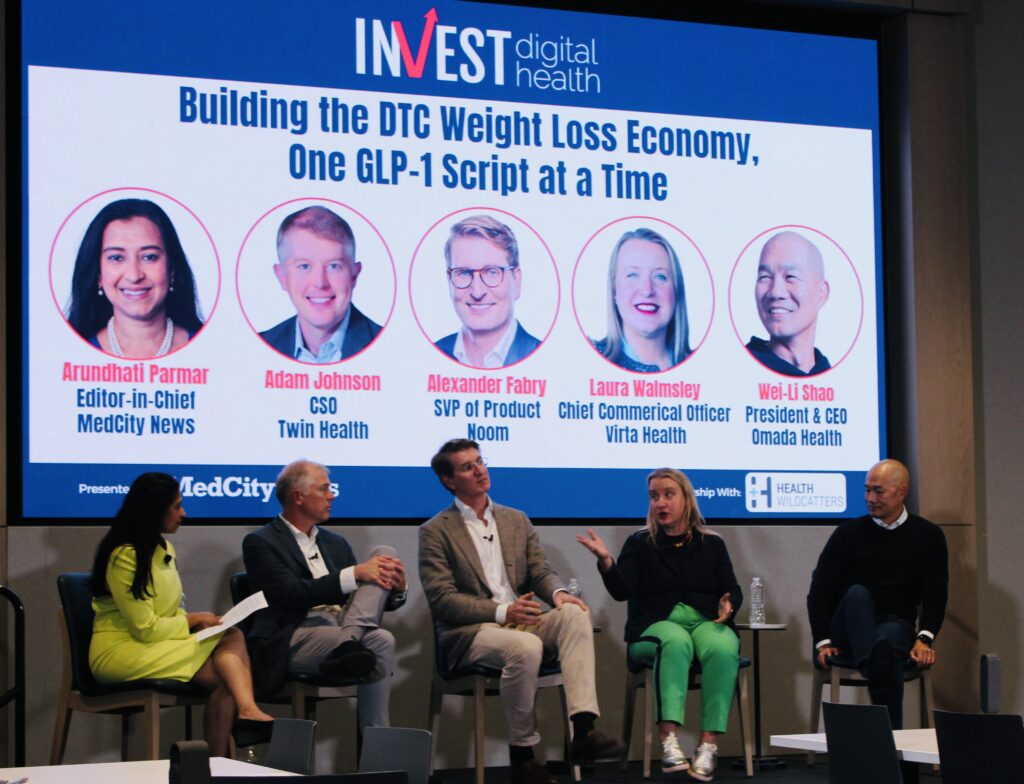
Demand for GLP-1 drugs has exploded, even as employers are pulling back because of the price tag. Adherence is also an issue, as these medications require fairly active management. So what are effective strategies that healthtech companies are employing to manage these patients?
Four executives participating in the INVEST Digital Health conference in late October articulated remarkably similar strategies, which center on going beyond weight loss to cardiometabolic health.
“You didn’t come for a drug, you came for health,” said Alexander Fabry, vice president of healthcare product, Noom told the audience. “So our pitch, and I think our message, is that these are incredibly powerful drugs. They produce exceptional results, but that every GLP-1 should be used with a companion. And I think the challenge for all of us is to fund that companion, to integrate it into a care delivery system, and as a consumer-oriented business, to get it used and loved by our members.”
Noom provides access to doctors who can prescribe GLP-1s and then supports the person taking the drug with tools to support healthy habits, as well as access to coaches. Noom is a direct-to-consumer company, but others on the panel representing business-to-business healthtech organizations stressed that they too are seeking to go beyond the pill with wraparound support services. Take Virta Health’s chief commercial officer.


Top 7 Modern AI-Powered EAP Providers for Global Workforces in 2026
Discover the top AI-powered EAP providers for 2026. Compare platforms like Kyan Health and Spring Health on triage speed, global reach, and clinical quality to transform workforce wellbeing.
“So GLP-1 compliance in the wild, without any of us kind of supporting, is somewhere in the 35th percentile if you take a GLP-1 at one year,” said Laura Walmsley. “And that’s not dissimilar for insulin compliance and other major life-saving medications. But if you take a GLP-1 with Virta at one year, we have over 80% compliance and engagement for people who start it.”
Virta Health also creates lifestyle support for people on GLP-1s to promote positive behavior change that includes nutrition support.
Nutrition support is part of that “companion support” offered by digital health companies, which takes into account the fact that someone who has weight challenges will likely have other comorbid conditions, be it diabetes, hypertension, or musculoskeletal challenges. Omada Health, one of the early digital health companies that built its reputation on generating clinical evidence for its prediabetes tools, has squarely focused on a multi-condition approach to helping folks on GLP-1 drugs.
“In the enterprise market, we all know that healthcare costs year over year are expected in 2027 to be probably the highest in recorded history since 2003,” said Wei-Li Shao, president and incoming CEO, Omada Health. “And the way you get compounded results and ROI with a client, with a buyer that’s super focused on ROI, which they should be, is by taking care of multiple conditions because they’re all interrelated; they’re all integrated. And when you move one and you make them better, the chances you make another condition better are higher too. And so there are multiple reasons why a multi-condition approach or a stack is really, really valuable.”

The AI-Native Clinician Is Already Here. Medical Education and Health Systems Need to Catch Up.
Medical students, residents, and fellows are not waiting for formal guidance on artificial intelligence before putting it to use.
Omada Health’s lifestyle support includes exercise guidance and nutrition and personalized coaching and education, among other things.
For Twin Health, the focus is on providing ROI to employers not just in getting better adherence with GLP-1 drugs and reaping the attendant health benefits, but also in getting patients healthy enough that they can be weaned off of medications. Adam Johnson, chief strategy officer at the company, explained that the company’s goal is to remove the fear GLP-1 patients have of being forced to take the drug forever or worry about weight regain after stopping the drug. Twin Health builds a program with a digital model of the patient/consumer, leveraging smart devices and sensors to gain information for that model and then provides users tailored recommendations for food, sleep, activity, stress, among other things. It’s a message that appeals to employers as well, who have increasingly been reluctant to cover GLP-1s as their costs have grown.
“We’re not here to tell you you can’t have a medication,” Johnson said. “We’re here to help you try to get enough impact that you get healthy enough that you no longer need it. And to the extent that that happens, you, as an individual, are going to win, and ultimately, your plan sponsor’s going to win as well.”
Omada, Virta and Twin Health, and, to an extent, Noom have similar holistic philosophies when it comes to targeting cardiometabolic or metabolic health to improve patients’ lives and using technology and coaching to get there. But at a time when providers and employers are looking for platform vendors, does the U.S. need all four? As moderator, I asked that question and then followed a fascinating exchange:
Parmar: “I’m asking if any of you will be around two, three years from now.”
Johnson (from Twin Health): “I think we will be.”
Shao (from Omada Health skeptically): “All of us?”
Johnson: “This is something that affects a material chunk of the American population. And I think until we have reached that material chunk of the American population, I think there’s an opportunity for people to continue to try to have impact on the world. Do I think every point solution in America will be around 10 years from now? I do not. And I don’t think anybody does, but I do think this is a space where there’s an opportunity for a lot of winners.”
Noom’s Fabry responded similarly but Shao went on in some depth about GLP-1 companies “coming out of the woodwork.” And some of those companies will be gone in 36 months, he added.
“I think there’s a spectrum upon which everybody is competing,” Shao said. “Those are kind of just creating access to GLP-1s. They’re more like vending machines. And then there’s the other side that’s trying to restrict the use of GLP-1s. That’s an extreme polar and there’s the whole spectrum in between. And I don’t think that that whole spectrum can exist in polars. I think the ends will basically contract …”
Virta’s Walmsley echoed Shao.
“I tend to agree on the consolidation,” she said. “No market can have as many entrants as this market has had in the last five years and not see consolidation in the future. So I fully agree that that consolidation is coming. I do think there is a big space for cardiometabolic health now and in the near future.”