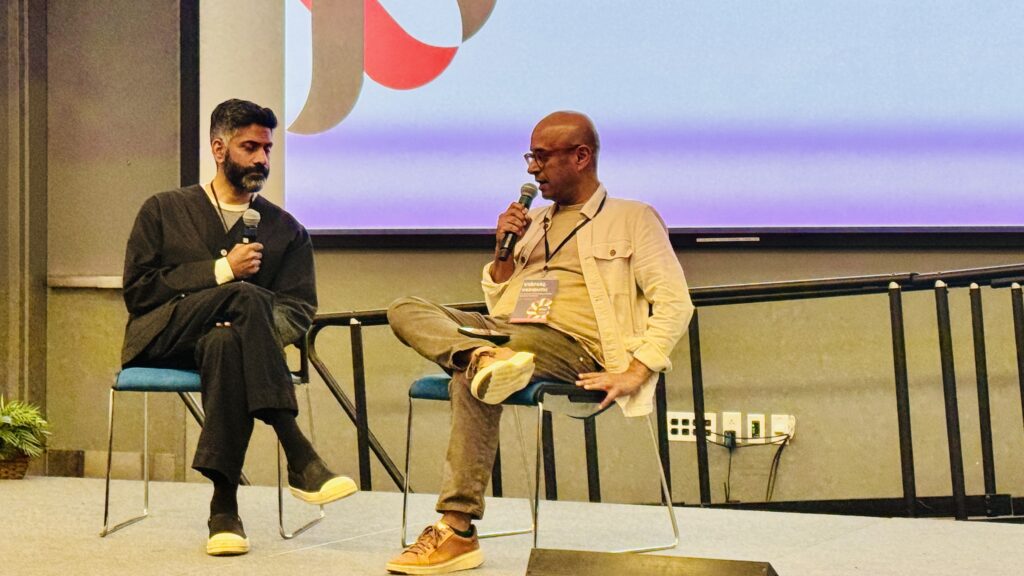
There is no shortage of great business profiles of Abridge CEO Shiv Rao.
Or of the unicorn AI company he has built and its impact on the lives of frustrated physicians. You will find them here, here and here. They describe his early interests in punk rock, history, religious studies and philosophy before the pivot to medicine, healthcare investment, and ultimately to co-founding Abridge in 2018.
But it was at the South Asian Healthcare Leadership Forum, held in Somerville, Massachusetts, on Saturday, that a fuller picture emerged of a self-assured leader with a kaleidoscopic set of experiences who defies easy labeling. He is clearly not the healthcare equivalent of a tech bro though his AI startup is now valued at more than $5 billion. Nor is he humorless and laconic. He is thoughtful in a way that likely doesn’t come from reading books like “How to Win Friends and Influence People” or “7 Habits of Highly Effective People.” It somehow doesn’t jive with his punk-rock listening, skateboarding, history and religious studies-studying image.


Automation Didn’t Dehumanize Care. Bad Systems Did.
We have the opportunity to design systems that give people greater capacity for the work where human presence matters most: listening, understanding, reassuring, deciding, and caring.
In fact, he declared at the conference that he is an introvert who had very few friends as a teenager.
So what makes him tick? Three experiences haven’t received much attention: Rao’s time in India as a young child, the death of a good friend when he was in high school in Pittsburgh and helping his father in his cardiology clinic.
A “formative experience”
Rao spent five years in India after his physician father decided that he and his two older sisters needed to be immersed in their heritage. The family moved back to Hyderabad, a southern Indian city. Once a month, his father would leave his physician practice in Pittsburgh to spend time with his family before flying back to America when the week was up.
“I commute now from Pittsburgh to San Francisco pretty much every single week. And I always think of him. It was like, that was a much more brutal commute than what I’m doing. He was able to do it, so I can” he told the gathered audience.


From Blind Spots to Better Outcomes: How SNF Data Transparency Strengthens LTSS
What if health plans could identify member decline before an avoidable hospitalization occurs? Real-time clinical visibility into long-stay SNF members uncovers risk earlier and drives better outcomes.
Rao became steeped in what it means to grow up in middle-class India — collecting stamps and coins, playing chess and cricket, and spending time with his grandparents. He acknowledges that the transition to India was easier for him than for his older sisters and Rao didn’t want to return to the U.S. when his parents decided it was time.
“For me, [the move to India] was pretty seamless,” he declared.
When he did return, it wasn’t necessarily warm and fuzzy.
“Came back, was bullied. I was, like, the Indian kid, but it’s funny, when I moved there, I was the American kid,” he said, laughing. “So I was bullied kind of both ways.”
Later, when Pillar VC did a psychological assessment of Rao in the early days of Abridge before investing in the company, they were satisfied with the outcome.
“They wanted to make sure I was damaged somehow,” he said implying that being the victim of bullying across continents has its advantages.
As the audience cackled audibly, moderator Vishal Vashisth, co-founder and managing director at Obvious Ventures, chimed in:
“That’s what they look for, like, damaged human beings.”
A grandfather with an unusual passion
If people are left wondering how a son of an immigrant South Asian doctor, goes from interest in skateboarding, punk rock, history, architecture and philosophy to becoming a cardiologist, investor and co-founder of a much-talked about healthcare AI company, some clues may come from genetics. Creativity — and the various ways that it expresses itself, whether in art, music or computer science — is something that his grandfather possessed in great measure, Rao implied through his description.
“My grandfather, by the way … was a lawyer and his real passion was poetry. And he wrote his poetry in Urdu, and he taught himself Urdu just because he felt like he could express himself in a more beautiful way in Urdu,” he recalled. “For the community that I grew up in, for this Hindu lawyer to teach himself Urdu to write poetry and to publish poetry in that language was always so inspiring to me.”
For those who don’t know much about regional and religious dynamics in India, here’s a short explainer: Urdu is a North Indian language that emerged in the capital city Delhi in the 12th Century. It is not commonly spoken in South India, where Rao’s family resided, let alone by Hindus, since its emergence is tied to the Mughal dynasty and its Muslim kings who spoke Persian.
A Death That Shaped His Ties To Pittsburgh
Rao’s love for Pittsburgh is well documented, especially in the context of a successful CEO who can choose to live anywhere, but remains firmly tethered to a city — that many will agree — has seen better days. Indeed, he could have left the area for college, but instead studied at Carnegie Mellon University, whose main campus is in Pittsburgh.
Why?
Rao spoke of a traumatic event from his high school days that ensured that he was to remain in the city for at least his college years. After he returned from Hyderabad to Pittsburgh, he had few friends.
“One of those friends got kidnapped and murdered when I was a junior in high school,” he said. “I remember we had a sleepover and watched Happy Gilmore. The next morning, he went to the mall to buy flowers for his girlfriend, and someone took him at gunpoint in a parking lot and, then took the FBI on a wild goose chase across the country. And for weeks, months, we didn’t know what was going on. And then finally they caught up to the guy and he shot himself, and he had already shot John a long, time ago.”
Rao recalled reading a lot of books on philosophy to come to terms with his friend’s brutal end. But he was not the only one negatively affected. The incident involving his friend, John Baglier, shook Rao’s parents so deeply that they told him he couldn’t leave the area, unlike one of his older sisters, who went to Cornell University.
“It was just, ‘You’re staying in Pittsburgh’ and I didn’t push back. Went to Carnegie Mellon. And I think probably that had something to do with why my parents [said], ‘Do whatever you want.'”
In other words, they would not stand in the way of Rao pursuing academic areas and other hobbies that didn’t fit neatly in the STEM-focus of most South Asian households in America. But eventually, a talk on design thinking by an architecture professor —who shared a story about an Indian ophthalmologist doing cataract surgery on a revolving platform to help countless people — flipped a switch in Rao’s brain. He realized medicine could be the only way to have such a massive impact on people’s lives.
And so he decided to go to medical school — also in Pittsburgh, given his girlfriend and future wife was in that city.
“But when I told my parents they never celebrated in front of me, they knew, that it might backfire on them, but it takes me a while sometimes to get to the thing that I’m really excited, or like I wander,” Rao said.
Rao As the Human Scribe
Years before building Abridge to leverage AI to assist physicians with note-taking and now prior authorization and clinical documentation, Rao would go into his father’s clinic and help him with his tech needs.
“I was going into Mercy Hospital in downtown Pittsburgh and just basically being his scribe.,” he said. “I was writing this stuff for him because he couldn’t figure out how to use the dictation technology. And he, he [typed] with his forefingers. He retired literally because he couldn’t type fast enough. He felt like he was outmoded, so he retired. His patients loved him… they still continue to send him cards.”
Rao said that his dad being in Pittsburgh is the main reason he chooses to remain in that city. He visits his father every Sunday with his children.
“Number one, he gives me inspiration because what can we build that would have kept him still in practice?” he said. “But number two, what did he do? What sacrifices did he make to give me the opportunity to get into punk rock, to play the drums growing up, to be a DJ, to make music, sell records in Japan, to take my time to sort of figure it out?