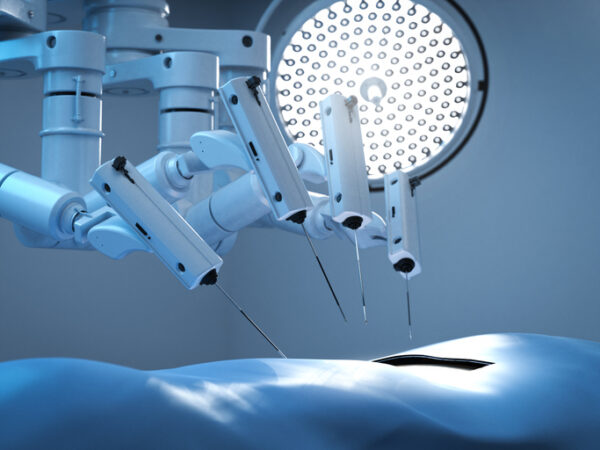
Robotics are increasingly being incorporated into today’s complex surgeries, and their capabilities are quickly expanding as they take on new tasks and higher levels of autonomy. The FDA recently published draft guidance on pre-market testing for robotically-assisted surgical devices, raising timely discussion around whether hospital infrastructures are capable of supporting increasingly complex systems.
It describes how robotic surgical devices should be tested prior to clinical use, covering everything from the robot’s movements to the design of its software, its reliability and accuracy, its cybersecurity measures, safety and sterility, how it visualizes patient images, and how it interfaces with the surgical team. The guidance is aimed at manufacturers and is currently nonbinding; it is open for comment until November 24.
As surgical technology becomes increasingly connected, the FDA’s guidance asks manufacturers to consider how different software functions within a single operating room interact. This raises a critical question for hospitals: as surgical robots become more sophisticated, what must the operating rooms around them have to successfully integrate the new technology?


The Healthcare Payments Industry Faces a Perception Challenge
Healthcare payments are no longer about transactions. It’s about controlling the revenue cycle. And increasingly, that control is not sitting with ISOs.
Dr. Nadine Hachach-Haram, a surgeon and the founder and CEO of Proximie, argues that the answer lies in understanding the operating room as a connected clinical ecosystem.
“What stands out to me in the FDA’s guidance is that it treats the robot as part of a much wider clinical system,” Hachach-Haram said. “It looks beyond the device itself to the software, connectivity, training and the environment in which it will actually be used. That matters because, as a surgeon, you quickly see that even very advanced technology has to work within the reality of the operating room.”
Proximie, headquartered in London, is a health technology company whose platform is designed to connect operating room devices and support intra-operative video and data capture. The company says its software is used by more than 700 hospitals worldwide.
Hachach-Haram asserts that it’s important for manufacturers to assess whether the addition of more complex capabilities may impact the performance of a new robotic device, a consideration which the FDA guidance also underscores.

From Blind Spots to Better Outcomes: How SNF Data Transparency Strengthens LTSS
What if health plans could identify member decline before an avoidable hospitalization occurs? Real-time clinical visibility into long-stay SNF members uncovers risk earlier and drives better outcomes.
“A great robot should still be a great robot once the video and data sit alongside it, not a lesser robot with a video system attached,” said Hachach-Haram.
The FDA guidance also addresses cybersecurity, a subject that’s top-of-mind for today’s healthcare leaders.
The guidance warned:
“Failure to maintain cybersecurity can result in risks such as compromised device functionality, loss of device availability, loss of data (medical or personal) availability and/or integrity, or exposure of other connected devices or networks to security threats. This in turn may have the potential to result in patient injury.”
Human factors are another focus, with the FDA emphasizing that testing should be conducted in realistic contexts to accurately assess performance within real-world operating room conditions.
As surgical robots continue to evolve, the guidance asks manufacturers to prove that these new technologies work smoothly as part of today’s complex human-and-machine operating team.
Photo: PhonlamaiPhoto, Getty Images