
Silicon Valley’s long-cherished ethos relies on aggressive disruption, rapid risk-taking, and a celebrated willingness to embrace failure. While this mindset has birthed many remarkable technological innovations, moving fast and breaking things in healthcare is an unthinkable recipe for disaster.
With the White House’s current approach to AI of “full steam ahead,” the healthcare industry finds itself at a crossroads: caught between the unprecedented velocity of AI innovation and the vital need to protect patient safety and improve outcomes, while simultaneously reducing administrative burden. At this crossroads, navigating complex public-private partnerships requires a delicate balancing act.
Having spent decades in healthcare interoperability, I have seen, firsthand, federal policy successfully reshape care delivery. We don’t need to reinvent the wheel to regulate healthcare AI; we just need to reflect on prior effective governance examples in our space, such as CMS’s Meaningful Use initiative and the journey it went on. This measure demonstrated that government regulation succeeds when it pairs regulatory boundaries with financial incentives (a carrot-and-stick strategy).


Automation Didn’t Dehumanize Care. Bad Systems Did.
We have the opportunity to design systems that give people greater capacity for the work where human presence matters most: listening, understanding, reassuring, deciding, and caring.
Meaningful Use required health systems to modernize and adopt EHR systems and presented plenty of carrots to do so. And it turbo charged EHR adoption. However, interoperability remained a concern, and we didn’t see all that new electronic data “unlocked” until the follow up stick of the 21st Century Cures Act which prohibits information blocking and has real consequences for not doing so. We got there eventually and need to learn from this success.
For AI, I believe it’s more crucial to be “stick forward” this time. Regulators will need to establish clear, but achievable, guardrails and define financial incentives that will encourage health systems and technology vendors to prioritize rigorous safety checks. That being said, it is equally important that we do not mistake the push for sensible AI oversight for anti-technology sentiment. AI models are already delivering value across clinical workflows throughout the world, providing high-value decision support at the point of care and earning clinician trust through industry-specific models.
Healthcare has been quietly integrating machine learning for decades. Automated systems have long analyzed radiology scans and flagged results for triage without triggering nationwide ethical panics or negatively impacting patient outcomes. We have become accustomed to machine assistance in healthcare. Built on machine learning, today’s clinical AI tools support fatigued physicians through hundreds of daily micro-decisions. The reality of AI in healthcare does not reflect the sensational hyperbole of public discourse.
Continuing this natural evolution and ensuring machine assistance functions reliably, health systems that deploy AI models must take full ownership of clinical outcomes and potential errors, holding themselves to the same standard of accountability expected of human physicians.

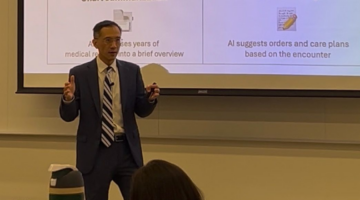
The AI-Native Clinician Is Already Here. Medical Education and Health Systems Need to Catch Up.
Medical students, residents, and fellows are not waiting for formal guidance on artificial intelligence before putting it to use.
Public debate has recently presented safety and innovation as a binary choice. However, the reality is they can and must move forward together. Safety and innovation are simultaneously available, and the answer lies with policymakers constructing sensible guardrails, which will inspire the confidence required for meaningful AI adoption.
Ultimately, building that confidence comes down to trust, accountability, and domain expertise. To put it plainly: I trust Epic more than I trust Anthropic. Established healthcare technology vendors have spent decades moving cautiously and self-regulating under strict oversight, and operating within frameworks designed to protect patients. They understand healthcare cannot serve as a testing ground for unchecked algorithms. In contrast, technology titans are built for rapid risk-taking and market dominance.
To achieve this balance, healthcare must remain grounded in data-driven clinical evidence. Effective policy does not require progress to stop. However, by applying proven and enforceable guardrails, coupled with smart financial incentives, we can ensure AI elevates medical care while maintaining the trust that holds our health system together. Pairing proactive regulatory standards with rigorous clinical validation establishes AI as a trusted instrument that empowers care teams, rather than as an unpredictable liability.
Photo: Pakorn Supajitsoontorn, Getty Images

Steve Heard, Chief Innovation Officer at J2 Interactive, has more than 20 years of leadership in healthcare interoperability, electronic health records, and public health research, partnering with some of healthcare’s most trusted names.
His deepest expertise is in Health Information Exchanges, alongside other large health data hubs including federal health agencies, national laboratory companies, and academic research centers. As J2’s first employee, he helped grow the Company to 275 people. Today he oversees staff development, direction, and technical strategy, always with an eye on what’s next, guiding work with some of the nation’s largest hospitals, health systems, payers, and research organizations. Globally, he has been instrumental in J2’s work with national health services and government health authorities in the UK, Europe, and the Middle East.
Committed to emerging standards, Steve’s current top focus is responsible AI. He also advocates for integrating social determinants of health into digital health and helps guide HL7’s Vulcan FHIR Accelerator.
This post appears through the MedCity Influencers program. Anyone can publish their perspective on business and innovation in healthcare on MedCity News through MedCity Influencers. Click here to find out how.