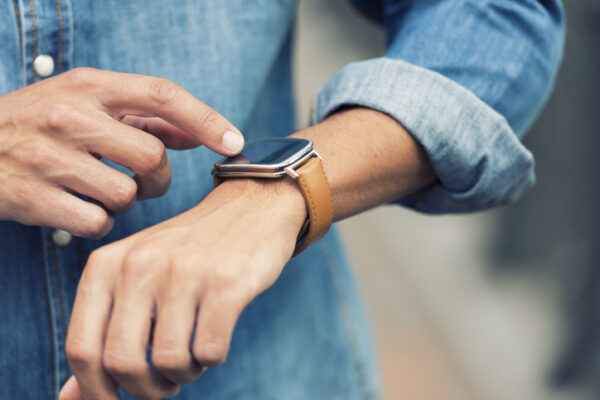
The most dangerous competitor is often the one nobody recognizes as a competitor yet. For decades, the laboratory business has operated around a simple fact of medicine: if we want to know what is happening inside the human body, we have to measure something. Blood gets drawn. Urine gets collected. Tissue gets sampled. A laboratory analyzes it, a result enters the medical record, and a physician interprets what it means. That machinery is not disappearing anytime soon. But something important is happening before the tube ever reaches the laboratory. The human body is becoming a constant stream of data, and increasingly the device collecting that data is on your wrist.
This should command the attention of every executive in diagnostics. The Apple Watch is not about to replace the clinical laboratory. The more interesting possibility is that companies such as Apple could capture something enormously valuable upstream: the moment when a consumer discovers there may be something worth testing. That changes the economics of diagnostics.
Think about how conventional diagnostic medicine works. Symptoms develop, a physician notices something, a screening guideline triggers testing, or family history raises concern. Eventually somebody asks: What is happening inside this patient? The laboratory helps answer that question. Diagnostic companies have built extraordinary infrastructure around doing so. Specimen collection, transportation, analytical platforms, quality systems, pathology expertise and massive testing menus cannot simply be compressed into a smartwatch. The next battle could occur one step earlier: Who gets to discover the question?

Why Pharma Companies Should Look To Social Media For Better Patient Insight
Healthcare decision-makers, especially at pharmaceutical companies, must prioritize patient input. Data collected from social media listening is a significant step in the right direction.
Apple Watch already offers irregular rhythm notifications, ECG functionality, heart-rate monitoring and other health features. In 2024, Apple added FDA-cleared sleep apnea notifications capable of analyzing breathing disturbances over time. Apple later introduced hypertension notifications, using optical heart sensor data over 30-day periods to identify patterns associated with chronic high blood pressure. A consumer electronics company now has a device on millions of wrists quietly observing physiology while people sleep, work and live. It does not need to diagnose every disease to become consequential. It only needs to become good enough to say: Something has changed. You should investigate this.
That sentence has enormous economic value. Imagine a consumer receiving a health notification on an ordinary Tuesday morning. The device has noticed a persistent physiological pattern. The person opens an app, learns what was detected and decides what happens next. Maybe they contact a physician. Maybe confirmatory testing is recommended. Maybe laboratory work becomes appropriate. That pathway may generate substantial downstream healthcare activity. The company that detected the signal did not necessarily perform any of it. It did something potentially more powerful: it stood at the beginning of the journey. The strategic asset is not merely the wearable. It is proximity to the human before the human becomes a patient.
Traditional laboratory companies are not standing still. Labcorp allows consumers to purchase tests through Labcorp OnDemand, while Quest Diagnostics also offers consumer-initiated laboratory testing. These moves reduce a traditional point of friction: getting the consumer into the testing system. But direct-to-consumer testing and continuous sensing solve different problems. One waits for the consumer to decide, “I want a test.” The other has the potential to tell the consumer, “You may have a reason to get one.” Strategically, that distinction is enormous.
A watch does not need to replace the laboratory to threaten its position. Claims that wearables will replace laboratory testing are medically weak and sensational. A wrist sensor is not performing a tissue biopsy, running a comprehensive metabolic panel or replacing microbiology and molecular diagnostics. Consumer health technology also has serious limitations; inaccurate measurements can create false reassurance or unnecessary concern. The laboratory retains something tremendously valuable: clinical-grade measurement. But disruption does not always require replacement. Sometimes it requires repositioning. The strategic question is whether a technology platform can become the traffic controller for diagnostic demand.


Top 7 Modern AI-Powered EAP Providers for Global Workforces in 2026
Discover the top AI-powered EAP providers for 2026. Compare platforms like Kyan Health and Spring Health on triage speed, global reach, and clinical quality to transform workforce wellbeing.
For most of medical history, diagnostic testing has been episodic. A person enters the healthcare system, measurements are taken, and the person leaves. Life happens between those measurements. Wearables attack that blind spot by observing patterns across days, weeks and months and comparing people against their own baselines. This creates a new relationship between continuous sensing and laboratory medicine: the wearable notices, the laboratory confirms, and the clinician interprets. Whoever owns that first step gains something the rest of the system wants: attention at the moment of concern. Where the platform sends that person next could become an enormous marketplace.
There is also an opportunity hiding inside the threat. Wearables could become formidable allies to laboratories. Continuous monitoring may create new categories of diagnostic demand. A wearable detects a persistent change, laboratory testing investigates it, the result feeds back into a digital system, and monitoring continues. The specimen and the sensor become complementary. That future could reward diagnostic companies that stop thinking of themselves simply as places where specimens are processed. Their actual product has always been information about human biology. Once the business is defined that way, the competitive map changes.
There is an old strategic mistake: protecting the castle while someone else acquires the road leading to it. Clinical laboratories have spent decades building extraordinary castles: instrumentation, logistics, scientific expertise, physician relationships, patient service centers and enormous datasets. Those assets remain valuable. But the road is changing. Consumers increasingly arrive in healthcare carrying devices that have been observing them long before the healthcare system sees them. The industry’s next major competitor may never build another national laboratory network or employ thousands of phlebotomists. It may simply own the device that notices something first. That leaves laboratory executives with a question worth asking before somebody else answers it for them: If the wearable discovers the problem, who owns what happens next?
Photo: LDProd, Getty Images

David M. Jackson is an independent writer and analyst from Adel, Georgia. He earned a Bachelor of Science in Healthcare Management from South University in Savannah, Georgia, and has a professional background spanning healthcare operations and laboratory medicine. His writing explores the business side of medicine, examining the technologies, incentives, economics and strategic shifts that are reshaping how healthcare is delivered and consumed behind the scenes.
This post appears through the MedCity Influencers program. Anyone can publish their perspective on business and innovation in healthcare on MedCity News through MedCity Influencers. Click here to find out how.