
In a letter, 15 consumer advocate organizations urged Congress to reform the drug patent system before the end of the year.
The organizations include Families USA, AIDS Chicago, Colorado Consumer Health Initiative, Colorado Policy Institute, Community Service Society of New York, Freedom Virginia, Hoosier Action, Iowa Citizen Action Network, Health Action New Mexico, Maine Consumers for Affordable Health Care, Maryland Health Care for All, Metro Health New York, New Jersey Appleseed, New Jersey Citizen Action and Utah Health Policy Project.
The letter notes that these organizations have worked “state by state” to pass policies that address prescription drug costs. At least 11 states have enacted Prescription Drug Affordability Boards, which are independent bodies that evaluate and manage rising prescription drug costs. In addition, four states have implemented upper payment limit authority, which allows a government agency or board to set a maximum ceiling on reimbursement for prescription drugs. Many have also implemented price transparency laws.

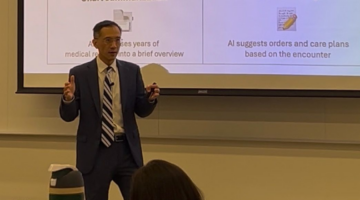
The AI-Native Clinician Is Already Here. Medical Education and Health Systems Need to Catch Up.
Medical students, residents, and fellows are not waiting for formal guidance on artificial intelligence before putting it to use.
But now the organizations need Congress to address the drug patent system, which they argue large drug companies are taking advantage of.
“The patent system exists to spur innovation and reward the discovery of new cures, but drug companies are increasingly abusing patent law to limit competition and raise prices instead,” they said. “They blanket one drug with multiple and overlapping patents to create a ‘patent thicket’ and ‘product hop’ from one patent to the next by making minor tweaks to existing drugs that add no clinical benefit. They reduce competition by offering patent settlements to generic companies to keep lowercost alternatives off the market through ‘pay-for-delay’ schemes.”
They added that when the big drug companies block competition, they’re then able to raise prices “at shocking rates.”
Drug companies are now using patent protections to challenge states’ efforts to address drug prices, the letter also noted. For example, Amgen is challenging Colorado’s efforts to lower prescription drug costs, arguing that patent protections give it the right to set prices for Enbrel, despite the drug’s list price increasing more than 1,500% since 1998. Colorado had set an upper payment limit after determining the drug was unaffordable for residents.

Automation Didn’t Dehumanize Care. Bad Systems Did.
We have the opportunity to design systems that give people greater capacity for the work where human presence matters most: listening, understanding, reassuring, deciding, and caring.
“That argument, if it succeeds, will not stay confined to Colorado or to a single drug,” the letter said. “It would convert every federal patent into a shield against every state affordability standard, every PDAB upper payment limit, and every legislative effort to rein in the price of a patented medicine – no matter how excessive that price is. States are not attempting to rewrite patent law, they are attempting to protect their residents from prices that are frequently the product of patent abuse, not patent-protected innovation.”
The organization noted that several bills would address patent issues. This includes the ETHIC Act and the Affordable Prescriptions for Patients Act, which both address patent thickets, and the Preserve Access to Affordable Generics and Biosimilars Act, which curbs pay-for-delay practices.
Photo: OsakaWayne Studios, Getty Images